TL;DR

Get business pricing on garage and car supplies
- Business-only prices and quantity discounts
- Tax-exempt purchasing
- Multiple users, one account, clear invoices
University of Michigan Engineering researchers, working with the Toyota Research Institute, built and tested a steering wheel with inflatable air sacs for two-way communication between drivers and semi-autonomous systems. In a driving simulator, participants spent less time fighting the system and reported lower effort and frustration, but the researchers also found that some drivers could become too trusting. The wheel has not been shown to be available in production cars.
University of Michigan Engineering researchers, working with the Toyota Research Institute, have built and tested a steering wheel with inflatable air sacs that lets drivers and semi-autonomous systems communicate through touch. In a simulator study, drivers spent less time fighting with the assistance system and reported lower effort and frustration, though the team also found signs that some participants could become too trusting of the system.
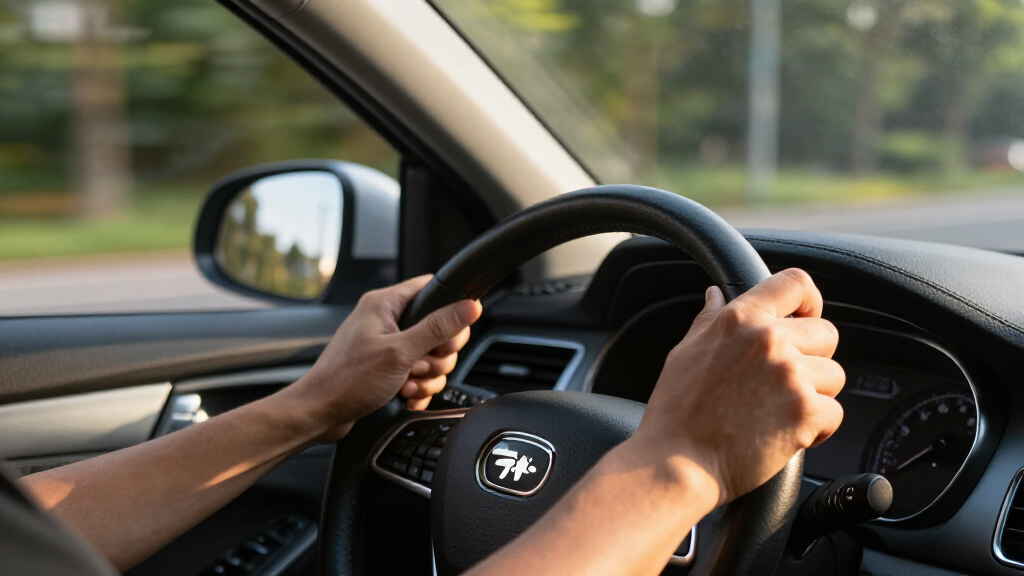
The wheel uses air sacs at the 10 o’clock and 2 o’clock positions, where drivers are expected to hold it. When the system intends to steer left, for example, sacs on the left side inflate. A driver who disagrees can press down on them to deflate them; if the system still favors the maneuver, it can send pulses of air that the driver can feel.
The researchers’ aim is to make interaction with driver assistance more direct than relying on warning lights and chimes. The wheel provides a way for the vehicle to signal an intended action and for the driver to respond without immediately taking control in a way that could switch the assistance system off. The supplied report says braking disengages many current systems.
To evaluate the idea, the team placed test drivers in a simulated driving task involving a turn and potentially unexpected obstacles. According to the study and a University of Michigan press release, participants spent less time contesting the assistance system and braked less. They also reported lower effort, frustration and physical demand, and researchers found that drivers were more likely to regain trust after a system error—though some became overly trusting.
The research addresses a practical problem as vehicles take on more driving tasks without removing the need for an attentive human. When a driver and an assistance system act at the same time, their intentions can conflict. The researchers argue that a wheel that communicates through touch could give drivers another way to respond, instead of leaving them to accept the system’s action or make an intervention that ends its assistance.
The simulator findings suggest that this kind of two-way feedback may reduce the physical and mental friction of shared control. That matters because a driver who better understands what a system is trying to do may be less likely to fight it. But the reported increase in trust cuts both ways: if a driver relies too heavily on a system that can make mistakes, clearer communication alone may not improve safety. The study describes a possible interaction method, not proof that the wheel prevents crashes.
smart steering wheel with touch feedback
As an affiliate, we earn on qualifying purchases.
As an affiliate, we earn on qualifying purchases.
Fully autonomous driving remains a longer-term goal, while driver-assistance systems that perform some tasks and still require an attentive driver are in use today. In this arrangement, the person and the vehicle share responsibility, and the driver may need to judge whether to accept or counter a system’s intended move.
The University of Michigan project, supported by the Toyota Research Institute, explores whether haptic feedback—information delivered through touch—can make that exchange easier. The supplied report contrasts it with a different approach cited in Mercedes’ MB.Drive Assist Pro: that system accepts inputs such as a steering-wheel tug or brake tap without completely disengaging. The comparison shows that the air-sac wheel is one proposed design among several, not an established industry standard.
“Drivers reported “lower effort, frustration, and physical demand.””
— University of Michigan Engineering researchers, as summarized in the university press release
Limits of the Simulator Findings
The supplied report does not give the number of participants, the size of the measured effects, or enough study details to judge how well the results might carry over to everyday driving. The test took place in a simulator, so it does not establish that the wheel improves safety on public roads.
It is also unclear whether the system has been tested outside the simulator, whether it will be developed for a production vehicle, or how drivers would respond over longer periods. The finding that some participants became too trusting points to a concern the researchers would need to address before any real-world use. No launch date, commercial partner plan or vehicle application is specified in the supplied material.
Further Testing Before Road Use
The immediate next step would be additional research to test how drivers respond across more situations and over longer periods, including when assistance systems make errors. The supplied report does not identify a planned follow-up study or a timetable for further development.
For now, the air-sac steering wheel is a research concept tested in a simulator, not a confirmed feature for sale. Any assessment of its practical value will depend on evidence beyond the reported test, including whether drivers can use its signals appropriately without becoming over-reliant on the assistance system.
Key Questions
How does the air-sac steering wheel work?
Inflatable sacs in the areas where drivers hold the wheel communicate an intended maneuver. A driver can press a sac to push back, and the system can use air pulses to signal that it still favors its action.
What did the simulator test find?
According to the research team’s account, participants spent less time fighting with the assistance system and braked less. They also reported lower effort, frustration and physical demand. The test does not establish real-road safety benefits.
Could the system make drivers too trusting?
Yes. Researchers found that participants were more likely to regain trust after the system made a mistake, but also reported that some became too trusting. That is a concern for any design intended to share driving control.
Will this steering wheel be available in cars?
The supplied report describes a research project and simulator testing. It does not say that the wheel is planned for production or give a release date.
Source: rss
Halloween Picks
halloween
As an affiliate, we earn on qualifying purchases.