A wireless tire pressure monitoring system (TPMS) is one of the cheapest insurance policies you can buy for a vehicle, especially an RV, trailer, or truck where a blowout can turn catastrophic. After comparing 15 of the most popular systems, the Avutrel TY01 stands out as the best overall pick thanks to its dual solar and USB charging, clear display, and reliable sensor accuracy. The GUTA GT30 makes the most sense for large towing setups with its 10-sensor capacity, while the Tymate TM7 balances capability and ease of use for typical four-wheel vehicles. The main tradeoff in this category is external sensors versus internal sensors: external sensors install in minutes but stick out of the valve stem and need anti-theft hardware, while internal sensors are cleaner but require professional mounting. Sensor battery life, pressure range (many RVs need 0–144 PSI support), and alarm customization also separate the winners from the rest. Keep reading for the full breakdown of all 15 systems.

Get business pricing on garage and car supplies
- Business-only prices and quantity discounts
- Tax-exempt purchasing
- Multiple users, one account, clear invoices
Complete the kit


Key Takeaways
- The Avutrel TY01 earned the top spot because it pairs dual solar/USB charging with accurate external sensors — a combination most competitors in this lineup only offer one half of.
- Pressure range is a silent dealbreaker: several budget picks (like the Marcala set at 0–98 PSI) simply cannot read high-pressure RV rear axles or trailer tires that run above 100 PSI.
- Across the lineup, Tymate models (TM2, TM7, TM8, TM12) repeat because they offer consistent sensor accuracy and alarm logic at different price tiers — the TM12 is the one to beat for six-wheel monitoring.
- Sensor count flexibility mattered more than expected: the GUTA GT30’s 10-sensor capacity and the Tymate TM12’s six-sensor option were the only realistic picks for truck-and-trailer or dually configurations.
- Solar charging was more of a battery-extender than a true power source in every model that offered it — buyers should treat USB/USB-C charging as the primary charging method and solar as a bonus.




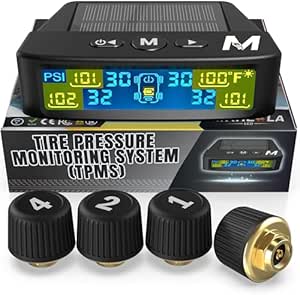


| wireless tire pressure monitoring system | Pressure Range | Sensors Included | Model |
|---|---|---|---|
| Avutrel TY01 Tire Pressure Mon | — | — | — |
| Solar Power Tire Pressure Moni | — | — | — |
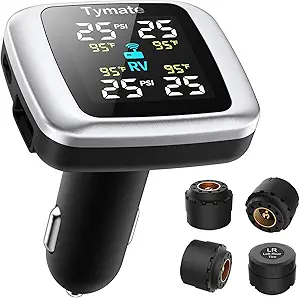
| Tymate TM7 RV Tire Pressure Mo | 0–144 PSI | — | — |
| 6-Wheel RV Tire Pressure Monit | 0–144 PSI | — | — |
| Tymate TM12 RV Tire Pressure M | 0–144 PSI | 6 | — |
| Wireless TPMS Tire Pressure Mo | 0–98 PSI | 4 external sensors | T12 |
| Tymate TM8 RV Tire Pressure Mo | 0–87 PSI | — | — |
| Tymate TM12 RV Tire Pressure M | 0–144 PSI | 4 | Tymate TM12 |
| Marcala Tire Pressure Monitori | 0–98 PSI | — | V2-4-Sensor |
| Masoll RV Tire Pressure Monito | — | 4 | XM-2+RP12+MZS3 |
| GUTA GT30 Trailer Tire Pressur | — | 10 | GT30+10GS02+GB30 |
| RV Tire Pressure Monitoring Sy | 0–144 PSI / 0–10 BAR | 4 external sensors | TS34 |
| Masoll M13 Tire Pressure Monit | 0–87 PSI | 4 | M13+MZS3 |
| Tire Pressure Monitoring Syste | 0–99 PSI | 4 external sensors | — |
| Tymate TM2 RV Tire Pressure Mo | 0–87 PSI | 4 external sensors | TM2 |
More Details on Our Top Picks
Avutrel TY01 Tire Pressure Monitoring System with Solar & USB Charging
This option stands out for balancing dual solar and USB charging with a display that auto-adjusts its brightness, so glare on a bright highway doesn’t wash out your readings the way fixed-backlight units can. The five alarm modes cover the failures that actually matter on the road — slow leaks, abnormal pressure, and heat buildup — and the roughly three-minute install makes it approachable even for first-time TPMS buyers. Compared with the similarly solar-powered red LCD model below, the Avutrel supports a broader range of vehicles, including off-road and commercial rigs, which gives it an edge in versatility. The tradeoff is familiar to anyone shopping external-sensor systems: the caps sit exposed to curbs, car washes, and theft, so they’re less durable than internal sensors over the long haul.
Pros:- Solar plus USB charging keeps the unit powered without relying on a single charging method
- Auto-dimming color display stays readable in direct sun and at night
- Covers sedans through commercial vehicles, so it works across a household fleet
- Installs in roughly three minutes with no professional help
Cons:- External sensors are more exposed to damage and theft than internal alternatives
- Limited to four-wheeled vehicles only
Best for: Everyday drivers of sedans, SUVs, and light commercial vehicles who want set-and-forget solar charging with a readable display day or night
Not ideal for: Owners of trailers or six-plus-wheel rigs — it only handles four tires, and long tow setups will need a system like the Tymate TM12
- Charging:Solar and USB
- Sensors:4 external pressure sensors
- Alarm Modes:5
- Compatibility:Sedans, SUVs, vans, off-road, commercial vehicles
- Item Weight:7.4 ounces
- Display:Color, auto-adjusting brightness
Our verdict“The most sensible all-around pick for typical passenger vehicles that want reliable monitoring without wiring or subscription fuss.”
Solar Power Tire Pressure Monitoring System with 4 External Sensors and LCD Display (Red)
For buyers who want core TPMS functionality without paying for extras, this model delivers a surprisingly complete package: six alarm modes, sealed sensors rated against dust, snow, and water, and customizable thresholds in both Bar/Psi and Celsius/Fahrenheit. Unlike the Tymate TM7, it never touches the cigarette lighter socket — solar handles daily duty with USB as backup — which matters if you already run a dash cam or phone charger from that port. The 12-month money-back warranty also softens the risk of a budget purchase. The catch is the 3.5 Bar (50 Psi) pressure ceiling, which rules out most RVs and heavier trucks at a glance, and some users find the sensors need a reinstall before they pair reliably the first time.
Pros:- Six alarm modes including leak, temperature, and sensor-fault detection
- Keeps the cigarette lighter socket free thanks to solar with USB backup
- Sealed sensors resist dust, snow, and water better than typical budget caps
- Customizable alarm thresholds with dual unit options
Cons:- Capped at 3.5 Bar / 50 Psi, excluding higher-pressure vehicles
- Sensors may need removal and reinstallation before they register properly
- External cap sensors are easier targets for theft than internal units
Best for: Budget-conscious passenger-car owners who want full alarm coverage and free solar power for under typical TPMS pricing
Not ideal for: RV and truck owners running pressures above 3.5 Bar — the system simply can’t read them
- Power Source:Solar and USB charging
- Sensors:4 external cap sensors, sealed
- Display:Digital LCD with backlight
- Alarm Modes:6
- Max Supported Pressure:3.5 Bar / 50 Psi
- Warranty:12 months money back or replacement
- Compatible Vehicles:Sedans, SUVs, MPVs, vans, coaches
Our verdict“A smart value pick for standard passenger vehicles, as long as your tire pressures stay well under the 50 Psi ceiling.”
Tymate TM7 RV Tire Pressure Monitoring System – TPMS with 4 Sensors
The TM7 takes a different power approach than the solar-only crowd: it plugs straight into the cigarette lighter socket, meaning no dependence on sunlight and no charging anxiety on long shaded hauls. In exchange, it gives back two USB charging ports on the unit itself, so you don’t actually lose the outlet — you gain one. Its 0–144 PSI range dwarfs the 3.5 Bar ceiling of the red solar model, making it genuinely RV- and trailer-capable, and the included CR1632 spares are a thoughtful touch. Compared with the Avutrel TY01, the TM7 trades solar independence for wider pressure coverage, a reasonable swap for heavy vehicles. The main limitation: trailers longer than 36 feet need a separately sold repeater, and plastic valve stems won’t hold these sensors securely.
Pros:- Plug-in power means no solar dependency or recharging routine
- Dual USB ports return the occupied socket with room for two devices
- 0–144 PSI range suits RVs, trucks, and trailers alike
- Four replacement CR1632 batteries included in the box
Cons:- Requires a separately sold repeater for trailers over 36 feet
- Metal valve stems recommended for stable sensor mounting
- Sensor batteries need periodic replacement
Best for: RV and truck owners who prefer always-on socket power over solar and want a wide 0–144 PSI monitoring range
Not ideal for: Drivers of longer tow setups over 36 feet without budgeting for the add-on repeater
- Pressure Range:0–144 PSI
- Accuracy:±1.5 PSI / ±3°F
- Power Source:Cigarette lighter socket (plug-in)
- Display:Color LCD, adjustable backlight
- USB Ports:2
- Sensor Battery:CR1632 (4 included)
- Item Weight:6.3 ounces
Our verdict“The strongest choice for RV owners who value dependable wired power and wide pressure range over solar convenience.”
6-Wheel RV Tire Pressure Monitoring System, 0–144 PSI
Six-tire coverage is the whole story here, and it’s a story the four-sensor majority of this roundup can’t tell. For dually pickups and Class C motorhomes with dual rear wheels, the customizable per-tire thresholds let you set different alarm limits front versus rear — something the four-sensor Tymate TM7 can’t accommodate without buying more sensors. The color LCD refreshes every six seconds with sensors reporting in 0.3 seconds, and solar plus USB-C charging gives flexible power options. A three-year warranty beats the 12-month coverage on the red solar model and signals longer-term confidence. On the downside, setup demands more care than the plug-and-play Tymate options: you’ll want a soapy-water leak check after mounting, and the CR1632 batteries are a recurring maintenance item.
Pros:- Monitors six tires out of the box with customizable per-tire thresholds
- Three-year warranty, the longest coverage in this batch
- Solar and USB-C charging for flexible power sourcing
- Fast 0.3-second sensor updates with automatic display brightness
Cons:- Requires careful installation plus a soapy-water leak check
- Sensor batteries need periodic replacement
Best for: Dually truck and six-wheel motorhome owners who need full coverage in one box without adding expansion sensors later
Not ideal for: Passenger-car owners — six sensors is wasted money when four-sensor systems cost less and do the same job
- Tire Capacity:6 tires
- Pressure Range:0–144 PSI
- Pressure Accuracy:±1.5 PSI
- Sensor Update Time:0.3 seconds
- Charging:Solar and USB-C
- Sensor Batteries:Replaceable CR1632
- Warranty:3 years
Our verdict“The clear pick for dual-rear-wheel rigs that need six-tire coverage from day one, provided you’re willing to do a careful install.”
Tymate TM12 RV Tire Pressure Monitoring System, 6 Sensors
The TM12 is the scalability champion of this lineup: six sensors ship in the box, but the display supports up to twelve, covering a motorhome towing a trailer with room to spare — a capability none of the four- or six-sensor models here can match without a second unit. Its six simultaneous readings and pre-programmed plug-and-play sensors make initial setup less fiddly than the six-wheel system above, which asks for a leak-check ritual. USB-C and solar charging both work, so you’re covered in any weather. The tradeoffs are scale-related rather than quality-related: big RVs or signal-blocking layouts may still need a repeater to stretch the 50-foot range past 100 feet, and solar charging slows considerably in weak light. Metal valve stems remain the recommended pairing for sensor stability.
Pros:- Expandable from 6 to 12 sensors on a single display
- Pre-programmed sensors enable genuine plug-and-play installation
- USB-C and solar dual charging for reliable power
- Waterproof external sensors with six comprehensive alarm types
Cons:- Repeater likely needed for large RVs or obstructed signal paths
- Solar charging performance depends heavily on available light
- Metal valve stems recommended for safe, stable sensor mounting
Best for: Large motorhome and multi-vehicle towing owners who need up to 12 tires monitored on one screen
Not ideal for: Four-tire passenger vehicles — the extra sensors and cost are pure overkill next to simpler systems like the Avutrel TY01
- Sensors Included:6
- Maximum Supported Sensors:12
- Pressure Range:0–144 PSI
- Transmission Range:50 ft (100+ ft with repeater)
- Display Power:USB-C or solar charging
- Alarm Modes:6
- Item Weight:12.3 ounces
Our verdict“The only sensible choice if you’re monitoring more than six tires at once, and overkill for anything less.”
Wireless TPMS Tire Pressure Monitoring System with 4 External Sensors
The ZYCAPATP T12 is a straightforward fit for drivers who want pressure and temperature readings across four wheels, with coverage for SUVs, RVs, trucks, and Jeeps. Its 0–98 PSI range and six alarm modes cover common pressure, leak, temperature, and sensor problems. Solar and USB-C charging give the display two ways to stay powered, while the IP67 external sensors are built for exposure to wet conditions. Compared with the Tymate TM8, which is recommended for vehicles under 20 feet and uses brand-specific TS3 sensors, the T12 lists broad four-wheel vehicle compatibility without that length limit. Its main drawback is a display that sleeps after three minutes of vehicle inactivity; that behavior can complicate sensor installation. Choose it for a general four-wheel setup, but skip it if you need multi-zone coverage for a larger RV.
Pros:- Monitors pressure and temperature across four wheels in real time
- Six alert modes include leak, temperature, pressure, and sensor warnings
- Display supports both solar and USB-C charging
- External sensors carry an IP67 rating
Cons:- Display sleeps after three minutes of vehicle inactivity, which can interrupt sensor installation
- Four included sensors limit the out-of-box setup to four tires
- The listed pressure range tops out at 98 PSI
Best for: SUV, truck, Jeep, and smaller RV owners who want four-wheel pressure and temperature alerts with solar or USB-C charging
Not ideal for: Owners of long RVs or trailers who need more than four monitored tires or extended signal coverage
- Brand:ZYCAPATP
- Model:T12
- Sensors included:4 external sensors
- Pressure range:0–98 PSI
- Charging:Solar and USB-C
- Alarm modes:6
- Compatibility:Four-wheel vehicles, including SUVs, RVs, trucks, and Jeeps
Our verdict“Pick the T12 for broad four-wheel vehicle compatibility and useful alerts, provided its four-sensor setup meets your needs.”
Tymate TM8 RV Tire Pressure Monitoring System with 4 Sensors
The Tymate TM8 suits drivers who want a compact color display and flexible charging for a car, SUV, or shorter RV. It tracks pressure and temperature in real time and gives alerts for pressure changes, air loss, temperature, battery, and signal issues. The display can draw power from solar, USB, or a cigarette lighter, though the lighter adapter is not included. Compared with the Tymate TM12, the TM8 is aimed at vehicles under 20 feet and has a lower 0–87 PSI range; it is a simpler match for shorter setups, while the TM12 supports more tires and higher pressures. The TM8 also pairs only with Tymate TS3 sensors, which narrows replacement options. Its listed pressure accuracy is inconsistent across product details, so buyers who depend on a precise tolerance should verify that point before choosing it.
Pros:- Real-time pressure and temperature monitoring with several alert types
- Solar, USB, and cigarette-lighter charging support
- Color LCD mounts on the windshield for easy viewing
- Listed for several vehicle types, including RVs, sedans, SUVs, MPVs, and trucks
Cons:- Recommended for vehicles under 20 feet
- Pairs only with Tymate TS3 replacement sensors
- Cigarette-lighter adapter is not included
Best for: Drivers of sedans, SUVs, and RVs under 20 feet who want a windshield-mounted color display and several charging options
Not ideal for: Owners of long RVs, high-pressure tires, or anyone seeking flexibility to use sensors from other brands
- Sensors:4
- Pressure range:0–87 PSI
- Pressure accuracy:Listed as ±3 PSI and ±1.5 PSI in product details
- Temperature accuracy:±3°F
- Maximum temperature:158°F
- Sensing distance:36 feet
- Display:Color LCD
- Charging:Solar, USB, or cigarette lighter; adapter not included
- Compatible replacement sensor:Tymate TS3
Our verdict“Choose the TM8 for a shorter vehicle and a color windshield display; the TM12 is a better fit for larger multi-tire setups.”
Tymate TM12 RV Tire Pressure Monitoring System – TPMS with 4 Sensors
The Tymate TM12 is the expansion-minded pick in this group: it includes four sensors but can support up to 12 tires across four zones. That gives RV and trailer owners room to add coverage later, while the six-wheel simultaneous display helps keep a larger front setup readable. Its 0–144 PSI range also reaches beyond the Tymate TM8, which is limited to 87 PSI and recommended for vehicles under 20 feet. Six alarm modes cover pressure, temperature, rapid air loss, low sensor battery, and lost signal. Pre-programmed sensors make initial setup more approachable, and USB-C plus solar charging offers useful flexibility. The tradeoff is that long or signal-blocked rigs may need a separately sold repeater to reach the stated extended range. Solar output depends on light, and the monitor cannot be manually switched off while charging by cable.
Pros:- Supports up to 12 sensors across four zones
- Six-wheel simultaneous display suits larger front setups
- Six alarm modes cover pressure, temperature, leaks, and sensor faults
- Pre-programmed plug-and-play sensors simplify DIY installation
Cons:- Repeater is sold separately for large RVs or obstructed signal paths
- Solar charging output varies with available light
- Monitor cannot be manually turned off while charging by cable
Best for: RV and trailer owners who expect to monitor more than four tires across multiple zones
Not ideal for: Drivers with a small four-wheel vehicle who do not need expansion capacity or a multi-zone display
- Model:Tymate TM12
- Sensors included:4
- Maximum sensors:12 across four zones
- Pressure range:0–144 PSI
- Signal range:50 feet; 100+ feet with repeater
- Power:USB-C and solar charging
- Alarm modes:6
- High pressure alert threshold:+25% above reference
- Low pressure alert threshold:−15% below reference
Our verdict“Choose the TM12 if you want to expand beyond four tires and need a higher pressure range than the TM8 provides.”
Marcala Tire Pressure Monitoring System – Set of 4 TPMS Sensors (0-98 PSI)
The Marcala V2 makes the most sense for everyday vehicles where a simple four-wheel display and quick updates matter more than long-range RV coverage. It monitors one to four wheels, reports pressure to a stated 1 PSI accuracy, and updates every second while driving. The bright color screen auto-dims, and its IP67 sensors suit cars, vans, trucks, SUVs, and motorcycles. Compared with the Masoll XM-2+RP12+MZS3, which includes a booster and lists a 120-foot transmission distance, the Marcala’s 26-foot sensor range is a poor match for long rigs or towing. Solar and USB charging add flexibility, and a lifetime replacement policy is a distinguishing support feature. Park-mode updates are slower, which may look like a fault, and installation can produce a brief air-leak hiss that may unsettle new users.
Pros:- Updates pressure and temperature every second while driving
- Bright auto-dimming color LCD with solar and USB charging
- IP67 sensors suit several everyday vehicle types
- Lifetime replacement policy from an American-owned family business
Cons:- 26-foot sensor range is limited for towing and large RVs
- Park-mode sensor updates are slower than driving updates
- Installation can produce a brief air-leak hiss that may concern first-time users
Best for: Car, van, SUV, truck, or motorcycle owners who want fast driving updates and a compact four-wheel setup
Not ideal for: People towing a trailer or monitoring a large RV who need long sensor range or frequent readings while parked
- Brand:Marcala
- Model:V2-4-Sensor
- Pressure range:0–98 PSI
- Accuracy:1 PSI
- Wheels monitored:1–4
- Sensor range:Up to 26 feet; 80 feet with extender
- Charging:Solar and USB
- Dimensions:4 × 4 × 1.3 inches
- Warranty:Lifetime replacement policy
Our verdict“Pick the Marcala for a car, SUV, van, or motorcycle where quick driving updates matter more than long-range coverage.”
Masoll RV Tire Pressure Monitoring System with 4 Sensors
The Masoll XM-2+RP12+MZS3 is the long-range choice here because it includes a signal booster and lists transmission distance up to 120 feet. That makes it more suited to an RV or trailer layout where the monitor and rear tires are far apart than the Marcala V2, whose listed sensor range is 26 feet without an extender. Four sensors are included, and the system installs without pairing, reducing setup steps. Its color LCD has four brightness levels, while visual and audio alerts cover pressure changes, high temperature, fast leakage, sensor loss, and low sensor voltage. The stated maximum is 145 PSI, so buyers should match that limit to their tire requirements. The booster is IP69 rated, but the supplied information does not list the same rating for the sensors themselves. Its one-year warranty is also shorter than Marcala’s lifetime replacement policy.
Pros:- Includes a signal booster for listed transmission distance up to 120 feet
- Installs without sensor pairing
- Color LCD offers four brightness levels
- Visual and audio alerts cover pressure, temperature, leaks, and sensor faults
Cons:- Maximum listed pressure is 145 PSI
- Warranty is one year
- Four included sensors may not cover every tire on a large RV or trailer
Best for: RV and trailer owners whose tire sensors need a signal path of up to 120 feet and who want an included booster
Not ideal for: Owners with tire pressure requirements above 145 PSI or buyers prioritizing a lifetime replacement policy
- Brand:Masoll
- Model:XM-2+RP12+MZS3
- Sensors included:4
- Maximum pressure:145 PSI
- Transmission distance:120 feet
- Display:Color LCD with 4 brightness levels
- Alarms:High/low pressure, high temperature, fast leakage, sensor loss, and low sensor voltage
- Booster:Included; IP69 waterproof and dustproof
- Warranty:1 year
Our verdict“Choose the Masoll for an RV or trailer that needs its included booster and 120-foot listed signal distance.”
GUTA GT30 Trailer Tire Pressure Monitoring System with 10 Sensors
The GUTA GT30 is the scale pick here: its included 10 sensors cover more wheels from the start, and the system can support up to 46 tires. That makes it a better fit for a large RV, trailer combination, or fleet than the four-sensor Tymate TM2, which supports up to 10 tires but starts with fewer sensors. The GT30 also pairs pressure readings with temperature monitoring and alerts for fast leaks, lost signals, and low sensor batteries. The tradeoff is a five-minute update interval, which gives less frequent feedback than the XBNVGP TS34’s 0.3-second refresh rate. Its monitor needs charging, and metal valve stems are recommended, so it is less convenient for smaller vehicles or setups with rubber stems.
Pros:- Includes 10 sensors and supports monitoring up to 46 tires
- Tracks tire pressure and temperature
- Provides visual and audio alerts for fast leaks, high temperature, lost signals, and low sensor batteries
- Monitor runs 12–14 days per charge, and sensor batteries are replaceable
Cons:- Data updates at five-minute intervals
- Metal valve stems are recommended; rubber stems are not
- Monitor requires a four-hour charge
Best for: Owners of large RV and trailer combinations who need to monitor many tires and want 10 sensors included.
Not ideal for: Drivers who want near-instant pressure updates, or who have rubber valve stems and do not plan to replace them.
- Sensors included:10
- Maximum tires supported:46
- Maximum pressure:188 psi
- Maximum tire temperature:185 °F
- Monitor battery life:12–14 days after a 4-hour charge
- Sensor battery:Replaceable CR2032; up to 4 years
- Model:GT30+10GS02+GB30
Our verdict“Choose the GT30 if you need broad tire coverage and can accept slower updates and the recommended metal valve stems.”
RV Tire Pressure Monitoring System with 4 Sensors, Solar & USB-C Charging, Color LCD Display, 0-144 PSI
For drivers who want frequent readings while underway, the XBNVGP TS34 stands apart from the GUTA GT30: its listed sensor refresh rate is 0.3 seconds, while the GT30 updates every five minutes. Six alarm modes and customizable thresholds help tailor warnings to the vehicle, and solar plus USB-C charging gives the display two ways to stay powered. Its tool-free setup is also a simpler fit for a four-wheel vehicle than the GT30’s larger multi-tire system. The limits are clear: it includes only four external sensors, and compatibility is specified for vehicles up to 50 feet long. External sensors are easier to fit without tire removal, but are more exposed to impact or tampering than internal sensors.
Pros:- 0.3-second sensor refresh rate
- Six alarm modes with customizable thresholds
- Solar and USB-C charging for the monitor
- Tool-free installation without removing tires
Cons:- Specified for vehicles up to 50 feet long
- Includes four external sensors, which are exposed to damage
- Sensor battery runtime is listed as 6+ months, with a 2-year total lifespan
Best for: RV and trailer owners under 50 feet who want rapid sensor updates, adjustable alerts, and straightforward installation.
Not ideal for: Owners of longer rigs or vehicles with more than four tires to monitor unless they confirm additional sensor support.
- Model:TS34
- Sensors included:4 external sensors
- Pressure range:0–144 PSI / 0–10 BAR
- Precision:2 PSI / 3°F
- Sensor refresh rate:0.3 seconds
- Alarm modes:6
- Charging:Solar and USB-C
- Sensor battery:Replaceable; 6+ months runtime, 2-year total lifespan
Our verdict“Pick the TS34 for quick updates and flexible charging on a rig within its 50-foot compatibility limit.”
Masoll M13 Tire Pressure Monitoring System with 4 Sensors for RV/Trailer
The Masoll M13 keeps setup simple by automatically calibrating its alarm thresholds around the reference pressure: 25% above and 15% below. That can spare drivers the manual threshold choices offered by the XBNVGP TS34, though the TS34 serves buyers who want more control and faster listed refreshes. The M13’s anti-reflective color LCD is intended to remain readable in sunlight, while solar charging supports ongoing use without relying solely on a cable. Its pressure range tops out at 87 PSI, and the stated vehicle fit is limited to travel trailers under 38 feet unless a separate signal booster is added. With four sensors and a shorter sensor warranty than the monitor warranty, this is a straightforward match for smaller rigs rather than a scalable multi-axle system.
Pros:- Automatically sets alarm thresholds from reference pressure
- Solar charging with auto wake-up and sleep
- Anti-reflective color LCD with auto backlight
- 1.5 PSI stated accuracy
Cons:- Pressure range is limited to 0–87 PSI
- Trailers longer than 38 feet require a separately sold signal booster
- Sensors have a 6-month warranty, compared with 1 year for the monitor
Best for: Owners of four-tire vehicles or travel trailers under 38 feet who prefer automatic alarm setup and a sunlight-readable display.
Not ideal for: Drivers with higher-pressure tires, longer trailers who do not want a separate booster, or those wanting a longer sensor warranty.
- Model:M13+MZS3
- Sensors included:4
- Pressure range:0–87 PSI
- Accuracy:1.5 PSI
- Power source:Solar charging
- Display:Color LCD with auto backlight
- Compatible vehicles:Sedan, SUV, pickup truck, RV, and travel trailer under 38 feet
- Warranty:1 year for monitor; 6 months for sensors
Our verdict“Choose the M13 for a smaller, lower-pressure setup where automatic thresholds and a readable display matter more than expansion.”
Tire Pressure Monitoring System with Solar & USB Charging, 4 External Sensors, 6 Alarm Modes, LCD Display
This four-sensor system makes a practical case for outdoor use with IP68 waterproof and dust-proof sensors and two monitor charging options, solar and USB. That protection gives it a more specific advantage over the Masoll M13, whose listed strengths center on automatic calibration and display readability. Six alarm modes cover rapid leaks, pressure limits, temperature, and sensor voltage, though the stated accuracy is ±3 PSI, looser than the M13’s 1.5 PSI. The 0–99 PSI range fits many passenger vehicles and some RV setups, but it is below the XBNVGP TS34’s 144 PSI ceiling. External sensors are convenient to install, yet they remain exposed, and the product description says it cannot warn of tire blowouts.
Pros:- IP68-rated sensors resist water and dust
- Monitor supports both solar and USB charging
- Six alarm modes include rapid-leak and high/low pressure alerts
- Adaptive-backlight color LCD
Cons:- ±3 PSI accuracy is less precise than the Masoll M13’s stated 1.5 PSI
- Maximum stated pressure is 99 PSI
- External sensors can be damaged or stolen, and the system cannot warn of blowouts
Best for: Drivers of cars, pickups, or modest-pressure trailers who want weather-resistant sensors and solar or USB charging.
Not ideal for: Owners who need tighter stated pressure accuracy, pressure capacity above 99 PSI, or blowout warnings.
- Sensors included:4 external sensors
- Pressure range:0–99 PSI
- Accuracy:±3 PSI
- Alarm modes:6
- Charging:Solar and USB
- Sensor battery life:Up to 6 months; service life up to 2 years
- Display:Color LCD with adaptive backlight
- Compatible vehicles:Sedans, SUVs, MPVs, RVs, pickup trucks, and travel trailers
Our verdict“Pick this system when weather resistance and flexible charging outweigh tighter accuracy or higher pressure capacity.”
Tymate TM2 RV Tire Pressure Monitoring System with 4 Sensors
The Tymate TM2 is a flexible starting point for RV owners who may add monitored tires later: it includes four pre-paired sensors and supports up to 10 tires. That gives it more expansion headroom than the four-sensor Masoll M13, which is described for four-tire vehicles, though the GUTA GT30 is the better fit for much larger setups with support for up to 46 tires. The TM2’s solar, USB, and cigarette-lighter power options help accommodate different dashboards, while its color display adjusts its backlight automatically. Its 0–87 PSI range and roughly 3 PSI accuracy margin set limits for higher-pressure tires or buyers wanting tighter readings. Long trailers may also need a repeater, and the cigarette-lighter adapter is not included.
Pros:- Supports up to 10 tires with four sensors included
- Pre-labeled sensors are paired with the monitor
- Solar, USB, and cigarette-lighter power options
- Alerts cover pressure, temperature, leaks, and sensor issues
Cons:- Pressure range ends at 87 PSI, with an approximately 3 PSI accuracy margin
- A repeater is recommended for trailers at least 36 feet long
- Cigarette-lighter adapter is not included
Best for: RV owners who want four sensors now and the option to monitor up to 10 tires as their setup grows.
Not ideal for: Owners with tire pressures above 87 PSI, trailers at least 36 feet long who do not want a repeater, or buyers expecting an included cigarette-lighter adapter.
- Model:TM2
- Sensors included:4 external sensors
- Maximum tires monitored:10
- Pressure range:0–87 PSI
- Sensor accuracy:Approximately 3 PSI margin for error
- Sensor battery:CR1632; up to 6 months, sensor lifespan up to 2 years
- Sensor water resistance:IP67
- Power options:Solar, USB, or cigarette-lighter socket
Our verdict“Choose the TM2 if you want a pre-paired four-sensor kit that can expand to a 10-tire RV setup.”
How We Picked
My ranking logic for these 15 wireless tire pressure monitoring systems came down to four buyer-facing criteria. Accuracy and pressure range came first: a system that reads 20 PSI off or maxes out below your actual tire pressure is worse than no system at all, so I prioritized models covering 0–144 PSI for RV and trailer compatibility. Power management came second — solar assistance, USB or USB-C charging, and replaceable versus sealed sensor batteries all affect long-term ownership, since a dead sensor battery often means buying a whole new kit.
From there I weighed expandability (four sensors is fine for a car, but towing setups need six to ten) and usability, meaning display readability in daylight, alarm customization, and how forgiving the pairing process is for first-time installers. I also factored in durability signals like sensor sealing, anti-theft hardware, and monitor mounting options, because these devices live in harsh environments. Products were then ordered by how well they serve their intended buyer — daily drivers, RV owners, and multi-vehicle towers — rather than by raw feature counts, which is why some cheaper models outrank pricier ones for specific use cases.
Factors to Consider When Choosing Wireless Tire Pressure Monitoring Systems
Before picking a specific model, it helps to understand what actually separates a useful wireless TPMS from one that ends up unplugged in a glovebox. These are the factors I would weigh first, based on the patterns I saw across all 15 systems.Match the Pressure Range to Your Actual Tires
The single most common mistake I saw in this category is buying a system rated below your tire pressure. Many budget kits cap out at 99 or 87 PSI, which is fine for a passenger car running 32 PSI but useless for a Class A motorhome rear axle running 110 PSI or a boat trailer at max load. When a sensor reads out of range, some monitors simply stop reporting that tire, which can create a false sense of security rather than a warning. My rule of thumb: take your maximum cold pressure, add 20 percent, and only consider systems whose ceiling exceeds that number. The 0–144 PSI models in this roundup exist precisely for this reason, and they cost only modestly more than their lower-range siblings. If you tow anything, buy the range up front — you cannot upgrade a sensor’s ceiling later.
External Sensors: Convenience With Tradeoffs
Every system in this roundup uses external sensors, and understanding their limitations is part of owning one. External sensors thread onto the valve stem in minutes, which is why they dominate the consumer market, but they add roughly 8–10 grams to the stem and can loosen from vibration if not properly torqued. More practically, they can interfere with adding air — you’ll be unscrewing sensors (or using a flow-through model) at every fill-up. Anti-theft locking hardware helps, but it means keeping a small wrench in the vehicle forever. Sealed sensor batteries typically last two to five years, and when they die, the sensor is trash; that’s a recurring cost most buyers don’t budget for. Internal sensors avoid these issues but require tire demounting and professional installation, which is why I only recommend them for people keeping one vehicle long-term.
Solar Charging Is a Bonus, Not a Power Strategy
Multiple products in this roundup advertise solar charging, and my advice is to treat that feature honestly. The small panels on these monitors can offset standby drain and stretch battery life during long trips, but they rarely deliver enough current to recover a depleted battery, especially if the unit sits in a shaded windshield or a garaged vehicle. USB and USB-C charging remain the dependable way to keep the monitor alive, and the models with modern USB-C ports are simply more convenient than older micro-USB units as cables become scarce. Where solar genuinely earns its keep is on RVs parked in storage with the monitor left mounted — trickle charging prevents the slow death that plagues neglected units. If you drive a daily commuter that lives in a parking garage, solar should rank near the bottom of your priority list.
Sensor Count and Expandability for Towing
Four-sensor kits are the default, and they’re the right choice for cars, trucks, and motorhomes without a towed vehicle. The math changes the moment you tow: a truck pulling a dual-axle trailer needs eight monitored positions, and a dually truck with a triple-axle toy hauler can need fourteen. Buying a four-sensor kit and hoping to add sensors later is a trap, because most consumer systems only pair the sensors they shipped with or require matching replacements from the same manufacturer. That’s why the GUTA GT30 with its 10-sensor support and the six-sensor Tymate TM12 configurations rank highly despite costing more — expandability is a structural feature, not an accessory. Map out every tire you want monitored before you buy anything, including the spare if you rotate it in.
Alarm Logic and Display Readability
A TPMS is only as good as its warnings, and alarm customization varies widely. The better systems in this roundup let you set independent high/low pressure thresholds per axle — useful because a steer axle at 110 PSI and a trailer axle at 65 PSI need different alerts — while cheaper units force one global threshold or use preset percentages. Fast-leak detection matters too: a slow overnight leak is an inconvenience, but a rapid pressure drop at highway speed is the event these systems exist to catch. On the display side, look for a color LCD that stays readable in direct sun; monochrome screens and tiny digits are a real problem in a bright windshield. Audible alarms should be loud enough to hear over road noise, which is a bigger hurdle in a diesel motorhome than a sedan.
Installation and Ongoing Maintenance Realities
Plan on more setup time than the product pages suggest. External sensors typically need to be ‘woken up’ before pairing, and a common gotcha is installing them without checking that each sensor reports to the correct wheel position on the display — mixed-up positions can mask a real problem. After installation, verify pressure readings against a trusted gauge; sensors can read a few PSI off, and knowing your unit’s bias helps you interpret alerts correctly down the road. Recheck sensor tightness after your first few hundred miles, as vibration settling is normal. Long-term, keep spare locking nuts and the sensor wrench accessible, and write down which sensor goes on which corner if you rotate tires. These habits take ten minutes and are the difference between a system you trust and one you ignore.
Frequently Asked Questions
Do wireless TPMS external sensors affect tire balance or valve stems?
External sensors add a small amount of rotating weight, but at typical passenger car and RV speeds the imbalance is minor and most drivers never notice it. The bigger practical issue is valve stem wear: constant vibration on a rubber stem can eventually cause cracking or slow leaks, which is why metal valve stems are strongly recommended before installing external sensors. If your vehicle has old rubber stems, replacing them with metal ones is a cheap, one-time fix that removes most of the risk. Sensor weight also matters more at highway speeds on small trailer tires than on large RV tires, simply because of rotational physics. As long as the sensors are torqued snugly — hand-tight plus a fraction with the wrench, never cranked down — stem damage is rare. Checking stem condition at every installation is a habit worth building.
Can I monitor both my RV and my towed car or trailer with one system?
Yes, but only if you buy a system with enough sensor channels from the start. Kits like the GUTA GT30 support up to 10 sensors, and six-sensor versions of the Tymate TM12 exist specifically for truck-plus-trailer setups, while four-sensor kits cannot be expanded later in most cases. You’ll want per-axle threshold settings too, because your motorhome’s drive tires and your towed car’s tires almost certainly run at very different pressures. Placement of the monitor also matters: in a motorhome towing a car, the signal usually reaches fine, but a long travel trailer behind a pickup can push wireless range, so look for systems with repeaters or stronger signal claims. Before committing, count every tire position you want covered, including the towed vehicle. It’s far cheaper to buy the right channel count once than to replace an entire system.
How long do the sensor batteries last, and what happens when they die?
Most external TPMS sensors use sealed batteries rated for two to five years, and battery life shortens in extreme heat or if the sensor transmits very frequently. Because the batteries are sealed for waterproofing, a dead sensor generally means replacing the sensor itself, and often the whole kit if the manufacturer no longer sells individual replacements. This is a hidden ownership cost that the product listings rarely emphasize. Some buyers mitigate it by removing sensors from vehicles that sit for months, since transmission is what drains the battery most. When comparing kits, check whether the brand sells replacement sensors individually — that single detail can determine whether the system is a long-term tool or a disposable purchase. My advice is to verify spare sensor availability before buying any budget-brand kit.
Why does my TPMS reading differ from my tire gauge, and which should I trust?
Small discrepancies of 1–3 PSI between a TPMS sensor and a handheld gauge are normal and come from calibration variance in both devices, plus temperature effects — tire pressure rises several PSI as tires warm up while driving. The TPMS’s job is less about absolute precision and more about detecting change: a tire that suddenly reads 15 PSI below its siblings is telling you something regardless of exact calibration. To settle the question, take a cold reading with both your gauge and the monitor, note the offset, and use that mental correction going forward. If the offset is large — say 6 PSI or more — check the sensor’s seating on the valve stem first, as a loose sensor causes false low readings. Trust a quality calibrated gauge for setting cold pressures, and trust the TPMS for catching leaks and heat events in real time. They serve different jobs.
Are solar-powered TPMS monitors reliable without regular USB charging?
Solar charging on these monitors is best understood as battery maintenance rather than a primary power source. The small panels can keep a healthy battery topped off when the monitor sits in direct sun, which is genuinely useful on an RV parked outdoors or during long driving days. But a depleted battery usually won’t recover on solar alone in a reasonable time, especially in winter sun, through window tinting, or in a shaded windshield. Temperature also works against the panel: very hot dashes can reduce charging efficiency even in bright light. The models with dual solar and USB or USB-C charging are the practical choice because you get the trickle-charge benefit with a dependable fallback. If your vehicle lives in a garage or carport, weight USB charging heavily in your decision and treat solar as a nice extra rather than a requirement.
Conclusion
After comparing all 15 wireless tire pressure monitoring systems, the right choice depends almost entirely on what you’re monitoring and for how long. For best overall, the Avutrel TY01 earns the top spot with its dual solar and USB charging, dependable accuracy, and a well-rounded feature set that works for cars, trucks, and smaller RVs alike. For best value, the Tymate TM7 delivers the core essentials — accurate sensors, usable alarms, and a clear display — without paying for features you may not use. RV owners with six wheels to cover should look at the Tymate TM12 as the best premium pick, thanks to its per-axle flexibility and proven platform. For beginners, the straightforward Wireless TPMS with 4 External Sensors or the Tymate TM2 keep pairing and setup forgiving for a first-time install. And for specific needs, the GUTA GT30 with 10 sensors is the clear choice for truck-and-trailer combinations, while the 6-Wheel RV TPMS (0–144 PSI) and the solar/USB-C color LCD model fit high-pressure motorhome applications where range and readability matter most. Whatever you pick, verify the pressure range against your actual tires first — that single check eliminates most buyer’s remorse in this category.
Fall Picks
fall essentials
As an affiliate, we earn on qualifying purchases.