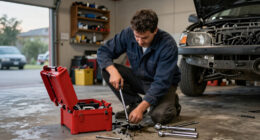

Choose and prepare an automotive tool kit so you can handle basic maintenance and minor roadside tasks with the right tools. This guide is for drivers with little or no repair experience. It takes about 30-60 minutes to select a kit, check that its contents suit your vehicle, and store it safely. The kit can help with simple jobs, but it does not replace a jack, spare tire, or professional help when a repair is unsafe or beyond your skill.

Get business pricing on garage and car supplies
- Business-only prices and quantity discounts
- Tax-exempt purchasing
- Multiple users, one account, clear invoices

Craftsman 262-Piece Mechanic Tool Set with 3-Drawer VERSASTACK Box
- ✔ Piece count: 262
- ✔ Drive sizes: 1/4 inch, 3/8 inch and 1/2 inch listed; some accessories are limited to 1/4 inch and 3/8 inch
- ✔ Socket standards: SAE and metric

DEWALT Mechanic Tool Set with Case, Metric and Standard Full 1/4- and 3/8-Inch Drive Socket Set, 168-Piece
- ✔ Piece count: 168
- ✔ Drive sizes: 1/4 inch and 3/8 inch
- ✔ Socket standards: Metric and standard

SEDY Premium 132-Piece Mechanics Tool Set, SAE and Metric 1/4- and 3/8-Inch Drive
- ✔ Piece count: 132
- ✔ Drive sizes: 1/4 inch and 3/8 inch
- ✔ Socket standards: SAE and metric
Difficulty: Beginner | Time: 30-60 minutes to choose and prepare; repair time varies
What You’ll Need
Tools & Materials:
- Your vehicle owner’s manual
- A basic automotive tool kit or individual tools
- A flashlight
- Protective gloves and eye protection
- A secure storage bag or case
Knowledge:
- How to locate your vehicle’s wheel wrench, jack, spare tire, and battery
- How to identify the vehicle’s make, model, year, and fastener sizes from the owner’s manual
Park on level ground, switch off the engine, apply the parking brake, and keep the key with you before inspecting or working on the vehicle. For roadside work, move away from traffic if possible and use hazard lights. Do not work beneath a vehicle supported only by a jack.
Craftsman 262-Piece Mechanic Tool Set with 3-Drawer VERSASTACK Box
For buyers who want one organized starting point for varied automotive jobs, the Craftsman 262-piece set has the most expansive assortment in this group. Its SAE and metric sockets, combination wrenches, hex keys, specialty bits and spark plug sockets give it a broader stated mix than the DEWALT and SEDY kits. That breadth is useful when repairs call for different tool types, though the piece count alone does not tell us how many sizes are included or how complete each range is.The low-profile 90-tooth ratchets are rated for a 5-degree arc swing, a useful feature when there is little clearance to reposition a handle. Compared with DEWALT’s 72-tooth ratchets, Craftsman specifies more teeth while listing the same swing angle; that specification is an access advantage on paper, rather than proof of a different result in every task. The three-drawer box and one-hand locking dial also set it apart from the two-drawer SEDY case, and VERSASTACK compatibility gives buyers a way to expand storage around the kit.Its main compromise is the lack of a listed drive larger than 3/8 inch, with certain accessories limited to 1/4- and 3/8-inch drives. We would choose it for breadth and storage, but buyers who regularly need larger-drive tools should plan for a separate set. Its substantial 27.5-pound listed weight also makes it less appealing if frequent carrying is a priority.
Pros:
- Broad stated mix of SAE and metric sockets, wrenches, hex keys, specialty bits and spark plug sockets.
- 90-tooth ratchets are specified with a 5-degree arc swing for restricted access.
- Three-drawer case has a one-hand locking dial and VERSASTACK compatibility.
Cons:
- The supplied details do not list drive sizes larger than 3/8 inch.
- At 27.5 pounds, it may be cumbersome for frequent transport.
Best for: Home mechanics who want a broad SAE and metric assortment, multiple tool types and expandable drawer storage for varied vehicle maintenance.
Not ideal for: Buyers who need larger drive sizes in one kit, prioritize a lightweight carry case, or only want a small selection of basic sockets.
Bottom line: We rank Craftsman first for its broad tool mix and expandable three-drawer storage, provided 3/8-inch maximum listed drive coverage suits your work.
“We rank Craftsman first for its broad tool mix and expandable three-drawer storage, provided 3/8-inch maximum listed drive coverage suits your work.”
DEWALT Mechanic Tool Set with Case, Metric and Standard Full 1/4- and 3/8-Inch Drive Socket Set, 168-Piece
The DEWALT 168-piece set takes a more focused approach than Craftsman’s larger assortment. It combines metric and standard sockets with three pear-head ratchets, hex keys, wrenches and specialty tools. Its defining distinction is DirectTorque technology, which the product description says helps prevent fastener rounding. That feature gives buyers a reason to consider it when preserving fasteners matters, although the supplied details do not specify how every tool in the set uses the technology.For work with limited handle clearance, its 72-tooth ratchets have a stated 5-degree swing. Craftsman lists 90-tooth ratchets with the same swing angle, so the DEWALT’s appeal rests more on its grip design and three pear-head ratchets than on having the highest listed tooth count. The anti-slip driver handle is another practical touch for jobs that involve repeated turning, and the case’s metal latches are intended to protect tools during transport.Compared with the three-drawer Craftsman and two-drawer SEDY, this kit’s listed case description is less specific about drawer organization. It also lacks a listed drive size above 3/8 inch, so it is not the obvious single-kit choice for larger fasteners. We place it second for its distinctive fastener-contact feature and tight-space ratchets, with the caveat that some socket counts in the product description appear duplicated and may need clarification before purchase.
Pros:
- DirectTorque technology is described as helping reduce fastener rounding.
- Three pear-head ratchets provide options across the listed set.
- 72-tooth ratchets are specified with a 5-degree swing.
- Anti-slip driver handle and metal case latches add practical handling and storage features.
Cons:
- The supplied specifications do not list a drive larger than 3/8 inch.
- The product description has duplicated socket-count entries that may cause uncertainty.
Best for: Vehicle owners and home mechanics who value the stated fastener-rounding protection, tight-space ratchet swing and a protective case with metal latches.
Not ideal for: Buyers who need a larger drive size in the kit, want clearly described drawer storage, or need certainty about the listed socket counts.
Bottom line: DEWALT is our fastener-control pick for buyers drawn to DirectTorque and close-clearance ratchets, though the listing’s socket-count ambiguity deserves attention.
“DEWALT is our fastener-control pick for buyers drawn to DirectTorque and close-clearance ratchets, though the listing’s socket-count ambiguity deserves attention.”
SEDY Premium 132-Piece Mechanics Tool Set, SAE and Metric 1/4- and 3/8-Inch Drive
SEDY’s 132-piece mechanics set is the most focused option here: it covers SAE and metric sockets for 1/4- and 3/8-inch drives, then adds ratcheting wrenches, extensions and adapters. That combination targets common maintenance tasks without claiming the broader assortment Craftsman provides. For someone who wants those specific tools organized together, the two-drawer lockable case offers a clear storage setup. Buyers new to mechanics tools may still find 132 pieces harder to sort than a simpler starter kit, as the supplied product details themselves note.The set is described as forged from chrome-vanadium steel with a polished finish, which distinguishes its stated construction from Craftsman’s alloy-steel, powder-coated description. It also includes a quick-release ratchet and ratcheting wrenches. Those wrenches offer a different way to work than relying on sockets alone, while the extensions and adapters can help reach fasteners or connect compatible tools. We should not infer exact socket ranges or performance from the material description alone.Against DEWALT, SEDY offers more explicitly described drawer storage and ratcheting wrenches, while DEWALT highlights DirectTorque and a 5-degree ratchet swing. Against Craftsman, SEDY gives up overall piece count and the stated mix of spark plug sockets, hex keys and specialty bits. We rank it third for the most specific buyer: it makes sense when its two drive sizes, wrench assortment and lockable storage align with your routine jobs, but not when maximum breadth is the main goal.
Pros:
- Includes SAE and metric sockets for both listed drive sizes.
- Adds ratcheting wrenches, a quick-release ratchet, extensions and adapters.
- Chrome-vanadium steel construction and a polished finish are specified.
- Lockable two-drawer case supports organized storage.
Cons:
- The supplied drive-size information stops at 3/8 inch.
- The 132-piece assortment may feel complex for beginners who need only basic sockets.
- The description gives less detail about specialty tools than the Craftsman listing.
Best for: Mechanics who mainly need SAE and metric 1/4- and 3/8-inch socket work, ratcheting wrenches and a lockable two-drawer case.
Not ideal for: Buyers looking for the broadest assortment, a very simple beginner kit, or a listed drive size larger than 3/8 inch.
Bottom line: SEDY is a practical focused choice when ratcheting wrenches and a lockable two-drawer case matter more than Craftsman’s broader assortment.
“SEDY is a practical focused choice when ratcheting wrenches and a lockable two-drawer case matter more than Craftsman’s broader assortment.”
As an Amazon Associate we earn from qualifying purchases.
Before You Start
Decide which tasks you want the kit to cover. A compact kit may handle loose trim, battery terminal checks, or simple adjustments, while wheel changes require vehicle-specific equipment and safe lifting procedures. Check your owner’s manual for warnings, recommended lifting points, battery guidance, and any special fasteners. Avoid buying a kit based only on the number of pieces; tool fit, quality, and safe storage matter more.
Step-by-Step Instructions
Step 1: List the jobs you want to handle
Write down a few realistic tasks, such as tightening an accessible battery clamp, replacing a fuse, or removing a trim fastener. Keep the list to work you are prepared to do safely. Do not plan to open high-voltage hybrid or electric vehicle systems, work on airbags, or repair brakes or steering without the required training and equipment.
Tip: A tool kit is for basic tasks and preparation. It does not make an unsafe repair safe.
Check: You have a short list of tasks that match your experience and the vehicle’s manual.
Step 2: Check your vehicle’s requirements
Use the owner’s manual to identify the wheel lug-nut or bolt size, battery location, fuse access, and any unusual fasteners. Note whether the vehicle has a spare tire, locking wheel nuts, or a tire repair kit. Confirm the correct lifting points and the equipment needed for a wheel change before relying on the kit for that job.
Tip: A standard socket set may not fit locking wheel nuts. Keep the matching key in a known, secure place.
Check: You know which vehicle-specific items and sizes the kit must include.
Step 3: Select a suitable kit
Choose a sturdy case with tools that match your planned jobs. For a general-purpose kit, look for a range of metric sockets and wrenches, a ratchet, screwdrivers, pliers, a small adjustable wrench, and a flashlight. Add a tire pressure gauge and gloves. Choose corrosion-resistant tools with handles that feel secure, and check that sockets fit the ratchet firmly.
Tip: Many vehicles use metric fasteners, but verify your own vehicle instead of assuming. Skip oversized kits with pieces you cannot identify or store safely.
Check: The kit covers your planned tasks and includes tools that fit the vehicle’s known fasteners.
Step 4: Add vehicle-specific and safety items
Gather any equipment the kit does not include, such as the locking wheel-nut key, fuse puller, spare fuses of the specified ratings, or the vehicle’s tire equipment. Keep a reflective warning triangle or other locally required roadside warning device, a first-aid kit, and a charged phone accessible. Use a torque wrench for wheel fasteners when the manual calls for one; a basic ratchet does not measure torque.
Tip: Never replace a fuse with one rated higher than the specified value. A wrong rating can create a fire risk.
Check: Required vehicle-specific items are present, and safety equipment is easy to reach.
Step 5: Inspect and organize the contents
Lay out the tools and compare them with the case labels or inventory. Check for cracked handles, bent pieces, rust, loose ratchets, or missing parts. Test that sockets seat on the ratchet and that the vehicle’s wheel key is present if applicable. Put each item in its marked place so missing tools are easy to spot after use.
Tip: Do not use a damaged tool or a tool that slips on a fastener. It can injure you or round off the fastener.
Check: Every planned tool is present, in usable condition, and returned to a labeled place.
Step 6: Store the kit securely
Place the closed case in a stable cargo area where it cannot slide into passengers or interfere with pedals. Use a cargo net, strap, or fitted compartment to restrain it. Keep emergency items, such as the flashlight and warning triangle, accessible without unpacking the entire kit. Avoid leaving loose tools in the cabin.
Tip: In hot or cold climates, check any batteries, adhesives, or repair products for storage limits on their packaging.
Check: The case stays put during normal driving, and emergency items can be reached quickly.
Step 7: Use the right tool for a basic task
Park safely, switch off the engine, and consult the manual before starting. Select a tool that fits the fastener exactly, keep it aligned, and apply steady pressure. Stop if the tool slips, the fastener resists unexpectedly, or you are unsure what the part does. For electrical work, follow the manual’s battery-disconnection instructions and avoid bridging battery terminals with metal tools.
Tip: Do not improvise with pliers on a fastener that needs a socket or wrench; slipping can damage the part or your hand.
Check: The task is completed without tool slippage, unexpected resistance, or damage, and the vehicle operates as the manual describes.
Step 8: Repack and review the kit
Count and return every tool to its place after the job. Wipe off moisture or dirt, inspect used tools for damage, and replace anything missing or worn. Check the flashlight battery and replenish consumables such as fuses or gloves. Update your contents list if you add vehicle-specific equipment.
Tip: Review the kit before a long trip and after any roadside use.
Check: The case closes securely, all listed items are present, and safety gear remains usable.
Common Mistakes to Avoid
- Choosing a kit by piece count alone. — Match tools to your vehicle and planned tasks; inspect quality, fit, and storage before buying.
- Assuming the kit includes what a tire change requires. — Check for a spare, jack, wheel wrench, locking key, and safe lifting instructions in the owner’s manual.
- Using a tool that nearly fits or forcing a stuck fastener. — Use the exact size, keep the tool aligned, and stop if it slips or resists unexpectedly.
- Leaving the case loose in the cabin or cargo area. — Secure it so it cannot move during braking and keep emergency gear accessible.
Troubleshooting
Problem: A socket or wrench does not fit the fastener.
Solution: Stop and check the size and fastener type in the owner’s manual. Do not force a near-fit tool; obtain the correct size or the vehicle-specific key.
Problem: A fastener will not loosen or begins to round off.
Solution: Stop applying force. Confirm you are turning in the correct direction and using the correct tool. If the fastener remains stuck or damaged, arrange professional service.
Problem: The kit is missing an item after use.
Solution: Check the work area and case pockets, then compare the contents with the inventory. Replace the missing item before the next trip.
Problem: You are unsure whether the repair is safe to continue.
Solution: Stop, move to a safe location if needed, and contact roadside assistance or a qualified mechanic. Do not work beneath an unsupported vehicle or on safety-critical systems without proper training.
What Success Looks Like
Your automotive tool kit is suited to your vehicle and planned basic tasks, its tools are in good condition, vehicle-specific items are included, and the case is secured in the vehicle. You can locate key emergency items quickly, identify when a task exceeds your skills, and return the kit to a complete state after use.
Next Steps
Check the kit every few months and before longer trips. Replace depleted supplies, damaged tools, and weak batteries. Recheck fit and vehicle equipment after changing vehicles. For repairs involving brakes, steering, airbags, fuel systems, or high-voltage components, use a qualified mechanic.
Frequently Asked Questions
What should a basic automotive tool kit contain?
Start with metric sockets and a ratchet, screwdrivers, pliers, a small adjustable wrench, a flashlight, gloves, and a tire pressure gauge. Add items based on your manual, such as a locking wheel-nut key or correctly rated spare fuses.
Can a standard tool kit change a flat tire?
Only if you also have the vehicle’s required lifting equipment, wheel wrench, spare or approved repair system, and any locking-nut key. Follow the manual’s lifting and wheel-fastener instructions, and never work beneath a vehicle held only by a jack.
Should I keep a torque wrench in the car?
If you plan to remove and reinstall wheels, a suitable torque wrench can help apply the specification in your owner’s manual. Store and use it according to its instructions; a regular ratchet cannot confirm torque.
How often should I inspect the kit?
Review it every few months, before long trips, and after each use. Confirm that tools are present and undamaged, the flashlight works, and consumables have not been used or expired.