
TL;DR

Get business pricing on garage and car supplies
- Business-only prices and quantity discounts
- Tax-exempt purchasing
- Multiple users, one account, clear invoices
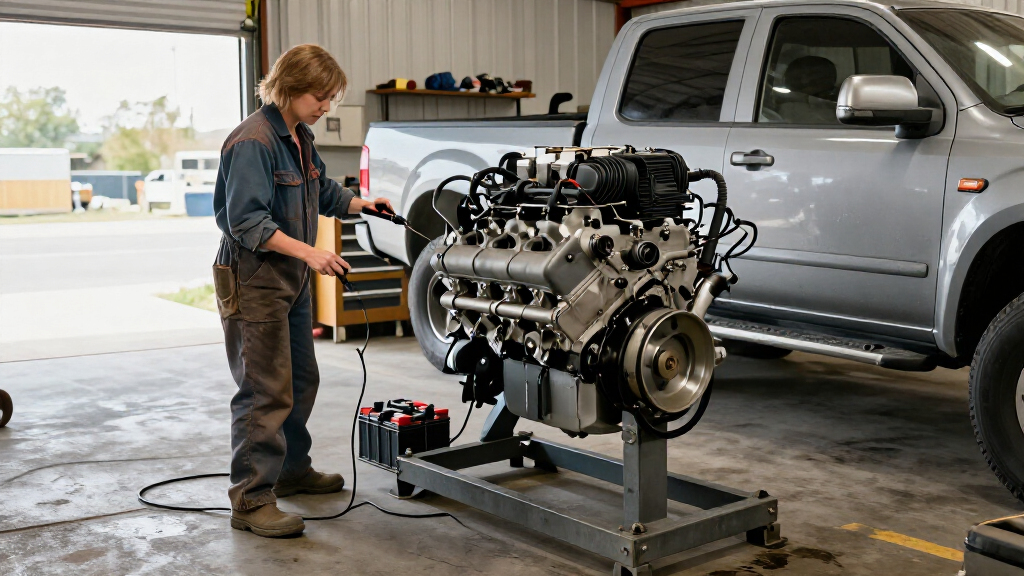
YouTuber Mr Hewes got a 102.4-liter Mirrlees Blackstone JS8 diesel engine running after its compressed-air starting system proved inadequate. The reported workaround was to wrap a ratchet strap around the flywheel and pull it with a Ford F-150. The engine was delivered to the U.K. Air Ministry in 1953 and had not run for years.
Engine-restoration YouTuber Mr Hewes has started a 102.4-liter Mirrlees Blackstone JS8 diesel using a ratchet strap pulled by a Ford F-150, after the engine’s usual compressed-air starting system failed to turn it over. The restart brings a long-idle piece of equipment, delivered to the U.K. Air Ministry in 1953, back to life, according to The Drive’s account of Hewes’ video.
The JS8 is a straight-eight turbodiesel with 102.4 liters of displacement. The Drive reports that the engine had accumulated 720 operating hours, although it had not run for a long time before the restoration attempt. Its Air Ministry delivery and size led Hewes to surmise that it had been used in a generator set at a Royal Air Force base; the report does not confirm the engine’s specific service history.
Before attempting a start, Hewes encountered problems familiar from engines left unused: stuck valves and injectors, along with a nonfunctioning oiling system. Water had filled the oil passageways and had to be pumped and vacuumed out by hand, The Drive reported. The engine could be turned freely after work, but turning it was not the same as getting it to start.
The engine was designed to start using compressed air, but the available supply was not enough. A forklift-driven attempt to rotate the flywheel also failed. Hewes then secured a ratchet strap around the flywheel and pulled it with an F-150 pickup. The video shows the engine starting and producing smoke; the report does not give further measurements or testing results.
A Scale Test for Engine Restoration
The restart is striking because of the difference in scale between the equipment and the improvised starting method, but it also illustrates the practical demands of restoring a large, long-idle diesel. A working engine of this size requires more than a powerful pull: Hewes first had to address contaminated oil passages and stuck components before trying to start it.
The story also offers a glimpse of machinery built for stationary power generation, rather than road use. The engine’s history remains partly unverified, but its possible role as a backup generator at an RAF base points to the large engines once used to supply power to facilities. The video documents a restart, not a return to regular service, so it does not establish the engine’s present reliability or output.
As an affiliate, we earn on qualifying purchases.
From Air Ministry Delivery to Restart
The Mirrlees Blackstone JS8 was delivered to the U.K. Air Ministry in 1953, according to The Drive. Hewes works on vintage agricultural and military equipment and has also worked with YouTuber Scott Nothing To Do With You on a Rolls-Royce Meteor engine from a Centurion tank. The Meteor’s 27-liter displacement is much smaller than the JS8’s 102.4 liters.
Generator sets combine an engine with a generator and related equipment, and are used to provide stationary power, including backup electricity for large buildings. The Drive notes that the JS8’s size and delivery history prompted Hewes’ theory about RAF use, but no record identifying its original site or exact job is given in the supplied report. The full restart video is nearly an hour long, according to The Drive.
“These engines are supposed to be started with compressed air.”
— The Drive, describing the engine’s starting setup
The Engine’s Service History
The available report does not establish where the engine operated or whether it powered a generator at a Royal Air Force base. That is Hewes’ inference from its size and Air Ministry ownership, not a confirmed service record. The source also does not state when the restart took place or how long the engine had been out of operation.
Starting the engine does not show that it can run reliably under load. No follow-up details are provided about its condition after the restart, generator equipment, repairs still needed, or whether it has since been operated again. The report describes smoke during the start but gives no emissions readings or technical assessment of the engine’s performance.
Further Tests After the Start
The next useful update would be whether Hewes can run the engine for an extended period and test it under load, as well as whether the oiling system and other repaired parts continue to work. The supplied report does not announce a test schedule or further restoration plans.
For now, the confirmed development is limited to the engine being brought to life after attempts with compressed air and a forklift failed. Any account of its future use, full mechanical condition, or original RAF role will depend on additional video details or documentary evidence.
Key Questions
What engine was started?
It was a 102.4-liter Mirrlees Blackstone JS8, an eight-cylinder turbodiesel delivered to the U.K. Air Ministry in 1953, according to The Drive.
How did the F-150 help start it?
Hewes wrapped a ratchet strap around the flywheel and pulled it with a Ford F-150 to turn the engine. The report says the usual compressed-air supply and a forklift attempt had not worked.
Was the engine confirmed to have powered an RAF generator?
No. Hewes surmised it may have been part of a generator set at a Royal Air Force base, based on its size and Air Ministry ownership. The supplied report does not confirm that history.
Does the restart mean the engine is ready for service?
That is not established. The report describes the engine starting, but gives no results from extended running, load tests, or a full assessment of its condition.
Source: rss
Halloween Picks
halloween
As an affiliate, we earn on qualifying purchases.