TL;DR

Get business pricing on garage and car supplies
- Business-only prices and quantity discounts
- Tax-exempt purchasing
- Multiple users, one account, clear invoices
JEHC and Valew have developed a prototype trailer for carrying trophy trucks, with a chassis designed for rough Baja roads and wheel-end components compatible with mid-2000s Chevy and GMC 3500 trucks. The companies have not announced a price or confirmed when the trailer will go into production.
JEHC and truck-body manufacturer Valew have developed a prototype trailer for trophy trucks built to carry race vehicles over rough Baja terrain, with wheel-end parts designed to accept mid-2000s Chevy and GMC 3500 front bearings and brakes. The approach is intended to make repairs easier in remote areas where compatible donor trucks may be easier to find than specialized trailer parts, according to The Drive’s report on the design.
The trailer is about 24 feet long and 96 inches wide, and was designed around race vehicles with wheelbases from 120 to 128 inches. JEHC founder Jason Heard said the deck’s support structure places a rib beneath the center of the vehicle, so tire contact patches rest over the trailer’s primary frame structure rather than unsupported sheet metal. The layout is intended to fit vehicles including Class 6100 and Class 1 race trucks.
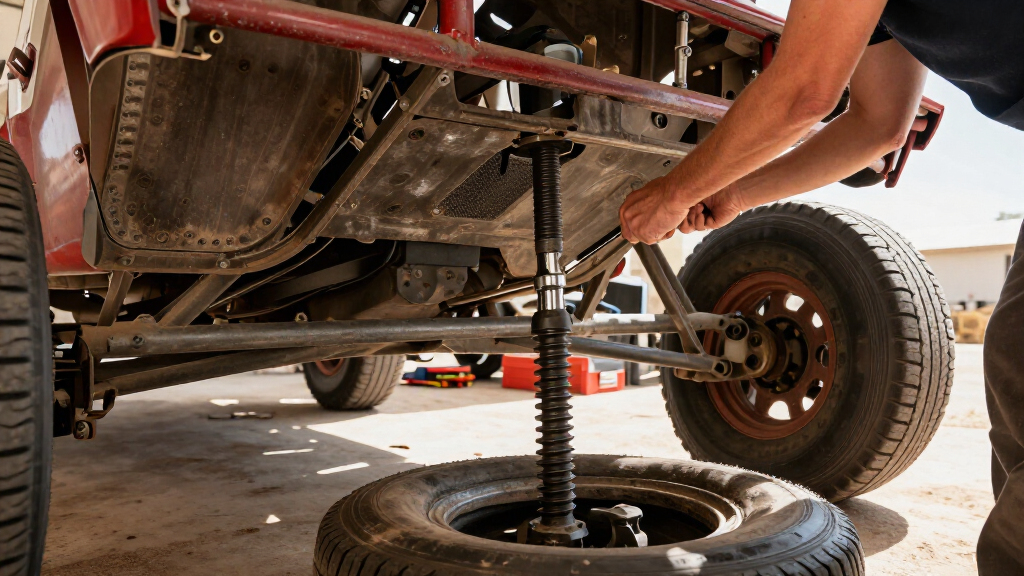
The chassis uses two 2-by-6-inch main frame rails with 3/16-inch walls, alongside supports made in thinner sections where possible, The Drive reported. The trailer has two 8,000-pound axles; Heard said a tri-axle version is under consideration. Its suspension uses a Timbren assembly instead of leaf springs or torsion bars. The prototype does not currently have shocks, and Heard said the setup has handled rough Baja roads well.
Storage is built into the design: three aluminum boxes sit on each side, and the front box contains the electric-over-hydraulic brake assembly. The space between the frame rails can hold up to five 42-inch tires, with capacity for more if a race vehicle can clear them. The aluminum boxes reportedly save 800 pounds compared with the first iteration. The Drive said the trailer’s overall weight has not been confirmed.
Repairs Built Around Baja Availability
Remote race routes can turn a damaged wheel bearing or brake component into a long delay if the replacement part is uncommon locally. By designing the trailer’s axle ends to accept components used on mid-2000s Chevy and GMC 3500 trucks, JEHC is aiming to make some repairs possible with parts that may be available in places such as Ensenada, Heard said. The design does not mean every breakdown can be fixed with pickup-truck parts, but it targets a specific source of downtime: hard-to-source trailer wheel-end hardware.
The structural choices also matter for teams transporting valuable race vehicles over rough roads. The trailer’s frame and tire-support layout are intended to carry the vehicle’s load through the main structure, while its storage areas keep tires and equipment with the transporter. Whether those features translate into a commercially viable product will depend on factors not yet disclosed, including price, final specifications and production plans.
Chevy GMC 3500 truck wheel bearings
As an affiliate, we earn on qualifying purchases.
As an affiliate, we earn on qualifying purchases.
From Race-Car Design to Transport
JEHC is primarily known for designing race cars, but Heard wanted to build a trailer suited to his own requirements, The Drive reported. The company partnered with Valew, a truck-body manufacturer, which brings experience manufacturing vehicle bodies and could potentially build the design at scale. The report describes the trailer as a prototype rather than a product with confirmed customer deliveries.
The layout is deliberately narrow for its purpose, with a deck intended to fit a race vehicle while limiting excess width. Ramps are stored at the rear, although the trailer sits low enough that trophy trucks may be able to drive onto it without using them. Its 96-inch width is close to the stated 96.75-inch width of a new Chevy Silverado 3500 dually; that comparison describes width only and does not establish what vehicle is suitable to tow it.
“At no point in time, if you have a race car on this trailer, is the contact patch of the tire ever floating between sheet metal.”
— Jason Heard, JEHC, as quoted by The Drive
Price, Weight and Production Status
The report does not give a confirmed price, overall trailer weight or production date. It also does not establish whether Valew will manufacture the trailer for sale, how many units might be built, or what final specifications could change before production. Heard said a tri-axle configuration is being considered, but the report does not say whether it will be offered.
The claimed repair advantage is specific to components designed to match the stated Chevy and GMC 3500 applications. The report does not provide a complete parts list, explain the availability of every compatible component along Baja routes, or establish that other trailer systems can be repaired using truck parts. Performance observations about rough-road handling come from Heard; independent testing results are not included.
Production Details Still Pending
The next practical milestones would be confirmation of whether the prototype enters production, along with its price, weight and final axle options. Potential buyers would also need towing and load specifications, parts compatibility details, and information on service support. None of those details is included in the report.
Until JEHC or Valew releases those figures, the design is best understood as a specialized prototype aimed at race teams working in remote terrain—not as a trailer with confirmed availability or a published purchase price.
Key Questions
Who designed the Baja-focused race trailer?
JEHC and Valew developed the trailer together. JEHC founder Jason Heard wanted to create a hauler for race vehicles, and Valew partnered on the build, according to The Drive.
What does “fixed with Chevy” mean in this report?
The trailer’s axle housing ends are designed to accept mid-2000s Chevy and GMC 3500 front unit bearings and brake assemblies. That could make those particular repairs easier where compatible truck parts are available; it does not mean every trailer repair can use Chevy parts.
How large is the trailer?
The reported dimensions are about 24 feet long and 96 inches wide. Its deck is designed for race vehicles with wheelbases between 120 and 128 inches.
Is the trailer on sale, and how much does it cost?
The report describes a prototype. No price, production schedule or confirmed sales plan has been announced in the source material.
What suspension and axles does the prototype use?
It uses a Timbren suspension assembly and two 8,000-pound axles. The prototype does not have shocks, and Heard said a tri-axle version is being considered.
Source: rss
Halloween Picks
halloween
As an affiliate, we earn on qualifying purchases.