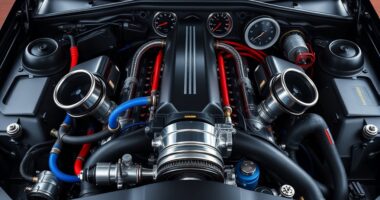
When you remove unnecessary modifications, your car can perform better because it reduces drag, turbulence, and airflow disruptions. Overly complex parts like big turbos, body kits, or extra cooling components can hinder airflow and cause overheating, which slows you down. Simplifying your setup restores aerodynamic balance and improves cooling efficiency, making your car faster and more reliable. If you keep exploring, you’ll discover how proper tuning and smart choices can release your vehicle’s true potential.

Get business pricing on garage and car supplies
- Business-only prices and quantity discounts
- Tax-exempt purchasing
- Multiple users, one account, clear invoices
Key Takeaways
- Excess modifications can cause airflow disruptions, leading to overheating and reduced engine performance.
- Overly complex aerodynamics increase drag, slowing the car despite aftermarket upgrades.
- Additional cooling components may hinder heat dissipation, causing thermal throttling.
- Removing unnecessary parts streamlines airflow, improving responsiveness and high-speed stability.
- Proper tuning and simplification help vehicles reach their true performance potential.

Sometimes, adding more modifications to your car doesn’t necessarily make it faster—in fact, removing certain upgrades can actually improve its performance. When you pile on parts like big turbos, aggressive exhausts, or flashy body kits, you might think you’re boosting speed. But often, these modifications can introduce new problems, especially if they aren’t properly balanced or tuned. For example, too many aftermarket parts can hinder your car’s engine cooling or disrupt its aerodynamic efficiency, both of which are essential for high-speed performance.
Engine cooling is a prime area where excess modifications can backfire. Overloading your car with parts like oversized intercoolers or additional radiators might seem beneficial, but if they aren’t properly integrated, they can cause airflow disruptions. Poor airflow can lead to overheating or reduced efficiency in heat dissipation, which in turn throttles your car’s engine’s power output. Sometimes, removing unnecessary cooling components or simplifying the cooling system helps maintain ideal engine temperatures. When your engine runs cooler and more efficiently, you sustain power longer and avoid performance dips caused by heat soak or thermal throttling. Recognizing the importance of proper airflow management is crucial for maintaining peak performance.
Aerodynamic efficiency is another vital factor that’s often overlooked when you add too many modifications. Many drivers focus on making their cars look aggressive with spoilers, splitters, and body kits, but these changes can sometimes create more drag than they reduce. If a modification disrupts the natural airflow around your car, it can slow you down instead of helping. Removing overly complex or poorly designed aerodynamic parts can restore a smoother airflow, reducing drag and increasing speed. Sometimes, the best way to improve your car’s performance is to strip away unnecessary parts that cause turbulence, allowing the car to cut through the air more efficiently. Additionally, understanding aerodynamic principles can help you make smarter modifications that enhance, rather than hinder, your vehicle’s speed. Paying attention to aerodynamic balance can further optimize your car’s performance. Moreover, simplifying aerodynamic setups can also help improve vehicle stability at high speeds.
Ultimately, the key isn’t just piling on upgrades but understanding how they interact with each other. When you back off some modifications—especially those that hinder engine cooling or aerodynamics—you often find your car becomes more responsive and faster on the track or street. Simplifying your setup and focusing on balance can lead to better overall performance. Sometimes, less truly is more, and that means recognizing when removing certain upgrades actually emancipates your car’s true potential. Less clutter, better airflow, and optimized cooling can turn a heavily modified car into a faster, more reliable machine. Recognizing the importance of proper tuning can make all the difference in harnessing your vehicle’s full capabilities.
automotive wind tunnel testing model kit
As an affiliate, we earn on qualifying purchases.
As an affiliate, we earn on qualifying purchases.
Frequently Asked Questions
How Does Reducing Modifications Improve a Car’s Speed?
Reducing modifications can improve your car’s speed because removing unnecessary aesthetic enhancements and safety features lightens the vehicle, making it more aerodynamic. Excess modifications may add weight or create drag, slowing you down. By simplifying your car, you guarantee that only essential parts are optimized for performance, allowing it to accelerate faster and handle better, ultimately boosting overall speed and efficiency.
Can Backing off Mods Damage a Vehicle’s Performance?
Backing off mods generally won’t damage your vehicle if done carefully, but it can hurt performance if you ignore engine efficiency and aerodynamics impact. Think of your car like a runner: removing unnecessary gear can help improve speed, but stripping essential support may slow you down. If you remove a vital intake or exhaust modification, you could hinder airflow, decreasing engine performance and making your car less responsive.
What Specific Mods Typically Hinder a Car’s Speed?
Certain mods like suspension upgrades and aesthetic enhancements can actually hinder your car’s speed. Suspension mods that raise your ride height or add weight can reduce aerodynamics and handling, slowing you down. Aesthetic enhancements, such as oversized wheels or heavy body kits, add unnecessary weight and drag. These modifications often prioritize looks over performance, so if you want maximum speed, it’s best to stick with upgrades that improve power and aerodynamics instead.
Is There a Point Where Removing Mods No Longer Helps?
You reach a point where removing mods no longer helps because your car’s performance hits a ceiling. Engine tuning and aerodynamics adjustments have their limits; once optimized, further modifications can cause more harm than good. It’s like trying to squeeze water from a stone. When gains plateau, it’s best to focus on fine-tuning rather than adding more mods, ensuring your car runs smoothly without unnecessary weight or complexity.
Do Stock Cars Always Perform Better Than Modified Ones?
Stock cars don’t always perform better than modified ones. While stock cars often have better engine reliability and fuel efficiency, modifications can enhance power and handling if done correctly. However, aggressive mods might reduce reliability or fuel economy. Your driving style and goals matter—if you prioritize long-term dependability and efficiency, stock might be best. But for speed and performance, well-chosen modifications can give you an edge without compromising too much.
Conclusion
So, next time you back off the mod list, remember—you’re not losing speed, you’re uncovering hidden potential. Sometimes less really is more, and easing off can unlock a car’s true power. It’s like peeling back layers to reveal a sharper edge, a secret waiting to be discovered. In this dance of performance, less interference often leads to more speed. Embrace the simplicity; let your car breathe and soar beyond what you thought possible.
Halloween Picks
halloween
As an affiliate, we earn on qualifying purchases.