
The best truck bed air compressor for most buyers is the VIAIR 400P Automatic: it balances portable 12V operation with automatic shutoff for tire inflation. The VIAIR Constant Duty kit with a 2.5-gallon tank is a stronger fit for a permanent onboard system, while the Kohree 12V Off-Road kit stands out for buyers who prioritize high stated airflow. The main tradeoff is between portability and sustained capacity: compact inflators are easier to store, while larger or tank-based systems suit repeated, demanding use but need more space and setup. Power source, duty cycle, hose reach, and your truck’s electrical limits matter as much as peak PSI. Read on for the full comparison and guidance on matching a compressor to your truck and workload.

Get business pricing on garage and car supplies
- Business-only prices and quantity discounts
- Tax-exempt purchasing
- Multiple users, one account, clear invoices
Complete the kit


Key Takeaways
Portable automatic inflation is the most balanced use case: the VIAIR 400P Automatic suits buyers who want a truck-ready 12V unit without committing to a permanent tank installation.
A tank changes the job, not just the storage: the VIAIR Constant Duty kit with a 2.5-gallon tank is the lineup’s clear onboard-air option, but it asks for more installation space and planning than portable kits.
High airflow claims need context: the Kohree’s stated 12.35 CFM makes it a standout on paper, but buyers should compare airflow conditions, duty cycle, and power requirements before treating that figure as a direct speed comparison.
Cordless convenience comes with a different operating envelope: the Calmara Y402 avoids a truck battery connection, while 12V clamp-powered units are generally the more natural fit for repeated truck-tire and off-road use.
The smallest option is not automatically the best truck option: the VIAIR 88P favors compact storage, while twin-cylinder choices such as the BUNKER INDUST and ALL-TOP trade extra bulk for a more heavy-duty setup.
| WOLFBOX HyperFlow60D 12V Portable Air Compressor, 150 PSI |  | Best for Extended Inflation Sessions | Power: 12 V DC; 1080 W | Maximum pressure: 150 PSI | Airflow: Up to 5.1 CFM at 40 PSI | VIEW LATEST PRICE | See Our Full Breakdown |
| Calmara Y402 Cordless Dual-Cylinder Tire Inflator |  | Best Dual-Power Portable Pick | Power sources: 20,000mAh rechargeable battery or 12V DC vehicle outlet | Maximum pressure: 160 PSI | Airflow: 40 L/min | VIEW LATEST PRICE | See Our Full Breakdown |
| VIAIR 400P-RV Automatic 12V Air Compressor, 150 PSI |  | Best for Dual-Rear-Wheel Access | Power: 12 V; maximum current 30 A; maximum power 414 W | Maximum pressure: 150 PSI | Free-flow rate: 2.30 CFM | VIEW LATEST PRICE | See Our Full Breakdown |
| VIAIR 400P Automatic Portable Air Compressor, 12V |  | Best Straightforward Vehicle-Powered Pick | Power source: 12V vehicle battery | Maximum working pressure: 150 PSI | Free-flow capacity: 2.30 CFM | VIEW LATEST PRICE | See Our Full Breakdown |
| OlarHike Heavy-Duty Portable Tire Inflator |  | Best Compact Cordless Pick | Power source: Battery powered; cordless | Maximum pressure: 150 PSI | Airflow: 50 L/min | VIEW LATEST PRICE | See Our Full Breakdown |
| VIAIR 12V Constant Duty Onboard Air Compressor Kit with 2.5-Gallon Tank, 150 PSI |  | Best for a Permanent Truck Bed Air System | Model: 450C | Voltage: 12V DC | Tank capacity: 2.5 gallons | VIEW LATEST PRICE | See Our Full Breakdown |
| BUNKER INDUST 12V Twin-Motor Air Compressor with Pressure Gauge, 150 PSI |  | Best for Fast Tire Inflation | Model: BI-DUAL-AC-FRD | Voltage: 12V | Maximum pressure: 150 PSI | VIEW LATEST PRICE | See Our Full Breakdown |
| VIAIR 450P-RV Automatic 12V Air Compressor, 150 PSI |  | Best for Large RV and Truck Tires | Voltage: 12 volts | Maximum pressure: 150 PSI | Free-flow capacity: 1.80 CFM | VIEW LATEST PRICE | See Our Full Breakdown |
| Kohree 12V Off-Road Air Compressor Kit with Digital Display, 12.35 CFM |  | Best for Preset Pressure Control | Voltage: 12 V | Airflow capacity: 350 L/min (12.35 CFM) | Maximum pressure: 150 PSI | VIEW LATEST PRICE | See Our Full Breakdown |
| VIAIR 88P 12V Portable Air Compressor Kit |  | Best Compact Truck-Bed Compressor | Voltage: 12V DC | Maximum working pressure: 120 PSI | Free-flow rate: 1.47 CFM | VIEW LATEST PRICE | See Our Full Breakdown |
| ALL-TOP 12V Dual-Cylinder Portable Air Compressor Kit, 150 PSI |  | Best for Long-Hose Reach | Voltage: 12 volts | Maximum pressure: 150 PSI | Air flow capacity: 350 liters per minute | VIEW LATEST PRICE | See Our Full Breakdown |
| truck bed air compressor | Maximum pressure | Hose length | Duty cycle | Voltage |
|---|---|---|---|---|
| WOLFBOX HyperFlow60D 12V Porta | 150 PSI | — | — | — |
| Calmara Y402 Cordless Dual-Cyl | 160 PSI | 19.68 inches | — | — |
| VIAIR 400P-RV Automatic 12V Ai | 150 PSI | — | 33% at 100 PSI | — |
| VIAIR 400P Automatic Portable | — | — | 33% at 100 PSI | — |
| OlarHike Heavy-Duty Portable T | 150 PSI | 31.5 inches | — | — |
| VIAIR 12V Constant Duty Onboar | — | 35 ft | 100% at 100 PSI | 12V DC |
| BUNKER INDUST 12V Twin-Motor A | 150 PSI | 25 feet | 100% | 12V |
| VIAIR 450P-RV Automatic 12V Ai | 150 PSI | — | 100% at 100 PSI | 12 volts |
| Kohree 12V Off-Road Air Compre | 150 PSI | 26.24 ft | — | 12 V |
| VIAIR 88P 12V Portable Air Com | — | — | 25 minutes at 30 PSI | 12V DC |
| ALL-TOP 12V Dual-Cylinder Port | 150 PSI | 26 feet | — | 12 volts |
More Details on Our Top Picks
WOLFBOX HyperFlow60D 12V Portable Air Compressor, 150 PSI
The WOLFBOX HyperFlow60D is the strongest fit here when several tires need attention in one stop. Its dual 60 mm cylinders and stated airflow of up to 5.1 CFM at 40 PSI favor faster inflation, while the rated 60-minute runtime at 77°F reduces interruptions compared with the VIAIR 400P Automatic, whose 33% duty cycle at 100 PSI calls for more frequent breaks. A 25.4-foot hose also makes it easier to reach tires around a truck without moving the compressor as often. The tradeoff is a heavier, louder unit: at 18.1 pounds and a stated 95 dB, it is less appealing for buyers prioritizing easy storage or a quieter roadside setup. Its digital preset and automatic shut-off simplify pressure checks, though the system pauses briefly to read pressure during inflation.
Pros:- Rated for up to 60 minutes of continuous operation at 77°F.
- Dual cylinders and stated airflow up to 5.1 CFM at 40 PSI support faster inflation.
- Long 25.4-foot hose offers useful reach around a truck.
- Digital preset pressure and automatic shut-off help limit guesswork.
Cons:- At 18.1 pounds, it is less convenient to carry than the 4.3-pound Calmara Y402.
- Stated 95 dB noise level may be intrusive at a campsite or roadside.
- Pressure-check pauses of 1–2 seconds can interrupt the inflation rhythm.
Best for: Truck owners who routinely inflate multiple tires or larger tires and want a long hose and extended stated runtime.
Not ideal for: Drivers seeking a lightweight, quiet compressor for occasional top-offs; this model weighs 18.1 pounds and is rated at 95 dB.
- Power:12 V DC; 1080 W
- Maximum pressure:150 PSI
- Airflow:Up to 5.1 CFM at 40 PSI
- Runtime:Up to 60 minutes at 77°F (25°C)
- Cylinder design:Dual 60 mm cylinders
- Hose and cord:25.4 ft hose; 7 ft power cord
- Weight and dimensions:18.1 lb; 13.94 × 5.43 × 9.84 in
- Connector and features:1/4-inch NPT quick connector; digital display, automatic shut-off, dual cooling fans
Our verdict“Choose the WOLFBOX if extended tire work and hose reach matter more to you than low weight and quieter operation.”
Calmara Y402 Cordless Dual-Cylinder Tire Inflator
The Calmara Y402 is the flexible choice for a truck bed because it can run from its 20,000mAh battery or a 12V vehicle outlet. That gives it an advantage over the battery-dependent OlarHike Heavy-Duty Portable Tire Inflator when a charge runs low, while its 4.3-pound weight is easier to manage than the 18.1-pound WOLFBOX. The digital gauge, preset shut-off, and LED light with a red strobe suit roadside top-offs after dark, and the dual-cylinder design also supports inflating or deflating some low-pressure items. Its stated 40 L/min airflow and short 19.68-inch hose point to convenience rather than truck-scale speed or reach. The low-pressure port is not intended for stand-up paddleboards, and the 90 dB rating means this compact option is not quiet.
Pros:- Runs on either a rechargeable battery or a 12V vehicle outlet.
- At 4.3 pounds, it is far easier to carry than the WOLFBOX HyperFlow60D.
- Digital pressure display and automatic shut-off support preset inflation.
- Built-in LED light includes a red strobe for roadside visibility.
Cons:- The 19.68-inch hose offers much less reach than the WOLFBOX’s 25.4-foot hose.
- Stated airflow of 40 L/min is a more modest fit for repeated large-tire inflation.
- The low-pressure port is not intended for stand-up paddleboards.
Best for: Truck drivers who want a carryable inflator for routine tire top-offs, with battery operation for situations where a 12V outlet is inconvenient.
Not ideal for: Owners who need a long hose for reaching all four tires from one setup point, or who want a compressor intended for stand-up paddleboards.
- Power sources:20,000mAh rechargeable battery or 12V DC vehicle outlet
- Maximum pressure:160 PSI
- Airflow:40 L/min
- Pressure accuracy:±1 PSI
- Hose length:19.68 inches
- Weight and dimensions:4.3 lb; 6.25 × 6.85 × 8.11 in
- Charging:65W USB-C fast charging; 3-hour charge time
- Features:Dual cylinders, LCD gauge, automatic shut-off, LED light with red strobe
Our verdict“Pick the Calmara if you value a lightweight inflator with both battery and vehicle power more than long-hose reach.”
VIAIR 400P-RV Automatic 12V Air Compressor, 150 PSI
The VIAIR 400P-RV Automatic is the practical pick for truck owners who need to reach awkward valve stems, especially on dual-rear-wheel setups. Its extended-reach chuck and two 30-foot coiled hoses offer more access than the standard VIAIR 400P Automatic, which has a 25-foot hose. The kit also includes several inflation tips, a Presta adapter, and a carrying bag, making it more adaptable than the simpler OlarHike inflator for mixed vehicle and accessory use. With 2.30 CFM and support for tires up to 35 inches, it is aimed at substantial vehicle tires, not just quick passenger-car top-offs. The compromise is its 33% duty cycle at 100 PSI, which limits continuous work, plus the need for a running 12V vehicle battery.
Pros:- Extended-reach chuck helps access dual-rear-wheel valve stems.
- Two 30-foot coiled hoses provide generous working reach.
- Automatic pressure control cycles the compressor during inflation.
- Includes a broad set of chucks, tips, and a carrying bag.
Cons:- The 33% duty cycle at 100 PSI limits sustained use.
- Requires a 12V vehicle battery and a running vehicle.
- Its 2.30 CFM free-flow rate is lower than the WOLFBOX HyperFlow60D’s stated airflow at 40 PSI.
Best for: Owners of trucks, RVs, or trailers with tires up to 35 inches, particularly drivers who need extra reach to dual-rear-wheel valve stems.
Not ideal for: Anyone needing cordless operation or long continuous inflation sessions; it requires a running vehicle and has a 33% duty cycle at 100 PSI.
- Power:12 V; maximum current 30 A; maximum power 414 W
- Maximum pressure:150 PSI
- Free-flow rate:2.30 CFM
- Duty cycle:33% at 100 PSI
- Maximum tire size:35 inches
- Hoses:Two 30-foot coiled hoses
- Weight and dimensions:10.4 lb; 10.87 × 5.83 × 7.48 in
- Included accessories:Inflation gun, extended-reach and twist-on chucks, three tips, Presta adapter, carrying bag
Our verdict“Choose this VIAIR for large vehicle tires and hard-to-reach dual-wheel valves, provided its duty cycle and vehicle-powered operation fit your routine.”
VIAIR 400P Automatic Portable Air Compressor, 12V
The VIAIR 400P Automatic suits truck owners who want a familiar battery-powered setup without the RV-specific extended-reach kit of the 400P-RV Automatic. It still handles tires up to 35 inches and includes an automatic shut-off system, a 25-foot hose, and inflation adapters, so it covers routine truck and outdoor needs with less emphasis on dual-wheel access. Its stated 74 dB noise level is lower than the WOLFBOX HyperFlow60D’s 95 dB rating, which may make roadside use less harsh. The tradeoff is shared with the RV version: a 33% duty cycle at 100 PSI limits continuous operation, and it needs a direct vehicle-battery connection. This is a straightforward fit for owners who prefer a vehicle-powered compressor over the battery-powered Calmara Y402.
Pros:- Designed for tires up to 35 inches with a 150 PSI maximum working pressure.
- Automatic pressure control and shut-off simplify inflation.
- 25-foot hose and included adapters support a range of vehicle and accessory uses.
- Stated 74 dB noise level is lower than the WOLFBOX HyperFlow60D’s stated 95 dB.
Cons:- Requires a vehicle-battery connection and a running vehicle.
- 33% duty cycle at 100 PSI limits continuous operation.
- Does not include the two 30-foot coiled hoses and extended-reach chuck supplied with the 400P-RV.
Best for: Truck and off-road vehicle owners who need a 35-inch-tire-capable compressor with a long hose and useful adapters, and who are comfortable connecting to a vehicle battery.
Not ideal for: Drivers who want cordless convenience, extended dual-rear-wheel access, or sustained inflation without duty-cycle breaks.
- Power source:12V vehicle battery
- Maximum working pressure:150 PSI
- Free-flow capacity:2.30 CFM
- Duty cycle:33% at 100 PSI
- Maximum amp draw:26 A
- Hose and power cord:25 ft hose; 8 ft power cord
- Weight and maximum dimension:10.7 lb; 10.87 in
- Included features:Inline 100 PSI gauge, inflation tips, Presta adapter, sand tray, thermal overload protector, carrying bag
Our verdict“Choose the standard VIAIR 400P if you want a capable, vehicle-powered compressor for truck tires but do not need the RV model’s extra valve-stem reach.”
OlarHike Heavy-Duty Portable Tire Inflator
The OlarHike Heavy-Duty Portable Tire Inflator is the storage-friendly choice for drivers who want a small, self-contained option in the truck bed. At 3.2 pounds and 7.3 × 3.8 × 2.5 inches, it is easier to stash than either VIAIR 400P model, both of which need a vehicle-battery connection. Its stated 50 L/min airflow and 150 PSI maximum make it useful for routine tire inflation, while the metal construction offers a sturdier enclosure than the Calmara Y402’s listed plastic-free description does not establish either way. Still, the OlarHike’s short 31.5-inch hose limits where it can sit relative to a tire, and the product data gives no battery capacity or runtime. That makes it less reassuring for repeated truck-tire work than the WOLFBOX, which lists a 60-minute runtime.
Pros:- Compact 7.3 × 3.8 × 2.5-inch form is easy to store.
- At 3.2 pounds, it is the lightest option in this group.
- Cordless, battery-powered operation avoids a direct vehicle-battery connection.
- Stated airflow is 50 L/min, with a 150 PSI maximum.
Cons:- The 31.5-inch hose may require placing the unit close to each tire.
- Battery capacity and operating runtime are not specified in the supplied product data.
- Lacks the long hoses and broad inflation accessory kits included with the VIAIR models.
Best for: Drivers who want a compact, cordless inflator for occasional tire top-offs and have limited truck-bed storage space.
Not ideal for: Owners who need a long hose, confirmed runtime for inflating several truck tires, or the extended reach and accessory set of the VIAIR compressors.
- Power source:Battery powered; cordless
- Maximum pressure:150 PSI
- Airflow:50 L/min
- Maximum power and current:190 W; 13 A
- Hose length:31.5 inches
- Weight and dimensions:3.2 lb; 7.3 × 3.8 × 2.5 in
- Material:Metal
- Noise level:78 dB
Our verdict“Pick the OlarHike for compact cordless storage and occasional top-offs, but choose a VIAIR or WOLFBOX for more demanding truck-tire sessions.”
VIAIR 12V Constant Duty Onboard Air Compressor Kit with 2.5-Gallon Tank, 150 PSI
The VIAIR 450C is the strongest fit here for buyers who want onboard air that stays with the truck, rather than a compressor to unpack at each stop. Its 2.5-gallon tank supplies stored air for tire inflation, air suspension, and pneumatic accessories, while the 100% duty cycle at 100 PSI suits repeated or extended use. The included 35-foot coil hose and dash-mounted gauge and switch make the setup more integrated than the portable VIAIR 450P-RV. That permanence comes with a real cost in flexibility: at 26.5 × 14.5 × 10 inches, the kit needs mounting space and installation, and it draws power from the vehicle battery with the engine running. I’d choose this over the 450P-RV for a dedicated truck build, but skip it if portability or a simple plug-in setup matters more.
Pros:- 2.5-gallon tank supplies stored air for multiple truck-bed tasks
- 100% duty cycle at 100 PSI supports extended use
- IP67 dust and water protection suits off-road mounting
- Includes a 35-foot hose, dash panel gauge and switch, and installation components
Cons:- Requires vehicle-battery wiring and engine operation
- Tank and compressor need substantial mounting space
- Fixed installation is less convenient to transfer or store than the portable VIAIR 450P-RV
Best for: Truck owners building a permanent onboard system for recurring tire, air-suspension, or pneumatic-accessory use
Not ideal for: Drivers who need a compressor they can easily move between vehicles or lack room and time for a tank-and-compressor installation
- Model:450C
- Voltage:12V DC
- Tank capacity:2.5 gallons
- Maximum working pressure:150 PSI
- Duty cycle:100% at 100 PSI
- Air flow:1.8 CFM
- Maximum current:23 A
- Hose length:35 ft
- Protection:IP67 dust and water protection; thermal overload protection
Our verdict“Choose the VIAIR 450C if you want a permanently mounted truck-bed air system with a tank; skip it if you need a portable inflator.”
BUNKER INDUST 12V Twin-Motor Air Compressor with Pressure Gauge, 150 PSI
For drivers who want to get large tires aired up quickly, the BUNKER INDUST’s twin motors and dual aluminum cylinders are its main advantage. The stated performance—filling a 33-inch tire from 0 to 30 PSI in under 2.5 minutes—makes it a more speed-focused portable choice than the compact VIAIR 88P, whose 25-minute duty limit suits shorter inflation sessions. Its 100% duty cycle also supports longer jobs without the same stated work-and-rest constraint. A 25-foot hose helps reach all four tires without relocating the unit, and the safety protections add reassurance during heavy use. The tradeoff is portability: at 29 pounds, it is a bulky item to lift in and out of a truck bed, and it still needs a 12V power source. I’d favor it for frequent off-road airing tasks, not occasional lightweight carry.
Pros:- Twin motors and dual cylinders are designed for rapid inflation
- Rated to inflate a 33-inch tire from 0 to 30 PSI in under 2.5 minutes
- 100% duty cycle supports extended inflation jobs
- 25-foot hose can reach all four tires without moving the compressor
Cons:- At 29 pounds, it is cumbersome to carry between storage and the truck
- Requires access to a 12V power source
- Larger and heavier than the VIAIR 88P for drivers who only need occasional tire top-offs
Best for: Off-road truck owners who regularly air up large tires and value speed and sustained operation over low carry weight
Not ideal for: Drivers seeking a compact emergency inflator or a compressor that does not depend on a 12V power source
- Model:BI-DUAL-AC-FRD
- Voltage:12V
- Maximum pressure:150 PSI
- Duty cycle:100%
- Inflation performance:33-inch tire from 0 to 30 PSI in under 2.5 minutes
- Hose length:25 feet
- Weight:29 pounds
- Cylinder material:Aluminum
- Safety features:Thermal protection, overcurrent safeguards, and dual fuses
Our verdict“Pick the BUNKER INDUST for fast, repeated large-tire inflation when its 29-pound weight is acceptable.”
VIAIR 450P-RV Automatic 12V Air Compressor, 150 PSI
The VIAIR 450P-RV makes the most sense for truck owners who also handle large RV or trailer tires and want portable equipment rather than a permanent tank system. It supports tires up to 42 inches and has an automatic pressure sensor that cycles the compressor while the inflation gun is engaged, reducing the need to manage compressor operation manually. That makes it a more specialized large-tire option than the VIAIR 88P, which is lighter and intended for tires up to 33 inches. The 450P-RV weighs 13.1 pounds and includes a carry bag, but it is still less convenient to carry than the 88P. It also needs a 12V vehicle-battery connection with the engine running and may need a rest after up to an hour of operation. Choose it for larger tires and controlled inflation, not minimal bulk.
Pros:- Designed for vehicle tires up to 42 inches
- Automatic pressure sensor cycles the compressor while the inflation gun is engaged
- Close-ended inflation gun supports controlled airflow and pressure checks
- Carry bag makes storage and transport easier
Cons:- Requires a 12V vehicle-battery connection and the engine running
- Needs a rest after up to one hour of operation
- Heavier to carry than the VIAIR 88P
Best for: Truck and RV owners who need a portable compressor for tires up to 42 inches and want automatic cycling during inflation
Not ideal for: Drivers with smaller tires who prioritize a lighter, more compact compressor or need uninterrupted operation beyond its stated run period
- Voltage:12 volts
- Maximum pressure:150 PSI
- Free-flow capacity:1.80 CFM
- Duty cycle:100% at 100 PSI
- Maximum current:23 A
- Maximum power:318 watts
- Weight:13.1 pounds
- Compatible tire size:Up to 42 inches
- Included accessories:Close-ended inflation gun and deluxe carry bag
Our verdict“Choose the 450P-RV if you need portable support for very large RV or truck tires and can accept its weight and operating breaks.”
Kohree 12V Off-Road Air Compressor Kit with Digital Display, 12.35 CFM
The Kohree is the pick for drivers who want to set a target and let the compressor stop when it reaches that pressure. Its digital display and automatic shutoff make pressure setting more direct than on the BUNKER INDUST, which is geared toward fast inflation with a pressure-gauge inflator. The dual-cylinder design is rated at 12.35 CFM and 150 PSI, giving it substantial stated airflow for truck, RV, and 4×4 tires. That performance comes in a 24-pound package, so it is not a lightweight grab-and-go inflator; the VIAIR 88P is easier to carry but lacks the Kohree’s preset shutoff. The compressor may also pause briefly two to four times during inflation to check tire pressure, which can interrupt a continuous workflow. I’d choose it for controlled off-road airing, not for minimum weight or uninterrupted inflation.
Pros:- Digital LCD supports target-pressure setting and automatic shutoff
- Dual-cylinder design is rated for airflow up to 350 L/min
- 26-foot hose provides reach around a truck
- Metal shell and base, aluminum cylinders, and rubber feet support a stable setup
Cons:- Weighs 24 pounds, making it less convenient to carry than the VIAIR 88P
- May pause two to four times during inflation to check tire pressure
- Requires a 12V power connection
Best for: Off-road truck and 4×4 owners who want digital target-pressure settings and automatic shutoff while airing tires
Not ideal for: Drivers who need a lightweight compressor or expect uninterrupted inflation without brief pressure-check pauses
- Voltage:12 V
- Airflow capacity:350 L/min (12.35 CFM)
- Maximum pressure:150 PSI
- Hose length:26.24 ft
- Power cord length:6.5 ft
- Weight:24 lbs
- Display:Digital LCD
- Pressure units:kg/cm², bar, kPa, PSI
- Warranty:2 years
Our verdict“Pick the Kohree if preset pressure and automatic shutoff matter more to you than low weight or uninterrupted inflation.”
VIAIR 88P 12V Portable Air Compressor Kit
The VIAIR 88P is the lineup’s compact, lightweight choice for drivers who want an emergency compressor that can live in a truck bed without taking much room. At about 4.75 pounds and under 10 inches long, it is far easier to store or move than the 24-pound Kohree or 29-pound BUNKER INDUST. It is rated for tires up to 33 inches and includes a pressure gauge, LED work light, carry bag, and adapters for other inflation jobs. The tradeoff is a 25-minute duty cycle at 30 PSI, which makes it less suited to repeated airing of multiple large tires than the BUNKER INDUST’s 100% duty cycle. It also connects directly to the vehicle battery with alligator clamps. I’d pick the 88P for occasional truck-tire use and compact storage, not sustained off-road inflation sessions.
Pros:- Approximately 4.75 pounds and compact dimensions make it easy to store
- Rated for vehicle tires up to 33 inches
- Includes a pressure gauge and LED work light
- Carry bag, inflation tips, and Presta adapter support storage and varied inflation tasks
Cons:- Limited to a 25-minute duty cycle at 30 PSI
- Requires direct vehicle-battery connection with alligator clamps
- Less suited to repeated large-tire inflation than the BUNKER INDUST with its 100% duty cycle
Best for: Truck owners who need a compact emergency compressor for tires up to 33 inches and occasional inflation tasks
Not ideal for: Drivers who regularly air down and reinflate several large tires or want a compressor with a 100% duty cycle
- Voltage:12V DC
- Maximum working pressure:120 PSI
- Free-flow rate:1.47 CFM
- Duty cycle:25 minutes at 30 PSI
- Compatible tire size:Up to 33 inches
- Power source:Vehicle battery
- Air hose length:16 feet
- Weight:Approximately 4.75 pounds
- Included accessories:Carry bag, LED work light, pressure gauge, brass twist-on tire chuck, three inflation tips, and Presta valve adapter
Our verdict“Choose the VIAIR 88P for compact storage and occasional truck-tire inflation, but select a higher-duty model for repeated off-road use.”
ALL-TOP 12V Dual-Cylinder Portable Air Compressor Kit, 150 PSI
The 26-foot hose is the main reason I’d choose this ALL-TOP for a truck bed: it gives more room to reach tires around a parked truck than the included hose on many compact kits. Its dual aluminum cylinders and 350 L/min listed airflow make it a heavy-duty option for drivers who air up larger tires, while thermal cut-off and over-current protection add safeguards during use. Compared with the VIAIR 88P, this kit is substantially heavier at 24 pounds, but it supplies more hose reach and a dual-cylinder layout. The tradeoff is portability: the metal-bodied unit is less appealing to lift in and out for occasional use. I’d also follow the manufacturer’s caution about using a separate pressure-gauge inflator, since over-pressure protection is needed.
Pros:- 26-foot air hose offers useful reach around a truck.
- Dual aluminum cylinders are designed to dissipate heat.
- Thermal cut-off and over-current protection help guard the motor.
- Includes nozzle adapters, a pressure-gauge hose, and a storage bag.
Cons:- At 24 pounds, it is less convenient to carry than compact portable compressors.
- A separate pressure-gauge inflator requires over-pressure protection.
- The listed 350 L/min airflow does not by itself specify inflation time under load.
Best for: Truck and off-road owners who want a long hose to reach all four tires and can store a 24-pound compressor in the bed.
Not ideal for: Drivers who need a lightweight unit for frequent carrying, or buyers who want pressure control without managing a separate gauge inflator.
- Voltage:12 volts
- Maximum pressure:150 PSI
- Air flow capacity:350 liters per minute
- Maximum power:307 watts
- Weight:24 pounds
- Hose length:26 feet
- Cylinder design:Dual aluminum cylinders
- Noise level:74 dB
- Warranty:2 years
Our verdict“Choose this ALL-TOP if hose reach and a dual-cylinder design matter more than keeping your truck-bed compressor light.”
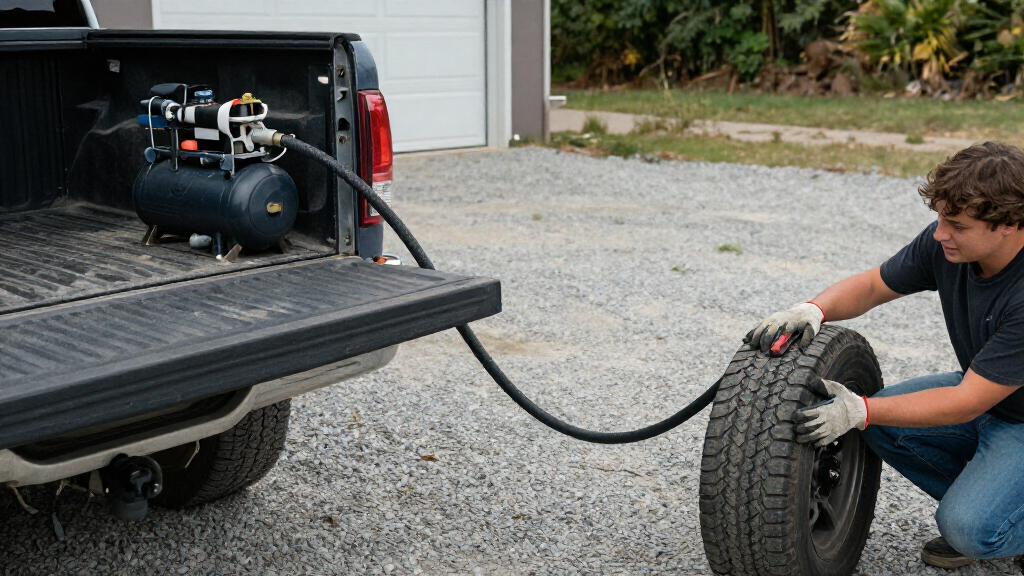
How We Picked
I ranked these compressors around the jobs truck owners are most likely to do from a bed or tailgate: topping up truck tires, airing down and back up on trails, handling repeated inflation, and supplying air for compatible accessories. I compared power source, stated pressure and airflow, automatic controls, included setup, portability, and whether a model is designed for temporary use or permanent installation. Build and maintenance needs also matter: a compressor that fits the job but is awkward to connect, store, or wire can be a poor match for a truck.
The order favors practical fit over a single headline specification. The VIAIR 400P Automatic leads as a balanced portable pick; the Constant Duty kit ranks for buyers who need installed air rather than quick storage; and the Kohree earns attention for its stated airflow, with the caveat that published CFM figures may use different test conditions. Cordless, compact, twin-cylinder, and RV-oriented models fill distinct roles below them. I weigh each product’s advantages against its setup demands and likely use, rather than treating maximum PSI as a complete measure of performance.
Factors to Consider When Choosing Best Truck Bed Air Compressors
Before choosing from this lineup, decide what your truck bed compressor needs to do on an ordinary day and on your most demanding one. The right match depends on the tires and accessories you plan to run, how often you need air, and whether you want a portable tool or a permanent system.
Match Airflow to the Work, Not Just the PSI
Maximum PSI tells you whether a compressor can reach a pressure; it does not tell you how quickly it will inflate a large truck tire. Airflow and duty cycle have more bearing on repeated fills, but published airflow can be measured under different conditions, so compare like with like when specifications are available. A small difference in a headline CFM number may matter less than whether the compressor can keep running long enough for your full set of tires. For occasional top-ups, portability and easy connections may be more useful than chasing the largest airflow claim. For frequent airing down and back up, look for clear duty-cycle guidance and a setup designed for sustained work. Avoid choosing on PSI alone, especially if the compressor will also run air tools or other accessories.
Choose Between Portable Power and an Installed System
A portable 12V compressor can be stored in the cab or bed and connected when needed, which keeps installation simple and lets you move it between vehicles. A constant-duty system with a tank is better suited to regular onboard access, but it takes mounting space, wiring, and time to install properly. Think through where the unit will live, how you will protect it from water and debris, and whether you can reach the battery safely. A permanently mounted system can be inconvenient if your truck configuration changes or the bed is often used for cargo. Portable models can also become a hassle if you repeatedly unpack them for the same task. Decide on the storage and installation plan before buying, not after the compressor arrives.
Check Electrical Draw and Connection Reach
Truck tire compressors can draw substantial current, so confirm the manufacturer’s connection instructions and your vehicle’s electrical limits before use. Some units connect at a 12V outlet, while heavier-duty models use battery clamps; these methods are not interchangeable. Do not assume a standard accessory socket can support every compressor simply because both are labeled 12V. Measure the distance from the battery or planned mounting spot to all four tires, then check the supplied power lead and air hose against that route. Short leads can force awkward positioning or require extensions, which add another compatibility and safety check. A practical setup lets you inflate the far-side tires without stretching cables across hot, moving, or sharp parts.
Treat Duty Cycle as a Real-World Limit
Duty cycle describes how long a compressor can run within a set period before it needs to cool, and it can be more useful than peak pressure for a truck owner airing up several tires. A model with a high maximum PSI but limited run time may struggle with repeated large-tire fills. Read the operating instructions for the stated temperature and time conditions, since heat, ambient weather, and workload affect performance. Plan for pauses if your use exceeds the rated run interval rather than assuming a compressor can run continuously. If you regularly inflate multiple vehicles or use air accessories, a higher-capacity or onboard option may justify its extra bulk. Occasional emergency use usually does not call for the same duty-cycle headroom.
Account for Tire Size, Pressure, and Trail Routine
List the tire size and normal operating pressure on your truck before comparing compressors, then factor in any trailer or second vehicle you expect to service. A compressor that works well for modest top-ups may take much longer when refilling large off-road tires after a trail run. The pressure you need also depends on the vehicle, load, and tire guidance—not just the compressor’s maximum rating. If you air down often, a longer hose and a reliable gauge can make the routine easier and reduce repeated trips around the truck. For occasional roadside use, a compact unit may be a better trade than carrying a larger system every day. Do not use a compressor’s advertised capability as a substitute for checking tire and vehicle requirements.
Budget for the Whole Setup, Not the Compressor Alone
A usable truck-bed setup may need more than the compressor: consider a suitable power connection, hose reach, storage case, mounting hardware, and any fittings required by your tires or accessories. Check which components are included and which must be sourced separately, especially for onboard installations. A tank adds stored air capacity but also brings mounting, plumbing, and upkeep needs that a portable unit avoids. Dust, moisture, vibration, and heat can shorten the life of equipment left in a truck bed, so storage and protection deserve a place in the decision. Paying more makes sense when you will use higher capacity regularly or value an installed system’s convenience. For occasional inflation, added components can become weight and complexity without a meaningful payoff.
Frequently Asked Questions
Can I run a truck bed air compressor from my truck’s 12V outlet?
Only if the compressor’s instructions allow that connection and the outlet is rated for its current draw. Many heavier-duty 12V compressors use battery clamps because a standard accessory outlet may not support the load. Check your truck’s outlet rating and the compressor’s electrical requirements before plugging it in. If the unit requires direct battery connection, do not substitute a lighter-duty socket or improvised adapter. Correct power delivery helps avoid blown fuses, overheated wiring, and interrupted inflation.
Is a 150 PSI compressor enough for large truck or off-road tires?
For many truck-tire inflation tasks, a 150 PSI maximum is more than the tire’s normal operating pressure, but that number alone does not tell you how quickly the compressor will work. Airflow, duty cycle, tire volume, and starting pressure all affect fill time. Large tires aired down for trail driving can demand much more sustained work than a small top-up. Check the compressor’s capacity and run-time guidance against your tire size and routine. Follow the vehicle and tire maker’s pressure recommendations rather than treating maximum compressor pressure as a target.
Should I buy a compressor with a tank or a portable unit?
Choose a tank-based onboard system if you need air ready at the truck for frequent use or compatible accessories, and you are prepared to install and maintain it. A portable compressor makes more sense if tire inflation is the main task and you want to avoid permanent wiring and mounting. Tank capacity does not replace compressor output: the compressor still has to replenish the air supply during sustained use. Think about bed space, weather exposure, wiring routes, and how often you need air before choosing. If your use is occasional, the installation burden may outweigh the convenience of onboard storage.
Are cordless inflators a good choice for airing up all four truck tires?
They can work for some owners, but check battery runtime, recharge arrangements, and the manufacturer’s guidance for tire size and repeated use. Cordless operation removes the need to connect to the truck battery, which is handy for quick jobs or use away from the vehicle. The tradeoff is that the task depends on a charged battery and the unit’s ability to handle a full set of tires without interruption. A 12V clamp-powered compressor can be a better fit for frequent trail use, provided you have safe access to the battery. Consider how often you air up and whether charging the inflator is a dependable part of your routine.
What should I check before leaving a compressor stored in the truck bed?
Check whether the manufacturer permits outdoor or vehicle-bed storage and protect the unit from water, dust, direct sun, and loose cargo. Secure the compressor so it cannot slide or strike other gear on rough roads. Inspect the power lead, air hose, connectors, and gauge periodically for wear, cracks, or damage. Keep the fittings clean and follow any instructions for cooling, lubrication, or storage after use. If the bed is exposed to weather, a protective case or enclosed storage location can help, but it should not block required ventilation during operation.
Conclusion
For the broadest mix of truck-tire use and portable setup, I recommend the VIAIR 400P Automatic as the best overall. Buyers who want a permanently mounted system should choose the VIAIR Constant Duty kit with its 2.5-gallon tank as the best premium-style fit for onboard air, while the Kohree is the standout for shoppers drawn to a high stated airflow figure who are willing to verify operating conditions. For a lower-complexity starting point, the VIAIR 88P is the compact pick; check that its capacity suits your tires and routine before deciding. If cordless convenience matters most, look at the Calmara Y402, while frequent off-road use may point toward a twin-cylinder or RV-oriented option such as the BUNKER INDUST, ALL-TOP, VIAIR 400P-RV, or VIAIR 450P-RV. Choose by how often you need air, how much installation you will accept, and whether portability or sustained capacity matters more in your truck.
Black Friday Picks

Sony WH-1000XM4C (M4 2nd Gen) Wireless Noise-Cancelling Headphones, Black
As an affiliate, we earn on qualifying purchases.