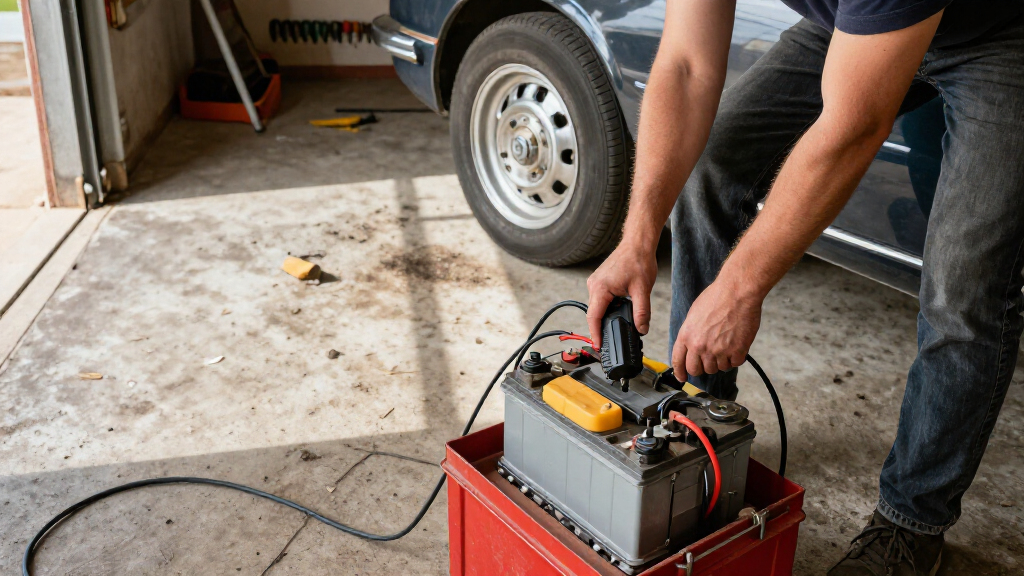
Automotive battery trickle chargers help keep a parked vehicle’s battery ready to start, but the right choice depends on battery type, capacity, and how long the vehicle sits. I’d choose the NOCO GENIUS2 as the best overall balance of selectable 6V and 12V support, smart charging, and a practical 2A output. The Battery Tender 3-Amp suits buyers who want more charging pace, while the FOVAL 1000mA is a straightforward fit for smaller batteries and slow maintenance. The main tradeoffs are charging speed versus gentler upkeep, broad compatibility versus simple setup, and one charger versus several dedicated units. Read on for the full breakdown and guidance on matching a charger to your vehicle and storage routine.

Get business pricing on garage and car supplies
- Business-only prices and quantity discounts
- Tax-exempt purchasing
- Multiple users, one account, clear invoices
Complete the kit


Key Takeaways
- The NOCO GENIUS2 leads as a versatile middle ground, with 6V and 12V support and more output than the 1A and sub-1A maintainers.
- A higher amp rating changes how quickly a charger can replenish a depleted battery; the Schumacher SC1280 and NEXPEAK NC201 are better suited to buyers who value faster charging than compact maintainers provide.
- Small-output choices such as the Battery Tender Junior and NOCO GENIUS1 make more sense for long-term maintenance of smaller batteries than for recovering a deeply discharged car battery.
- The GENIUS2D stands apart by mounting onboard, which can suit a vehicle with regular access to power but is less convenient to move between vehicles.
- Several FOVAL options share a 1000mA maintenance focus; the four-pack is useful when several vehicles need dedicated chargers, while a single unit avoids buying more than one setup requires.


| automotive battery trickle charger | Output voltage | Warranty | Input voltage |
|---|---|---|---|
| NOCO GENIUS2 2A 6V/12V Smart B | 12 volts | 3 years | 12 volts |
| NEXPEAK 10A Car Battery Charge | 12V and 24V | 30-day return guarantee | 110V |
| MOTOPOWER MP00205A 12V 800mA A | 12V DC | 2 years | 110V AC |
| Schumacher Electric SC1355 1.5 | — | — | — |
| NOCO Genius5 5A 6-12V Smart Ba | 12 volts | — | 120 volts |
| FOVAL Fully Automatic Trickle | 12V | 18 months | — |
| FOVAL Fully Automatic Trickle | 12V DC | 18 months | — |
| NOCO GENIUS1 1A 6/12V Smart Ba | — | — | 120V |
| Foval Automatic Trickle Batter | 12V | 18 months | — |
| Battery Tender 3-Amp Smart Bat | — | 5 years | — |
| NOCO GENIUS2D 2A 12V Onboard B | 12V | 3 years | 120V |
| Battery Tender Plus 12V 1.25 A | 12V | 10 years | 120V AC |
| Schumacher Electric SC1280 15A | — | — | — |
| Battery Tender Junior 12V 750m | 12V | 5 years | 12V |
| 1.5A 6V/12V Car Battery Charge | 6V and 12V | 1 year | 120V |
More Details on Our Top Picks
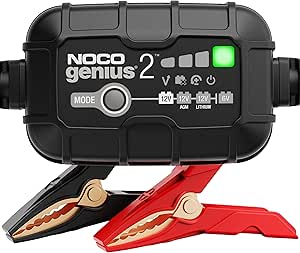
NOCO GENIUS2 2A 6V/12V Smart Battery Charger and Maintainer
The NOCO GENIUS2 is a good fit when one trickle charger needs to cover both 6V and 12V batteries, including lead-acid and LiFePO4. Its temperature adjustment tailors charging to hot or cold conditions, while Force Mode can supply charge to a battery that has fallen to zero volts. Those features give it more flexibility than the MOTOPOWER MP00205A, which is limited to 12V lead-acid batteries. The tradeoff is its 2A output: it favors routine upkeep and smaller batteries over quick recovery of a large car battery, and the listed capacity tops out at 40 Ah. Clamps, eyelet terminals, and mounting hardware support different connection setups, though the lack of a listed display means less at-a-glance charge information.
Pros:- Supports 6V and 12V lead-acid and LiFePO4 batteries
- Temperature-adjusted charging adapts to hot and cold conditions
- Force Mode can charge batteries down to zero volts
- Includes clamps, eyelet terminals, and mounting hardware
Cons:- 2A output can make charging larger batteries slow
- Listed maximum battery capacity is 40 Ah
- No detailed display is listed
Best for: Owners maintaining a mix of 6V and 12V lead-acid or LiFePO4 batteries, especially smaller batteries kept on charge between uses
Not ideal for: Drivers who need fast charging for larger batteries or want a display with detailed charging status
- Amperage:2 A
- Battery compatibility:6V and 12V lead-acid and LiFePO4
- Maximum battery capacity:Up to 40 Ah
- Output voltage:12 volts
- Input voltage:12 volts
- Battery charge time:10 hours
- Cable lengths:72-inch AC cable; 80-inch DC cable
- Warranty:3 years
Our verdict“Choose the GENIUS2 for flexible long-term upkeep across several battery types, provided its 2A output suits your charging needs.”
NEXPEAK 10A Car Battery Charger, 12V/24V Trickle Charger & Maintainer (NC201)
For buyers who want a charger that can also replenish a battery faster, the NEXPEAK NC201 offers 10A output for 12V systems and 5A for 24V systems. Its LCD reports voltage, current, temperature, and charge percentage, making progress easier to track than with the NOCO GENIUS2, whose listed specs do not include a display. The seven-stage charging and safety protections suit routine charging and maintenance across several lead-acid vehicle types, while pulse repair is intended to address sulfation. Its higher output makes it a less gentle trickle-maintenance specialist than lower-amperage models, and it cannot revive a completely dead 0V battery. Buyers should also note that the compatibility listed is for lead-acid batteries and the supplied connector is alligator clips.
Pros:- Provides 10A for 12V systems and 5A for 24V systems
- LCD shows voltage, current, temperature, and charge percentage
- Seven-stage charging includes multiple safety protections
- Pulse repair function targets sulfated batteries
Cons:- Cannot revive a completely dead 0V battery
- Listed compatibility is for lead-acid batteries
- Uses alligator clips rather than listed ring-terminal connectors
Best for: Owners of cars, trucks, boats, or lawn equipment who want faster lead-acid charging and a screen to monitor progress
Not ideal for: Owners of LiFePO4 batteries or completely dead 0V batteries, and buyers seeking a low-current maintainer for unattended long-term storage
- Amperage:10A for 12V; 5A for 24V
- Output voltage:12V and 24V
- Input voltage:110V
- Compatible devices:Car, truck, motorcycle, lawn mower, boat, and marine lead-acid batteries
- Charging stages:7-stage
- Connector type:Alligator clips
- Display:LCD showing voltage, current, temperature, and charge percentage
- Warranty:30-day return guarantee
Our verdict“Pick the NC201 when faster charging and visible status matter more than zero-volt recovery or low-current storage maintenance.”
MOTOPOWER MP00205A 12V 800mA Automatic Battery Charger and Maintainer
The MOTOPOWER MP00205A is a small, straightforward choice for keeping a 12V lead-acid battery maintained in a car, motorcycle, ATV, or boat. Its 800mA output suits maintenance and gradual charging, while automatic maintenance mode and pulse-current desulfation add functions for batteries that spend long periods idle. At 2 x 4.1 x 1.5 inches and 300g, it is easier to store than the higher-output NEXPEAK NC201, but it also charges more slowly and lacks the NC201’s display and 24V support. Its scope is narrower than the NOCO GENIUS2 as well: it handles 12V lead-acid chemistries only, not 6V or LiFePO4 batteries. The single port makes it a one-battery-at-a-time option.
Pros:- Compact 2 x 4.1 x 1.5-inch body weighs 300g
- Automatic maintenance mode supports long-term upkeep
- Pulse-current desulfation is included
- Includes overcharge, short-circuit, and reverse-polarity protection
Cons:- Compatible with 12V lead-acid batteries only
- 800mA output is slow for charging larger batteries
- Single charging port handles one battery at a time
Best for: Motorcycle, ATV, or car owners who need a compact maintainer for one 12V flooded, AGM, or gel battery
Not ideal for: People maintaining 6V, LiFePO4, or 24V batteries, or anyone who needs faster charging or multiple ports
- Output voltage:12V DC
- Input voltage:110V AC
- Current:800mA
- Compatible batteries:12V flooded, AGM, and gel lead-acid
- Dimensions:2 x 4.1 x 1.5 in
- Weight:300g
- Connector:Cable clamps/alligator clips
- Warranty:2 years
Our verdict“Choose the MP00205A for compact, low-current upkeep of a single 12V lead-acid battery.”
Schumacher Electric SC1355 1.5A 6V/12V Battery Charger and Maintainer
The Schumacher Electric SC1355 combines charging, maintenance, and reconditioning for 6V and 12V standard, AGM, and deep-cycle batteries. That makes it a useful middle ground for owners whose battery needs go beyond a typical 12V car: the MOTOPOWER MP00205A is smaller but limited to 12V lead-acid, while the SC1355 also covers 6V and deep-cycle batteries. Its 1.5A output is geared toward gradual charging and upkeep, not quick turnaround on a large battery. Schumacher includes both clamps and ring connectors, so the owner can choose a temporary connection or a more convenient installed lead. Automatic voltage detection and reverse-polarity protection add practical safeguards, though the listed cord and booster cable lengths may constrain placement if the outlet or battery is far away.
Pros:- Supports both 6V and 12V batteries
- Works with standard, AGM, and deep-cycle battery types
- Includes charging, maintenance, and reconditioning functions
- Comes with clamps and ring connectors
Cons:- 1.5A output may charge larger batteries slowly
- LiFePO4 compatibility is not listed
- Six-foot power cord and five-foot booster cables can limit placement
Best for: Owners of classic vehicles or equipment with 6V batteries, and drivers maintaining standard, AGM, or deep-cycle batteries
Not ideal for: Drivers who need rapid charging for a large battery or need support for LiFePO4 chemistry
- Model:SC1355
- Charging current:1.5A
- Battery voltage:6V and 12V
- Compatible battery types:Standard, AGM, and deep-cycle
- Functions:Charging, maintaining, and reconditioning
- Safety feature:Reverse-polarity protection
- Power cord length:6 feet
- Booster cable length:5 feet
Our verdict“The SC1355 suits owners who need 6V flexibility and deep-cycle support and can accept a gradual 1.5A charge.”
NOCO Genius5 5A 6-12V Smart Battery Charger, Trickle Charger & Maintainer
The NOCO Genius5 is the stronger choice for owners who want one smart charger for both regular charging and long-term maintenance. Its 5A output gives it more charging headroom than the GENIUS2, while support for 6V and 12V lead-acid and LiFePO4 batteries covers a broad mix of vehicles and equipment. A thermal sensor adjusts charging for ambient conditions, and Force Mode provides an option for dead batteries. Compared with the Schumacher SC1355, the Genius5 adds listed LiFePO4 support and higher output, while Schumacher lists deep-cycle compatibility and includes both clamps and ring connectors. The Genius5’s main tradeoff is visibility: there is no built-in LCD for detailed status. Its supplied specs also do not list a maximum battery capacity or cable lengths, so those details may matter when planning a particular installation.
Pros:- 5A output offers more charging headroom than the 2A NOCO GENIUS2
- Supports 6V and 12V lead-acid and LiFePO4 batteries
- Thermal sensor adjusts charging for hot and cold environments
- Force Mode provides an option for dead batteries
Cons:- No built-in LCD for detailed charge-status monitoring
- Maximum battery capacity is not provided in the supplied specs
- Cable lengths are not provided in the supplied specs
Best for: Owners maintaining mixed 6V and 12V lead-acid or LiFePO4 batteries who want more output than a basic trickle maintainer
Not ideal for: Buyers who want a detailed LCD status display or need listed capacity and cable-length specifications before choosing
- Amperage:5A
- Output voltage:12 volts
- Input voltage:120 volts
- Battery charge time:8 hours
- Battery compatibility:6V and 12V lead-acid and LiFePO4
- Charging functions:Charging, trickle charging, maintenance, and desulfation
- Temperature feature:Integrated thermal sensor adjusts charging
- Force Mode:Available for dead batteries
Our verdict“Choose the Genius5 for higher-output, multi-chemistry charging and maintenance if a detailed display is not a priority.”
FOVAL Fully Automatic Trickle Charger, 1000mA 12V Smart Battery Maintainer for Car, Motorcycle, Lawn Mower, Boat
I’d choose this phone-size 1A maintainer for a single 12V vehicle that sits between drives, such as a motorcycle or lawn mower. Its four-stage program moves from initialization through float mode, so it can maintain a compatible lead-acid battery without the owner managing each stage. Ring and alligator leads make it practical for either a more permanent connection or occasional use. Compared with the Battery Tender 3-Amp, the FOVAL is smaller and lighter, but its lower current is a poor fit when faster charging matters. The listed protections cover common connection and power faults. Its main limits are the 12V-only design and slow charging on larger batteries; this is best treated as a maintainer, not a quick recovery charger.
Pros:- Compact 300 g body is easy to store with vehicle accessories.
- Four-stage charging program switches to float maintenance.
- Ring and alligator cables support installed or temporary connections.
- Reverse-polarity, over-current, overload, and over-voltage protections are listed.
Cons:- 1A output can take a long time to replenish larger batteries.
- Designed for 12V systems, with no listed 6V support.
Best for: Owners of a 12V motorcycle, mower, or seasonal car who want a small maintainer with both ring and clamp leads.
Not ideal for: Drivers who need to recharge a large, depleted battery quickly or maintain a 6V system.
- Output voltage:12V
- Current:1A
- Charging stages:Initialization, bulk, absorption, float
- Connectors:Alligator and ring
- Dimensions:3.9 × 2.4 × 1.25 in
- Weight:300 g
- Warranty:18 months
Our verdict“Choose this FOVAL for compact, low-current maintenance of one 12V lead-acid battery, and look to the 3A Battery Tender when more charging speed or 6V support matters.”
FOVAL Fully Automatic Trickle Battery Charger (4-Pack), 1000mA 12V Smart Car Battery Charger, Battery Maintainer & Float Charger for Motorcycle, Car, Lawn Mower, Boat, ATV Lead Acid Batteries
The standout here is the four-unit bundle: it lets an owner keep separate 12V maintainers with several seasonal vehicles or equipment pieces. Each compact charger supplies 1A and uses four stages, ending in float maintenance for compatible lead-acid batteries. Ring and alligator connections offer a choice between leaving a lead installed and attaching clamps when needed. That makes the bundle more useful for a garage with several motorcycles, mowers, or boats than the single-unit FOVAL B082VQJQJP. The tradeoff is that buying four does not improve charging speed: each unit remains limited to 1A and 12V. I’d skip this pack if only one battery needs attention or if a larger battery needs a quicker charge.
Pros:- Four individual chargers can be placed with separate vehicles or equipment.
- Four-stage program includes float maintenance.
- Each unit includes ring and alligator cable options.
- Compact 300 g units are easy to store or keep near the battery.
Cons:- Each charger is limited to 1A, so larger batteries charge slowly.
- Supports 12V systems only, according to the supplied product data.
Best for: Owners maintaining several 12V lead-acid vehicles or machines at separate parking spots, such as a motorcycle, mower, and boat.
Not ideal for: A buyer with one vehicle, a 6V battery, or a large battery that needs faster charging.
- Pack size:4 chargers
- Output voltage:12V DC
- Current:1A per charger
- Supported battery types:SLA, VRLA, GEL, AGM, WET lead-acid
- Charging stages:Initialization, bulk, absorption, float
- Connectors:Alligator and ring
- Dimensions per unit:3.9 × 2.4 × 1.25 in
- Weight per unit:300 g
- Warranty:18 months
Our verdict“Pick the four-pack when several 12V batteries need separate maintainers; for a single vehicle, the one-unit FOVAL B082VQJQJP is the more fitting choice.”
NOCO GENIUS1 1A 6/12V Smart Battery Charger, Trickle Charger & Maintainer
The GENIUS1 earns its place for owners who need one low-current charger for both 6V and 12V batteries, including lead-acid and LiFePO4. That chemistry range distinguishes it from the 12V lead-acid FOVAL models, though its 1A output still points toward maintenance and gradual charging rather than speed. Temperature-aware charging adjusts to ambient conditions, while pulse charging is described as a way to address sulfation in lead-acid cells. Compared with the Battery Tender 3-Amp, the NOCO offers LiFePO4 support and a smaller form, but gives up current and the faster replenishment that can bring. Its broad compatibility makes it the more flexible choice for mixed battery types; buyers with only a large 12V battery may prefer a higher-current unit.
Pros:- Supports both 6V and 12V batteries.
- Works with lead-acid and LiFePO4 chemistries.
- Temperature sensing adjusts charging to ambient conditions.
- Pulse charging is designed to address sulfation in lead-acid batteries.
Cons:- 1A output is slow for larger batteries.
- Supplied product data gives limited physical specifications, such as dimensions and weight.
Best for: Owners of small vehicles or equipment with 6V and 12V batteries, including households that also use LiFePO4 batteries.
Not ideal for: Drivers who need to charge large, deeply depleted batteries promptly or want a higher-current maintainer.
- Battery voltage support:6V and 12V
- Current:1A
- Supported chemistries:Lead-acid and LiFePO4
- Input voltage:120V
- Included connection:DC cable with clamps
- Charging features:Temperature adjustment and pulse charging
- Battery charge time:10 hours
Our verdict“Choose the GENIUS1 for compact maintenance across 6V, 12V, and LiFePO4 batteries; choose the 3A Battery Tender when charging speed matters more.”
Foval Automatic Trickle Battery Charger 12V 1000mA Smart Battery Charger
This FOVAL is a straightforward choice for owners who want automatic 12V lead-acid maintenance in a small package. Its four-stage cycle ends in float mode, and the supplied ring and alligator leads cover both longer-term attachment and occasional charging. Listed safeguards include reverse polarity, over-current, overload, and over-voltage protection. Compared with the NOCO GENIUS1, it is limited to 12V and the description lists lead-acid chemistries rather than LiFePO4, so it is less adaptable across a mixed battery collection. In return, its role is easy to understand: maintain compatible batteries in cars, boats, or small equipment. The LED indicators are basic, and 1A current means slower charging; the listed cable length may also constrain where it can reach.
Pros:- Four-stage cycle provides automatic charging through float maintenance.
- Compact, 300 g design is easy to carry and store.
- Ring and alligator connectors accommodate different hookup preferences.
- Multiple listed protections cover common electrical and connection faults.
Cons:- 1A output is slow for larger or substantially discharged batteries.
- LED indicators provide less charge detail than an LCD.
- Cable length may not reach every battery location.
Best for: Owners of a 12V lead-acid car, boat, or powersports battery who want a compact maintainer with ring and clamp leads.
Not ideal for: People who need 6V or LiFePO4 support, detailed charge readouts, or a fast charge for a large battery.
- Output voltage:12V
- Current:1A
- Supported battery types:SLA, VRLA, GEL, AGM lead-acid
- Charging stages:Initialization, bulk, absorption, float
- Connectors:Alligator and ring
- Dimensions:2.4 × 3.9 × 1.25 in
- Weight:300 g
- Warranty:18 months
Our verdict“Choose this FOVAL for simple 12V lead-acid maintenance, while the NOCO GENIUS1 is a better match for buyers needing 6V or LiFePO4 compatibility.”
Battery Tender 3-Amp Smart Battery Charger and Maintainer, Switchable 6V/12V
With 3A output and selectable 6V or 12V operation, this Battery Tender is the practical step up when a 1A maintainer feels too slow. It supports flooded lead-acid, AGM, and gel batteries, then switches to float mode for ongoing maintenance. The combined 11-foot AC and DC reach can make placement easier around a garage, while ring terminals and alligator clips suit either a more permanent or temporary setup. Compared with the NOCO GENIUS1, it supplies three times the current, but the NOCO lists LiFePO4 support and temperature adjustment, which this model’s supplied details do not. Its 3A output remains modest against higher-current chargers, and the product data does not list lithium compatibility despite a title reference.
Pros:- Selectable 6V and 12V operation supports more than one system voltage.
- 3A output is quicker than the 1A FOVAL and NOCO options here.
- Float mode supports ongoing maintenance after charging.
- Includes ring-terminal and alligator-clip leads with 11 ft combined cable reach.
Cons:- 3A may still charge larger batteries slowly compared with higher-current chargers.
- Supplied battery compatibility details do not list lithium support.
- Larger and heavier than the compact 1A maintainers in this group.
Best for: Owners of 6V or 12V lead-acid, AGM, or gel batteries who want more charging current than a compact 1A maintainer provides.
Not ideal for: LiFePO4 battery owners or people who need high-current charging for large batteries.
- Selectable battery voltage:6V or 12V
- Current:3A
- Input:120V AC
- Supported battery types:Lead-acid, flooded, AGM, gel
- Cable reach:11 ft combined (6 ft AC, 5 ft DC)
- Connectors:Ring terminal and alligator clip
- Weight:1.4 lb
- Warranty:5 years
Our verdict“Choose this Battery Tender for 6V/12V lead-acid maintenance with a useful current step up from 1A models, but pick the NOCO GENIUS1 for listed LiFePO4 support.”
NOCO GENIUS2D 2A 12V Onboard Battery Charger and Maintainer
The GENIUS2D is built for a battery that stays in its vehicle: its included eyelet leads and mounting hardware suit a boat, tractor, or RV that needs monitored upkeep between outings. Temperature adjustment helps tailor charging as conditions change, while recovery from very low charge gives it more flexibility than a basic float maintainer. Compared with the Battery Tender Plus, it delivers more current and is designed to mount onboard; the Plus is a more conventional portable choice with a quick-disconnect harness. The tradeoff is its narrow fit: this model serves 12V lead-acid batteries only, and 2A remains a maintenance-oriented rate rather than a quick recharge for a large depleted battery. Choose it for a fixed installation, not frequent transfers between vehicles.
Pros:- Included eyelet cables and mounting hardware support a permanent installation
- Temperature-adjusted charging adapts to changing storage conditions
- Can charge down to 1V and offers Force Mode for completely dead batteries
- Monitored maintenance and pulse charging support long-term storage
Cons:- 2A output is slow for restoring large, heavily discharged batteries
- Works with 12V lead-acid batteries, not lithium or 6V batteries
Best for: Owners of boats, RVs, tractors, or seasonal vehicles who want a charger mounted near a 12V lead-acid battery for ongoing maintenance
Not ideal for: Drivers who need one charger for both 6V and 12V batteries, lithium batteries, or rapid recovery of large batteries
- Output voltage:12V
- Input voltage:120V
- Charging current:2A
- Battery capacity:Up to 40Ah
- Compatible batteries:Lead-acid, AGM, gel, SLA, VRLA, flooded, deep-cycle
- Included cables:24-inch AC cable and 24-inch DC cable with eyelet terminals
- Dimensions:3.47 × 3.43 × 6.5 in
- Warranty:3 years
Our verdict“Pick the GENIUS2D when you want a mountable, temperature-aware maintainer for a stored 12V lead-acid vehicle.”
Battery Tender Plus 12V 1.25 Amp Car & Motorcycle Battery Charger and Maintainer
The Battery Tender Plus pairs a modest 1.25A output with a four-step charging program, making it a straightforward fit for a car, motorcycle, ATV, or mower that sits between uses. Its ring-terminal and alligator-clip leads cover both a more permanent battery connection and occasional hookup, while the quick-disconnect harness makes switching between them less fussy. Compared with the Battery Tender Junior, the Plus supplies more current for larger batteries; the Junior is smaller in output and makes more sense for smaller powersports batteries. The Plus still charges slowly beside the Schumacher SC1280, which can deliver a rapid 15A charge. That difference matters if a vehicle needs to get back on the road quickly. This is a storage and upkeep pick, not a fast charger.
Pros:- Four-step smart charging adapts as the battery charges
- Includes both alligator clips and ring-terminal accessories
- Quick-disconnect harness makes repeated connection easier
- Dual-color LED provides a simple charge status indication
Cons:- 1.25A output can take a long time on larger or deeply discharged batteries
- Supports 12V batteries only
- One port cannot maintain multiple batteries at once
Best for: Owners maintaining a 12V car or motorcycle battery between drives who want clip and ring-terminal connection options
Not ideal for: People who need to recharge a large depleted battery quickly or maintain 6V batteries
- Output voltage:12V
- Input voltage:120V AC
- Charging current:1.25A
- Charging program:Four-step
- Connectors:Alligator clips and ring terminals
- Ports:1
- Dimensions:2.9 × 2.15 × 4.4 in
- Warranty:10 years
Our verdict“Choose the Plus for routine maintenance of one 12V vehicle battery when connection convenience matters more than charging speed.”
Schumacher Electric SC1280 15A Car Battery Charger & Maintainer (6V/12V)
If a battery needs more than a slow overnight top-up, the SC1280’s 15A rapid-charge mode sets it apart from maintainers such as the Battery Tender Plus. It also tests batteries, offers desulfation, and has dedicated 3A 12V and 2A 6V maintenance modes, so one unit can handle both recovery and storage duties. Support for 6V and 12V batteries gives it a wider voltage range than the NOCO GENIUS2D, which is limited to 12V lead-acid batteries. The tradeoff is that the SC1280 is a more garage-oriented charger with six-foot cables, rather than a compact onboard maintainer. Its digital interface provides operating information, though the supplied description does not specify a detailed LCD charge display. For buyers focused on trickle maintenance alone, its rapid-charge capacity may be more than they need.
Pros:- 15A rapid mode can restore charge faster than low-current maintainers
- Supports both 6V and 12V batteries
- Combines charging, maintenance, battery testing, and desulfation
- Reverse-clamp protection helps guard against incorrect connections
Cons:- Rapid-charge capability is unnecessary for buyers who only need storage maintenance
- Limited to 6V and 12V batteries
- The product description does not specify a detailed LCD charge display
Best for: Home mechanics who maintain both 6V and 12V automotive batteries and want a faster charger with built-in battery testing
Not ideal for: Owners seeking a tiny, permanently mounted maintainer or a simple low-current charger for one small battery
- Supported voltages:6V and 12V
- Rapid charging current:Up to 15A
- 12V maintain current:3A
- 6V maintain current:2A
- Battery types:Standard, AGM, gel, deep-cycle
- Battery tester:Built-in
- Desulfation mode:Yes
- Power and booster cable lengths:6 ft each
Our verdict“Pick the SC1280 if you want one garage charger for faster recovery, battery checks, and maintenance across 6V and 12V batteries.”
Battery Tender Junior 12V 750mA Charger & Maintainer for Powersports
The Battery Tender Junior’s 750mA output suits smaller batteries that spend long stretches in storage, such as those in motorcycles and other powersports vehicles. Once charged, it switches to float mode, and spark-proof circuitry plus reverse-hookup detection add protection during routine connections. Its small body is easier to tuck away than the larger garage-focused Schumacher SC1280, but the Junior has no rapid-recovery role. It also delivers less current than the Battery Tender Plus, so owners of cars or larger batteries should expect longer charging times. The included alligator clips and ring terminals offer flexible hookup options, and the 12-foot cord can help reach a parked vehicle. Choose it for keeping a suitable battery ready over time, rather than bringing a flat car battery back quickly.
Pros:- Compact body is easy to store or carry between vehicles
- Automatically switches to float mode after charging
- Works with 12V flooded, AGM, and gel lead-acid batteries
- Spark-proof circuitry and reverse-hookup detection add connection safeguards
Cons:- 750mA output is slow for larger automotive batteries
- Supports 12V batteries only
- Single port maintains one battery at a time
Best for: Motorcycle and powersports owners storing a 12V lead-acid battery and looking for a compact float maintainer
Not ideal for: Car owners who need faster charging, anyone maintaining 6V or lithium batteries, or people needing multiple ports
- Output voltage:12V
- Input voltage:12V
- Charging current:750mA
- Compatible batteries:Lead-acid, AGM, gel, flooded
- Connectors:Alligator clips and ring terminals
- Ports:1
- Dimensions:2.9 × 2.15 × 4.4 in
- Warranty:5 years
Our verdict“Choose the Junior for long-term maintenance of a small 12V powersports battery where compact size matters more than speed.”
1.5A 6V/12V Car Battery Charger – Automatic Trickle Charger, Battery Maintainer & Desulfator
This charger’s main distinction is 6V and 12V support paired with compatibility for LiFePO4 and lead-acid batteries. That makes it a broader match for a garage with varied battery chemistries than the NOCO GENIUS2D, which handles 12V lead-acid batteries. Temperature compensation and stated safety protections also suit vehicles kept through changing seasons, while the compact case is easy to store. Its 1.5A output sits between the Battery Tender Junior’s 750mA and the Plus’s 1.25A, but it remains a low-current charger; it is not the pick for quickly reviving a large battery. The product description claims pulse repair and desulfation, though it gives little detail about repair limits. The one-year warranty is shorter than the longer coverage listed for those Battery Tender models.
Pros:- Supports both 6V and 12V batteries
- Compatible with LiFePO4 as well as several lead-acid battery types
- Temperature compensation adapts charging to ambient conditions
- Compact case is easy to store
Cons:- 1.5A output is slow for large or deeply discharged batteries
- Only alligator clamps are listed, with no ring-terminal option
- One-year manufacturer warranty is shorter than the Battery Tender Plus and Junior warranties
Best for: Owners of classic or powersports vehicles with a mix of 6V and 12V LiFePO4 or lead-acid batteries who need a low-current maintainer
Not ideal for: Drivers who prioritize fast charging, need a long warranty, or want a charger with ring-terminal leads for a fixed hookup
- Output voltage:6V and 12V
- Input voltage:120V
- Charging current:1.5A
- Compatible batteries:LiFePO4, lead-acid, AGM, gel, SLA, flooded
- Connector type:Alligator clamps
- Dimensions:3.35 × 2.18 × 1.96 in
- Warranty:1 year
Our verdict“Choose this model when varied 6V and 12V battery chemistries matter more than rapid charging or extended warranty coverage.”
How We Picked
I compared the 15 listed chargers by the factors that shape day-to-day ownership: output, supported voltage, stated battery compatibility, charging and maintenance modes, connection style, and suitability for long storage. For trickle-charger use, low-current stability and a maintenance mode matter more than a large peak output alone; a charger intended to replenish a drained battery also needs enough output to make that task practical. I gave weight to clear fit for a buyer type, such as a powersports battery, multiple stored vehicles, or an onboard installation.
The ranking favors useful versatility and a clear match to common automotive storage needs. The GENIUS2 ranks first because its 2A output and 6V/12V support provide a strong balance for mixed use. Higher-output chargers rank well for buyers who need faster recovery, but their broader charging role does not make them the best choice for every storage setup. Small maintainers earn a place for simpler, lower-demand jobs, while specialized or multi-unit designs rank according to how well their narrower use case serves the right buyer.
Factors to Consider When Choosing Automotive Battery Trickle Chargers
I’d start with the battery and the way the vehicle is stored, then compare charger features. A charger can have an impressive output and still be a poor fit if it lacks the right voltage setting or chemistry support. These factors help separate a maintainer for a motorcycle from a charger meant to recover a car battery.
Match output to battery size and charging job
Amperage affects how quickly a charger can put energy back into a battery, but the largest number is not automatically the best choice for storage. A small maintainer can keep a healthy powersports battery topped up over time, yet it may take a long while to restore a car battery that has lost substantial charge. For a larger car battery or occasional recovery, a higher-output model can shorten the wait. Check the battery maker’s recommended charging range before choosing a powerful unit. Think about whether you need ongoing maintenance, recovery from discharge, or both; those are different jobs. A charger designed for both can be convenient, while a dedicated low-output maintainer may be simpler for a vehicle that is already stored with a healthy battery.
Check voltage and battery chemistry before connecting
Confirm whether the battery is 6V or 12V and whether the charger explicitly supports its chemistry, such as AGM, conventional lead-acid, gel, or LiFePO4. A selectable voltage setting is handy for a household with different vehicles, but it also creates a chance to choose the wrong mode. Lithium batteries require a compatible charging profile; a generic lead-acid mode should not be assumed to work. Product titles sometimes list several chemistries, so verify the manual’s supported battery types and operating limits. Do not rely on a charger’s desulfation feature as a repair for a damaged or failing battery. When the battery type is uncertain, identify it from its label or vehicle documentation before purchasing.
Plan for the storage location and connection method
Distance to a safe power outlet can decide which design is practical. A portable charger with clips or ring terminals can move between vehicles, while an onboard unit saves repeated setup if one vehicle stays near power. Check cable length, connector type, and whether the lead can remain attached without interfering with vehicle use. Outdoor or damp storage calls for careful attention to the charger’s stated weather resistance and the outlet arrangement. Avoid assuming that “automatic” means the unit can sit in any location indefinitely. A convenient connection is only useful if the charger and cables can be positioned according to the manual’s safety directions.
Decide how many vehicles need a charger
If several vehicles sit unused, individual maintainers can let each battery stay connected without swapping one charger around. A multi-pack can simplify that arrangement, though it ties the purchase to one style of charger and requires enough suitable outlets. For a single vehicle or occasional maintenance across a household, a portable unit may be more practical. Count the batteries and available outlets, and consider whether the vehicles are stored together. Do not connect multiple chargers to one battery unless their instructions explicitly permit that setup. Separate units also make it easier to leave one vehicle maintained while using another.
Balance convenience against controls and safeguards
Automatic shutoff or maintenance modes reduce the need to watch a charging session, but the exact behavior varies by charger. Check how the unit signals charging status, handles a full battery, and responds to reverse polarity or a poor connection. Temperature compensation can matter when a vehicle is stored through changing seasonal conditions, provided the feature applies to the battery type and setup. More settings can help with varied batteries but may complicate use for someone who wants a simple routine. Beginners should favor clear indicators, straightforward connections, and a manual that explains the modes plainly. Before leaving any charger connected for long storage, follow its instructions for ventilation, placement, and inspection.
Frequently Asked Questions
Can a trickle charger recharge a car battery that is already dead?
It depends on how discharged the battery is and what the charger can detect. Low-current maintainers are mainly intended to preserve charge and can take a long time to replenish a depleted car battery. Some automatic chargers may refuse to start if battery voltage falls below their detection threshold. A higher-output charger can be a better fit for recovery, but it cannot fix a battery that has failed internally. If a battery repeatedly goes flat, check its condition and the vehicle’s charging system instead of relying on a maintainer to solve the cause.
Is it safe to leave an automatic battery maintainer connected for weeks?
Many maintainers are designed for extended connection, but only when used as directed with a compatible battery and a suitable power source. Confirm that the manual describes long-term maintenance or float operation rather than assuming every charger supports it. Position the unit and cables as instructed, and inspect them periodically for damage, heat, or loose connections. A faulty battery or poor connection can still create problems even with an automatic charger. If the vehicle is stored somewhere damp or exposed, check the charger’s environmental limits before leaving it connected.
Should I pick a 1A maintainer or a higher-output charger for my car?
For a healthy car battery that only needs to stay charged during storage, a low-output maintainer can be adequate when its specifications match the battery. If you expect to restore a partly discharged battery, need shorter charging sessions, or maintain a larger battery, more output may be useful. Higher output does not remove the need to select the right battery mode or follow the battery maker’s charging limits. Consider the most common job rather than buying solely for an occasional worst case. A separate recovery charger may make sense if long-term maintenance is the only regular need.
Can I use one charger for both a car and a motorcycle?
Often, provided the charger supports the batteries’ voltage and chemistry and offers an appropriate charging profile for each. A selectable 6V/12V model can cover different voltage systems, while output and connection options determine how convenient it is to switch vehicles. Small motorcycle batteries may need more care than a car battery, so check whether the charger is suitable for their capacity. Ring terminals can be convenient for one vehicle, while clips may make a shared charger easier to move. Verify the manual for each battery rather than treating vehicle type alone as proof of compatibility.
Does a 12V trickle charger work with a lithium car battery?
Only if the charger specifically supports the lithium chemistry and battery configuration in question. A 12V label describes voltage, not the charging profile, and LiFePO4 batteries do not use the same charging behavior as lead-acid batteries. Use a lithium mode or a charger whose manual explicitly lists the battery type. Do not use a desulfation mode on a lithium battery unless the maker directly says it is safe. When the charger’s documentation is unclear, choose a model with explicit support rather than relying on a broad product title.
Conclusion
For most buyers who want one flexible charger for storage and occasional upkeep, I recommend the NOCO GENIUS2 as the best overall pick. The FOVAL 1000mA is a sensible value choice for a compatible battery that mainly needs steady maintenance, while the Schumacher SC1280 is the premium fit for buyers prioritizing higher output and broader charging duties. Beginners may prefer the Battery Tender Junior for a simple powersports maintenance routine, provided its output fits their battery and task. Choose the GENIUS2D for a vehicle that benefits from a mounted onboard connection, or the FOVAL four-pack when several vehicles need dedicated maintainers. Match the charger to the battery chemistry, voltage, and storage pattern, and the tradeoffs become much easier to judge.