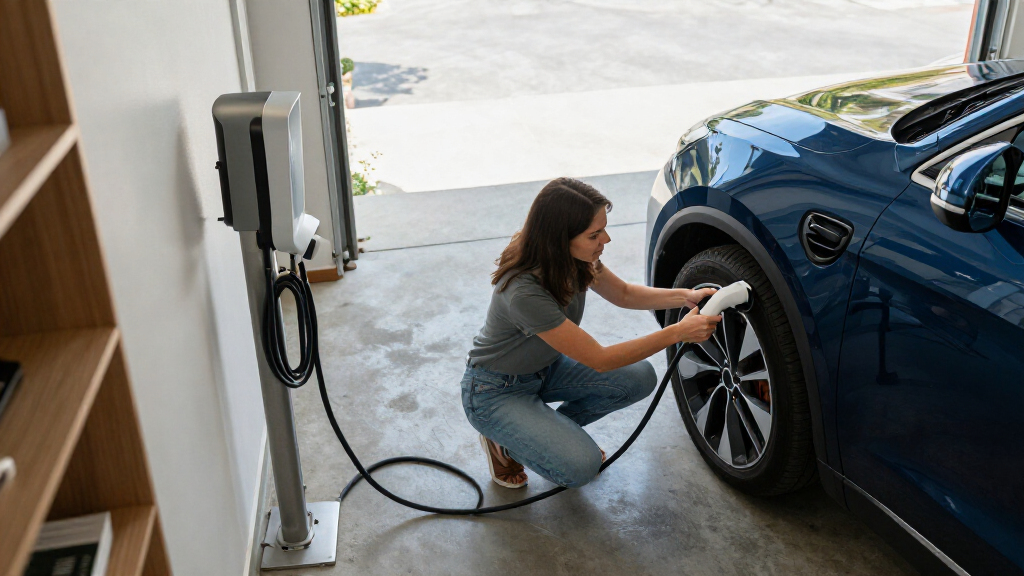
The best electric vehicle home charging stations balance charging speed, electrical compatibility, installation needs, and connector fit. My best overall pick is the Emporia Pro 48A, which pairs substantial charging capacity with PowerSmart features; the Autel 50A hardwired charger is a strong alternative for drivers who want a higher-amperage J1772 setup, while the EVDANCE 12A/16A portable charger suits people who value outlet flexibility over speed. The main tradeoffs are plug-in convenience versus hardwired installation, and higher output versus the electrical capacity your home and vehicle can actually use. Connector type matters too, especially for owners choosing between J1772 and NACS equipment. Read on for the full breakdown and guidance on matching a charger to your setup.

Get business pricing on garage and car supplies
- Business-only prices and quantity discounts
- Tax-exempt purchasing
- Multiple users, one account, clear invoices
Complete the kit


Key Takeaways
- Emporia Pro and the 48A Emporia hardwired model prioritize high output, but their value depends on whether your vehicle and home circuit can use that capacity.
- Plug-in models simplify setup and potential removal, while hardwired options such as the Autel and ChargePoint NACS models call for a more committed installation.
- Connector choice divides this lineup: several Autel, Emporia, and EVDANCE options use J1772, while the IYILO 48A and ChargePoint HomeFlex hardwired models use NACS.
- Portable chargers serve different needs, not just lower budgets. The 40A EVDANCE and ELEGRP offer 240V portability, while EVDANCE’s 12A/16A model can also use 120V.
- There are several closely related Autel and ChargePoint configurations, so compare amperage, plug type, connector, and installation method rather than relying on the product family name.


| electric vehicle home charging station | Connector | Cable length | Installation | Charging level |
|---|---|---|---|---|
| IYILO Level 2 EV Charger | SAE J1772 | 25 ft | — | Level 2 |
| IYILO Level 2 EV Charger | NACS (J3400) | 25 ft | Hardwired; 60A breaker and licensed electrician required | Level 2 |
| Autel 50A Level 2 EV Charger | J1772 | 25 ft | Hardwired | Level 2 |
| EVDANCE Level 2 Portable EV Ch | — | 25 ft | — | Level 2 |
| ELEGRP Level 2 Portable EV Cha | J1772 | 25 ft | — | Level 2 |
| ChargePoint HomeFlex Level 2 H | NACS (Tesla) | — | Hardwired; electrician required | — |
| Autel 50A Level 2 Hardwired EV | — | — | Hardwired | — |
| Emporia Pro Level 2 EV Charger | SAE J1772 | 25 ft | NEMA 14-50 plug or hardwired | — |
| Autel MaxiCharger Level 2 EV C | — | — | — | — |
| 50A Level 2 J1772 EV Charger | J1772 | — | NEMA 14-50 plug or professional hardwiring | — |
| EVDANCE Portable Level 1 and L | J1772 | 25 ft | — | — |
| ChargePoint HomeFlex Level 2 E | J1772 | 23 ft | — | — |
| Autel MaxiCharger AC Home Leve | J1772 | 25 ft | Hardwired | Level 2 |
| Emporia Level 2 EV Charger | SAE J1772 | 25 ft | Hardwired with whip | Level 2 |
| Lectron Level 2 J1772 Nexus EV | J1772 | 23 ft | Hardwired; professional installation required | Level 2 |
More Details on Our Top Picks
IYILO Level 2 EV Charger, 40A, 9.6 kW, 240V, NEMA 14-50P, Wi-Fi
I’d pick this IYILO for a driver who wants app-based scheduling and energy tracking without committing to a hardwired installation. Its NEMA 14-50 plug and adjustable 6–40A output make it more flexible to set up than the hardwired Autel 50A Level 2 EV Charger, while the 25-foot cable can reach across many garages. The app also lets owners set charging times and monitor energy use, and the connector temperature protection adds a useful layer of safety.
The tradeoff is that its 40A ceiling is below the Autel’s 50A output, so it may take longer to replenish a vehicle that can use more power. It also relies on 2.4 GHz Wi-Fi, and Tesla drivers need to buy a NACS adapter separately. Choose it for a plug-in smart setup, not maximum charging speed.
Pros:- NEMA 14-50 plug supports a plug-in installation where a suitable outlet is already available.
- Current adjusts from 6A to 40A in 1A increments to suit different electrical limits.
- App scheduling and energy tracking help owners manage charging sessions.
- 25-foot cable, NEMA 4 rating, and connector temperature protection support flexible placement and safer operation.
Cons:- Maximum 40A output is lower than the hardwired Autel 50A charger’s 50A capacity.
- Wi-Fi connectivity is limited to 2.4 GHz.
- Tesla vehicles require a separately purchased NACS adapter; hardwiring at 40A calls for a 50A breaker and licensed electrician.
Best for: J1772 EV owners with a NEMA 14-50 outlet who want scheduling and energy tracking without hardwiring a charger.
Not ideal for: Drivers seeking the highest available charging output, or Tesla owners who want a compatible connector included.
- Charging level:Level 2
- Maximum current:40A
- Power and voltage:9.6 kW; 240V
- Plug:NEMA 14-50P
- Connector:SAE J1772
- Cable length:25 ft
- Current adjustment:6A–40A in 1A increments
- Connectivity and warranty:2.4 GHz Wi-Fi; 3 years
Our verdict“Choose this IYILO if you have a NEMA 14-50 outlet and value adjustable, app-managed charging more than the higher output of a hardwired unit.”
IYILO Level 2 EV Charger, 48A, 11.5 kW, NACS Connector
For a NACS-equipped vehicle and a home ready for electrical work, this IYILO offers a native NACS connector and up to 48A, avoiding the separate adapter needed by the J1772 IYILO 40A. Its 25-foot cable and adjustable current let owners tailor output to the installation, while the app adds schedules, energy tracking, RFID access, and power sharing. Temperature monitoring can reduce power or stop charging if the connector overheats.
That capability comes with a firm installation commitment: it is hardwired and requires a 60A breaker installed by a licensed electrician. The J1772 Autel 50A also needs hardwiring, but offers a 50A maximum and a longer five-year warranty; this IYILO instead makes the most sense when native NACS support and RFID matter more. Its 2.4 GHz-only Wi-Fi and the need for an adapter on J1772 vehicles narrow its fit.
Pros:- Native NACS connector avoids an adapter for compatible vehicles.
- Up to 48A output with 1A current adjustments supports a range of electrical setups.
- App includes scheduling, energy tracking, RFID access, power sharing, and remote updates.
- Overheat protection can reduce output or shut charging off.
Cons:- Hardwired installation requires a 60A breaker and a licensed electrician.
- J1772 vehicles need a separate adapter.
- Wi-Fi is limited to 2.4 GHz, and the three-year warranty is shorter than the five-year coverage listed for the Autel 50A.
Best for: NACS vehicle owners planning a hardwired home installation who want RFID access, scheduling, and power-sharing features.
Not ideal for: Drivers with J1772 vehicles who want an adapter included, or homeowners who need a plug-in charger instead of licensed electrical work.
- Charging level:Level 2
- Maximum current and power:48A; 11.5 kW
- Connector:NACS (J3400)
- Installation:Hardwired; 60A breaker and licensed electrician required
- Cable length:25 ft
- Current adjustment:6A–48A in 1A increments
- Smart features:Scheduling, RFID, energy tracking, power sharing, OTA updates
- Connectivity and warranty:2.4 GHz Wi-Fi; 3 years
Our verdict“Pick this IYILO for a hardwired NACS vehicle setup where RFID and power-sharing features matter more than a plug-in connection or longer warranty.”
Autel 50A Level 2 EV Charger, 240V Hardwired, J1772, Wi-Fi, 25 ft Cable
This Autel is the lineup’s strongest fit for a J1772 driver who wants more headroom than a 40A plug-in charger and is prepared for hardwired installation. Adjustable output from 6A to 50A can make use of a suitable home circuit, and the 25-foot cable helps with parking flexibility. Its app handles schedules, session monitoring, and energy insights, while temperature monitoring and flame-retardant materials support indoor or outdoor installation.
Compared with the plug-in IYILO 40A, the Autel can deliver more current but requires electrical work rather than using a NEMA 14-50 outlet. The IYILO 48A NACS model is another hardwired alternative, though its connector suits a different vehicle inlet. This Autel’s five-year warranty is a practical differentiator; skip it if you need a portable unit or want native NACS compatibility.
Pros:- Adjustable 6A–50A output offers more capacity than the 40A plug-in options.
- App supports charging schedules, session monitoring, and energy-use insights.
- Temperature monitoring and flame-retardant materials support indoor or outdoor placement.
- Five-year warranty is longer than the listed warranty on either IYILO charger.
Cons:- Hardwired installation may require electrical work.
- J1772 connector may need an adapter for vehicles with a different inlet.
- Unlike the EVDANCE portable charger, it is not designed for easy transport between locations.
Best for: J1772 EV and plug-in hybrid owners with a suitable electrical system who want up to 50A output and a five-year warranty.
Not ideal for: Renters, drivers who need a NEMA 14-50 plug-in charger, or owners of vehicles that require a non-J1772 connector without an adapter.
- Charging level:Level 2
- Voltage:240V AC
- Adjustable current:6A–50A
- Installation:Hardwired
- Connector:J1772
- Cable length:25 ft
- Connectivity:Wi-Fi
- Certification and warranty:UL-certified by CSA; 5 years
Our verdict“Choose the Autel if you drive a J1772 vehicle, can hardwire the unit, and want more output and longer warranty coverage than the plug-in alternatives.”
EVDANCE Level 2 Portable EV Charger, 40A, 240V, 25 ft Cable
The EVDANCE is the clearest choice here for drivers who want a portable 40A charger they can move between a home outlet and other suitable NEMA 14-50 locations. Its carry bag, 25-foot cable, and adjustable settings make it more travel-ready than the hardwired Autel 50A, while the TFT display shows charging information at the unit rather than relying on an app. A 1–12 hour delay start gives owners a straightforward way to postpone charging.
The tradeoff is a simpler feature set: unlike the IYILO 40A, it does not list Wi-Fi scheduling or energy tracking. Its current choices are set steps from 10A to 40A rather than 1A increments, and a NEMA 14-50 outlet is required. The IP66 rating and broad operating-temperature range suit varied locations, but Tesla drivers need to supply a separate J1772 adapter.
Pros:- Portable design includes a carry bag and holders for the cable and control box.
- 25-foot cable supports flexible parking and outlet placement.
- Delay start can be set from 1 to 12 hours.
- IP66 weather resistance and operation from -22°F to 122°F support varied environments.
Cons:- Requires a NEMA 14-50 outlet, so it cannot serve homes without one unless electrical work is added.
- Current choices are limited to six fixed settings rather than the IYILO 40A’s 1A increments.
- Tesla vehicles need a separate J1772 adapter, and app-based energy tracking is not listed.
Best for: J1772 EV owners who want to carry one Level 2 charger between a home NEMA 14-50 outlet and other compatible outlets.
Not ideal for: Drivers who want app-based energy tracking, fine-grained current adjustment, or a hardwired high-output installation.
- Charging level:Level 2
- Maximum current and power:40A; 9.6 kW
- Voltage:240V
- Plug and connector:NEMA 14-50; J1772
- Current settings:10A, 16A, 20A, 24A, 32A, 40A
- Cable length:25 ft
- Delay start and display:1–12 hours; 2.4-inch TFT
Our verdict“Choose the EVDANCE if portability, a clear on-unit display, and a carry bag matter more than app controls or precise current adjustment.”
ELEGRP Level 2 Portable EV Charger, 40 A, J1772, 240 V NEMA 14-50 Plug, 25 ft Cable
For a portable charger that may spend time outdoors, the ELEGRP’s IP67 rating gives it a clear distinction from the EVDANCE, which is rated IP66. It also delivers up to 40A through a NEMA 14-50 plug, with five current settings and a 25-foot cable for everyday home charging. The 1–12 hour delayed start is useful for setting a later session, and ETL certification plus overheat protection add relevant safety details.
Compared with the IYILO 40A, this ELEGRP is simpler: the supplied data lists delayed start but not Wi-Fi scheduling or energy tracking. Its current settings begin at 16A, so it offers less low-current flexibility than the IYILO’s 6A–40A adjustment. The two-year warranty is also shorter than the IYILO’s three years. It suits owners who value weather protection and straightforward portable charging, not smart-home monitoring.
Pros:- IP67 ingress protection is higher than the EVDANCE’s listed IP66 rating.
- Five current settings let owners select output from 16A to 40A.
- 25-foot cable and 1–12 hour delayed start support flexible home charging.
- ETL certification and overheat protection add safety-focused features.
Cons:- Requires a 240V NEMA 14-50 outlet.
- Current adjustment starts at 16A and lacks the IYILO 40A’s finer 1A increments.
- Two-year warranty is shorter than the IYILO 40A’s three-year coverage, and Tesla requires a separate NACS adapter.
Best for: J1772 drivers with a NEMA 14-50 outlet who want a portable charger with a high weather-protection rating for garage or outdoor use.
Not ideal for: Owners who need app-based energy tracking, current adjustment below 16A, or a charger that works without a NEMA 14-50 outlet.
- Charging level:Level 2
- Maximum current and power:40A; 9.6 kW
- Voltage and plug:240V; NEMA 14-50
- Connector:J1772
- Current settings:16A, 20A, 24A, 32A, 40A
- Cable length:25 ft
- Ingress protection and operating temperature:IP67; -21°F to 121°F
- Certification and warranty:ETL; 2 years
Our verdict“Pick the ELEGRP if weather resistance is your priority for a portable NEMA 14-50 setup and you do not need app-based tracking.”
ChargePoint HomeFlex Level 2 Hardwired EV Charger with NACS Connector
The NACS connector makes this ChargePoint a direct-fit choice for Tesla drivers, avoiding the separate adapter needed with the J1772 Emporia Pro or Autel chargers in this lineup. It delivers up to 45 miles of range per hour, depending on the vehicle, and the ChargePoint app adds charging controls, reminders, and session information for people who want more than a basic wall unit. Its indoor-or-outdoor installation and UL certification suit a permanent home setup. The tradeoff is that this is not a plug-in charger: an electrician must hardwire it, and the product description calls for a 20A or 80A circuit, so buyers should confirm the required circuit and installation plan before purchase. Compared with the plug-in Autel MaxiCharger, this is less flexible to move or install, but its native Tesla connector is the clearer fit for compatible vehicles.
Pros:- NACS connector provides a direct connection for compatible Tesla vehicles.
- Delivers up to 45 miles of range per hour, depending on the vehicle.
- ChargePoint app supports controls, reminders, and charging information.
- UL-certified and suitable for indoor or outdoor installation.
Cons:- Hardwiring requires an electrician and does not offer a plug-in installation option.
- The stated 20A or 80A circuit requirement calls for careful electrical planning.
Best for: Tesla owners planning a permanent indoor or outdoor charging installation who want native NACS compatibility and app-based charging controls.
Not ideal for: Renters or homeowners who need a plug-in unit, and drivers with J1772 vehicles who prefer a connector that fits without an adapter.
- Output voltage:240 volts
- Connector:NACS (Tesla)
- Ports:1
- Installation:Hardwired; electrician required
- Installation location:Indoor or outdoor
- Certification:UL-certified
- Dimensions:7.06 × 11.19 × 5.2 inches
- Warranty:3 years
Our verdict“Choose this ChargePoint for a permanent home setup with a compatible Tesla; skip it if you need plug-in flexibility or a J1772-first connection.”
Autel 50A Level 2 Hardwired EV Charger, 240V, J1772, Wi-Fi and Bluetooth, 25 ft Cable
The Autel Maxi US AC W12 is the strongest fit here for buyers who want high output with adjustable current: it reaches 50A and 12 kW, while allowing settings from 6A to 50A. That range gives households more control over charging demand than the 40A Autel MaxiCharger plug-in model, though actual charging speed also depends on the vehicle and available circuit. Its 25-foot J1772 cable can reach across a garage, and Wi-Fi and Bluetooth connect the charger to scheduling and session monitoring in the Autel Charge App. The NEMA 4X enclosure suits indoor or outdoor placement. Unlike the Emporia Pro, it does not include a whole-home energy monitor or advertise panel load balancing. It also requires hardwiring, so this is better for a planned permanent installation than for someone who wants a simpler outlet-based setup.
Pros:- Adjustable current from 6A to 50A supports different charging and electrical needs.
- Up to 50A and 12 kW output offers more capacity than the 40A Autel MaxiCharger plug-in model.
- 25-foot J1772 cable and integrated holster add reach and convenient storage.
- Wi-Fi, Bluetooth, and a NEMA 4X enclosure support app control and indoor or outdoor use.
Cons:- Permanent hardwiring requires an electrician.
- J1772 connector may need an adapter for vehicles with a different inlet.
- Does not include the Emporia Pro’s Vue 3 energy monitor or stated panel load balancing.
Best for: J1772 vehicle owners with a suitable electrical service who want adjustable charging up to 50A, a long cable, and app-based scheduling.
Not ideal for: Renters, buyers who need a plug-in charger, or Tesla owners who do not want to use a separate adapter.
- Model:Maxi US AC W12
- Input voltage:240V
- Maximum output:50A, 12 kW
- Adjustable current:6A–50A
- Connector and cable:J1772; 25 ft
- Installation:Hardwired
- Connectivity:Wi-Fi and Bluetooth
- Certification:CSA
- Warranty:3 years
Our verdict“Pick the Autel W12 if you want adjustable, high-output J1772 charging in a permanent installation and can accommodate hardwiring.”
Emporia Pro Level 2 EV Charger with PowerSmart, 48A, J1772 Connector and 25 ft Cable
The Emporia Pro stands apart by pairing 48A charging with PowerSmart load balancing and an included Vue 3 energy monitor. That combination can help a household coordinate EV charging with broader electricity use, while the app adds schedules, real-time tracking, and solar management. It is the most energy-management-focused option in this group; the Autel W12 also offers app scheduling and high output, but its listed package does not include a whole-home monitor or PowerSmart. Installation is more flexible than the hardwired-only Autel W12: this Emporia can use a NEMA 14-50 plug or hardwiring. Its J1772 connector suits many North American EVs, but Tesla drivers need a separate adapter. Buyers should also confirm that the chosen installation method and electrical setup suit their home; the added monitoring features are most useful to people who will actively use them.
Pros:- PowerSmart balances charging load with the home’s electrical panel.
- Included Vue 3 monitor and app provide household energy tracking and solar management.
- Supports NEMA 14-50 plug-in or hardwired installation.
- 48A output and a 25-foot J1772 cable suit many home charging layouts.
Cons:- Tesla vehicles require a separate adapter.
- Installation still requires a suitable NEMA 14-50 connection or hardwiring.
- The extra energy features may add little value for buyers who only need scheduled charging.
Best for: Homeowners who want to track household electricity, coordinate EV charging with solar, or manage charging load alongside other electrical use.
Not ideal for: Tesla owners seeking a charger with a native NACS connector, or buyers who want a basic charger without extra monitoring features.
- Output and input voltage:240V AC
- Current:48A
- Connector:SAE J1772
- Cable length:25 ft
- Installation:NEMA 14-50 plug or hardwired
- Connectivity:Wi-Fi and Bluetooth
- Included monitor:Emporia Vue 3 Energy Monitor
- Certification:UL
- Use:Indoor and outdoor
Our verdict“Choose the Emporia Pro if energy monitoring and load management matter as much as charging speed; choose a simpler Autel model if they do not.”
Autel MaxiCharger Level 2 EV Charger, 40A, 240V, 25-Foot Cable, NEMA 14-50 Plug
The Autel MaxiCharger is the practical pick for a garage that already has a NEMA 14-50 receptacle: it plugs in rather than requiring the permanent wiring needed by the Autel W12 or ChargePoint hardwired model. Its current adjusts from 16A to 40A, which lets owners select a lower setting when their setup calls for it, while the 25-foot cable gives more placement reach than a short lead. NEMA 4X protection and indoor-or-outdoor suitability add flexibility, and the app supports scheduled charging. The tradeoff is its 40A ceiling: the 50A Autel W12 and 48A Emporia Pro offer higher listed output, but require different installation planning and, in the W12’s case, hardwiring. This model also depends on a compatible outlet, so plug-in convenience disappears if one must be added.
Pros:- NEMA 14-50 plug avoids hardwiring when a compatible outlet is already available.
- Adjustable output from 16A to 40A helps match charging to the home setup.
- 25-foot cable offers useful reach around a garage or driveway.
- NEMA 4X protection, app scheduling, and a 3-year warranty support home use.
Cons:- Requires a compatible NEMA 14-50 receptacle.
- 40A maximum is below the listed output of the 48A Emporia Pro and 50A Autel W12.
- RFID access control is optional rather than a standard listed feature.
Best for: Homeowners with an existing NEMA 14-50 outlet who want an adjustable Level 2 charger without hardwiring.
Not ideal for: Drivers seeking the highest listed output, or households without a compatible receptacle that want to avoid electrical work.
- Input and output voltage:240V
- Maximum current:40A
- Adjustable amperage:16A, 24A, 32A, 40A
- Installation connector:NEMA 14-50 plug
- Charging cable length:25 ft
- Ingress protection:NEMA 4X
- Certification:CSA
- Warranty:3 years
Our verdict“Choose this Autel when a NEMA 14-50 outlet is already in place and plug-in installation matters more than maximum output.”
50A Level 2 J1772 EV Charger, NEMA 14-50 or Hardwired, 240V
This 50A J1772 charger earns its place through two installation paths: it can use a NEMA 14-50 outlet or be professionally hardwired. That makes it more adaptable than the hardwired-only ChargePoint HomeFlex and Autel W12, while offering a higher listed maximum current than the 40A plug-in Autel MaxiCharger when hardwired. Its app covers schedules, remote status, charging history, and access control; thermal sensors with automatic power cutoff add a safety layer, and the weather-resistant enclosure supports outdoor placement. The product data does not provide a cable length or certification, so buyers comparing reach or third-party certification should verify those details before choosing. Tesla compatibility requires an adapter, unlike the ChargePoint’s native NACS connection. It fits shoppers who value installation flexibility, but less so anyone prioritizing a named manufacturer or detailed specification record.
Pros:- Offers NEMA 14-50 plug-in or professional hardwired installation.
- Supports up to 50A when hardwired.
- App provides scheduling, remote status, usage history, and access control.
- Thermal sensors, automatic power cutoff, and weather-resistant construction support home use.
Cons:- Tesla vehicles require a separate adapter.
- Hardwired installation requires a professional.
- Product data does not specify cable length or a certification.
Best for: J1772 vehicle owners who want to choose between a compatible NEMA 14-50 outlet and professional hardwiring, with app controls and outdoor placement.
Not ideal for: Tesla owners who want native NACS compatibility, or buyers who need confirmed cable length and certification details before purchase.
- Charger level:Level 2
- Voltage:240V
- Connector:J1772
- Maximum current:Up to 50A when hardwired
- Installation:NEMA 14-50 plug or professional hardwiring
- Smart features:App control, scheduling, real-time status, charging history, and access control
- Safety features:Thermal sensors and automatic power cutoff
- Enclosure:Flame-retardant PC+ASA; weather-resistant
- Compatibility:J1772 vehicles; Tesla Model 3, Y, S, and X with adapter
Our verdict“Pick this charger if you want a 50A-capable J1772 unit with both outlet and hardwired setup options, and confirm its cable and certification details first.”
EVDANCE Portable Level 1 and Level 2 J1772 EV Charger, 12A/120V and 16A/240V, 25 ft Cable
The EVDANCE Portable Level 1 and Level 2 is the adaptable pick for drivers who want one charger for a standard household outlet and a compatible 240V receptacle. Its 12A Level 1 mode can provide a basic overnight top-up where faster charging is unavailable; at 16A on 240V, it offers a step up without the output of the ChargePoint HomeFlex or the hardwired Autel MaxiCharger. The 25-foot cable, status display, and carry bag also suit occasional travel or a garage with awkward outlet placement. The tradeoff is outlet flexibility: it does not directly support NEMA 14-50 or 6-50, and Tesla drivers need a separate adapter. I’d choose it for portability and dual-voltage use, not as the fastest primary home station.
Pros:- Supports both 120V Level 1 and compatible 240V Level 2 outlets.
- A 25-foot cable offers useful reach in garages and driveways.
- LED display reports charging status and errors.
- Carry bag and included plug adapter support portable use.
Cons:- 16A maximum on 240V is slower than the 40A–50A options in this roundup.
- Does not directly fit NEMA 14-50 or 6-50 outlets.
- Tesla vehicles require a separately sold J1772 adapter, and compatibility varies by vehicle.
Best for: J1772 drivers who need a portable charger for both standard 120V outlets and compatible NEMA 6-20 outlets, including occasional charging away from home.
Not ideal for: Drivers who want fast daily charging, have a NEMA 14-50 or 6-50 outlet, or need native Tesla compatibility.
- Connector:J1772
- Charging levels:Level 1 and Level 2
- Amperage:12A at 120V; 16A at 240V
- Maximum power:3.84 kW
- Cable length:25 ft
- Supported outlets:NEMA 5-15/5-20 at 120V; NEMA 6-20 at 240V
- Housing protection:IP66
- Warranty:1 year
Our verdict“Choose this EVDANCE if portability and 120V/240V flexibility matter more than high-speed home charging.”
ChargePoint HomeFlex Level 2 EV Charger with J1772 Connector and NEMA 14-50 Plug
The ChargePoint HomeFlex makes sense for drivers with a suitable NEMA 14-50 receptacle who want app controls without choosing a hardwired station. Its mobile app adds charging controls, reminders, and session information, while the 23-foot cable gives more reach than a cramped outlet location might allow. ChargePoint lists charging speeds of up to 45 miles of range per hour, although actual results depend on the vehicle and circuit. Compared with the hardwired Autel MaxiCharger AC Home, this model avoids a direct hardwire connection but is tied to its specified plug and circuit requirements. It still calls for electrician involvement, and its 40A or 50A circuit requirement limits where it can be installed. Tesla owners also need an adapter. I’d favor it for app-led convenience, not for buyers seeking a plug-anywhere setup.
Pros:- App offers charging controls, reminders, and charging information.
- 23-foot cable is designed for use in colder conditions.
- UL listed and rated for indoor or outdoor use.
- NEMA 14-50 plug avoids a direct hardwire connection.
Cons:- Requires a suitable NEMA 14-50 receptacle and a 40A or 50A circuit.
- Electrician installation may be needed to prepare or verify the circuit.
- Tesla vehicles need a separate adapter.
Best for: Owners of J1772 EVs who already have, or plan to install, a suitable NEMA 14-50 receptacle and want app-based charging controls.
Not ideal for: Drivers without a compatible 240V receptacle or circuit, or those who prefer a hardwired installation and do not need the plug-in format.
- Output voltage:240V
- Amperage:50A
- Connector:J1772
- Plug:NEMA 14-50
- Circuit requirement:40A or 50A circuit
- Cable length:23 ft
- Charging rate:Up to 45 miles of range per hour, depending on vehicle
- Certification and warranty:UL listed; 3-year parts warranty
Our verdict“Pick the ChargePoint HomeFlex if you have the right receptacle and value app controls over the hardwired flexibility of the Autel MaxiCharger AC Home.”
Autel MaxiCharger AC Home Level 2 EV Charger, 50A, J1772, Wi-Fi, Hardwired, 25 ft
For a home set up for higher-output charging, the Autel MaxiCharger AC Home pairs up to 50A and 12 kW with an adjustable 6–50A range. That range gives an electrician room to configure output for the available circuit, while the 25-foot cable can reach across a garage or driveway. Its app supports scheduling and remote control, and the NEMA Type 4 enclosure suits indoor or outdoor placement. Compared with the plug-in ChargePoint HomeFlex, this Autel is a more committed installation: it is hardwired, so a qualified electrician must handle setup, but it avoids reliance on a particular receptacle. The cable is specified to remain flexible in very cold conditions, a useful distinction for outdoor parking. It costs the buyer flexibility at installation time and uses J1772, so some vehicles need an adapter.
Pros:- Up to 50A and 12 kW output, with adjustable current from 6A to 50A.
- 25-foot cable is designed to stay flexible in temperatures down to -40°C.
- NEMA Type 4 enclosure supports indoor or outdoor installation.
- Wi-Fi, Bluetooth, and app controls support remote use and schedules.
Cons:- Hardwired installation requires an electrician and suitable electrical capacity.
- J1772 may require an adapter for vehicles with a different charge-port standard.
- Fixed installation is less convenient to move than the plug-in ChargePoint HomeFlex.
Best for: J1772 EV owners who have a suitable electrical service, want high-output charging, and are prepared for a permanent hardwired installation.
Not ideal for: Renters, drivers who need a portable plug-in station, or households whose electrical capacity cannot support the desired output.
- Charging level:Level 2
- Connector:J1772
- Installation:Hardwired
- Maximum amperage:50A
- Adjustable amperage:6–50A
- Power:12 kW
- Cable length:25 ft
- Connectivity and control:Wi-Fi and Bluetooth; Autel Charge app
- Warranty:3 years
Our verdict“Choose the Autel MaxiCharger AC Home for adjustable, high-output charging when a permanent installation is preferable to ChargePoint’s plug-in format.”
Emporia Level 2 EV Charger, 48A, 240V, J1772, Wi-Fi, 25 ft Cable, Hardwired
The Emporia Level 2 is a strong match for drivers who want charging data alongside a substantial hardwired station. Its 2.4 GHz Wi-Fi connection supports real-time energy data, mobile controls, and scheduled charging, making it more focused on tracking household charging than the simpler portable EVDANCE. At up to 48A, it is close to the Autel MaxiCharger AC Home’s 50A ceiling; the small output difference is less likely to matter than each home’s circuit capacity and vehicle limits. The 25-foot cable helps with parking flexibility, and UL listing plus ENERGY STAR certification provide useful product credentials. The tradeoff is that it needs professional hardwired installation and a compatible Wi-Fi connection. Its J1772 connector also means some vehicles need an adapter. I’d choose Emporia for monitoring features, not for plug-in portability.
Pros:- Up to 48A output, with listed charging speeds of up to 46 miles per hour.
- Wi-Fi supports real-time energy data, mobile controls, and scheduled charging.
- 25-foot cable and included wall mount and holster help with reach and storage.
- UL listed and ENERGY STAR certified.
Cons:- Hardwired installation calls for a qualified professional.
- Wi-Fi features depend on a usable 2.4 GHz connection at the installation location.
- J1772 is not a direct fit for every vehicle; some require an adapter.
Best for: Homeowners with J1772 vehicles who want hardwired Level 2 charging, scheduled sessions, and real-time energy information through Wi-Fi.
Not ideal for: Renters or drivers who need a portable charger, lack a suitable hardwire location or Wi-Fi coverage, or need a connector other than J1772.
- Charging level:Level 2
- Output voltage:240V
- Connector:SAE J1772
- Maximum amperage:48A
- Cable length:25 ft
- Installation:Hardwired with whip
- Connectivity:2.4 GHz Wi-Fi
- Certifications:UL listed; ENERGY STAR certified
- Warranty:3 years
Our verdict“Choose Emporia over the Autel MaxiCharger AC Home if energy tracking is a priority and you are comfortable with a 48A hardwired station.”
Lectron Level 2 J1772 Nexus EV Home Charger, 48A Hardwired
The Lectron Level 2 J1772 Nexus suits buyers who need a hardwired station that can live outdoors as well as indoors. Its IP66 weather resistance, 23-foot cable, and included holster make the daily routine simpler when the charger is mounted near an exterior parking spot. Output reaches 48A and 11.5 kW, placing it near the Emporia Level 2 and just below the Autel MaxiCharger AC Home’s stated maximum; for most buyers, cable reach, site conditions, and vehicle limits may matter more than that modest output gap. The listed UL and ETL certifications and built-in electrical protections add useful safety detail. The tradeoff is a required professional hardwire installation, with no plug-in portability. Tesla vehicles also need a compatible NACS adapter. I’d pick Lectron for outdoor resilience rather than app-based energy tracking.
Pros:- 48A and 11.5 kW output support substantial Level 2 home charging.
- IP66 rating supports indoor and outdoor installation.
- 23-foot cable and included holster simplify reach and storage.
- Listed UL and ETL safety certifications and built-in electrical protections.
Cons:- Professional hardwired installation is required.
- Tesla vehicles need a compatible NACS adapter.
- The supplied information does not list app connectivity or energy-monitoring functions.
Best for: Homeowners with J1772 vehicles who need a hardwired charger near an outdoor parking space and value weather resistance and included cable storage.
Not ideal for: Renters, buyers who need a plug-in unit, or households that prioritize Wi-Fi schedules and energy monitoring over outdoor protection.
- Charging level:Level 2
- Connector:J1772
- Maximum output:48A
- Voltage and power:240V; 11.5 kW
- Charging rate:Up to 46 miles of range per hour
- Installation:Hardwired; professional installation required
- Cable length:23 ft
- Weather resistance:IP66
- Safety certifications:UL 2594, UL 2231, UL 2251; ETL listed
Our verdict“Choose the Lectron Nexus for a weather-resistant outdoor installation; choose the Emporia instead if Wi-Fi energy data is more useful to you.”
How We Picked
I ranked these electric vehicle home charging stations by how well their stated specifications fit common home-charging needs: available output, connector compatibility, installation format, cable reach, and the usefulness of listed smart features. I gave more weight to choices that make their practical role clear, such as a portable 240V unit, a hardwired higher-amperage charger, or a model with both 120V and 240V capability. A larger amperage figure alone did not determine placement; buyers also need a suitable circuit and a vehicle able to accept that power.
The order reflects use-case versatility and clarity of fit, not a claim that one charger suits every home or has been independently tested here. Models with similar names were separated by connector and installation details, while plug-in options were judged against hardwired alternatives for flexibility and installation commitment. I also accounted for the tradeoffs buyers must verify before purchase, including electrical capacity, connector fit, and whether the listed cable and smart features match their routine.
| electric vehicle home charging station | Connector |
|---|---|
| IYILO Level 2 EV Charger | SAE J1772 |
| IYILO Level 2 EV Charger | NACS (J3400) |
| Autel 50A Level 2 EV Charger | J1772 |
| EVDANCE Level 2 Portable EV Ch | — |
| ELEGRP Level 2 Portable EV Cha | J1772 |
| ChargePoint HomeFlex Level 2 H | NACS (Tesla) |
| Autel 50A Level 2 Hardwired EV | — |
| Emporia Pro Level 2 EV Charger | SAE J1772 |
| Autel MaxiCharger Level 2 EV C | — |
| 50A Level 2 J1772 EV Charger | J1772 |
| EVDANCE Portable Level 1 and L | J1772 |
| ChargePoint HomeFlex Level 2 E | J1772 |
| Autel MaxiCharger AC Home Leve | J1772 |
| Emporia Level 2 EV Charger | SAE J1772 |
| Lectron Level 2 J1772 Nexus EV | J1772 |
Factors to Consider When Choosing Electric Vehicle Home Charging Stations
Before choosing a station, match the charger to the vehicle, home electrical system, and parking arrangement—not just the highest amperage on the label. These factors help avoid paying for unused capacity or buying a model that does not fit the installation you have.
Match Charging Output to Your Vehicle and Circuit
A 48A or 50A charger can only deliver its full output when the vehicle supports it and the home circuit is sized for the installation. A lower-capacity onboard charger in the car can limit the benefit of a higher-output station, so check the vehicle specifications before paying for extra capacity. Have an electrician confirm the circuit and service requirements for a planned installation; do not assume an existing outlet is suitable because its shape matches the plug. Higher output can make sense for a household with a large battery, frequent driving, or more than one EV, but it may add installation work without changing everyday charging much for other drivers. The portable 40A models can offer useful flexibility, though they still need an appropriate 240V supply. Choose based on the entire charging path, from panel to vehicle, rather than the charger’s maximum figure alone.
Choose Between Plug-In and Hardwired Installation
A NEMA 14-50 plug can make a station easier to remove or relocate, but it requires a properly installed, compatible receptacle. A plug-in charger is not automatically a do-it-yourself installation: the outlet, wiring, and circuit must all support the intended load. Hardwiring can suit a permanent parking spot and avoids relying on a receptacle, though installation is less flexible and typically requires electrical work. Think about whether you might move, change parking locations, or want the charger removed when you sell the home. A common mistake is choosing a plug-in model before checking whether the needed outlet exists; adding one can change the cost and scope of the project. Confirm installation requirements for the exact model with a qualified electrician.
Verify Connector Fit and Future Compatibility
Connector selection is a purchase decision tied to the vehicle you own and the charging standard it uses. This roundup includes both J1772 and NACS equipment, so buyers should confirm the connector on the car and any approved adapter requirements before ordering. An adapter may bridge a mismatch, but compatibility can depend on the vehicle, adapter, and charging setup; check the vehicle maker’s guidance rather than assuming every combination works. If you expect to replace your car soon, weigh the next vehicle’s connector against the convenience of using an adapter with a charger you already own. Households with different EVs should check the needs of each vehicle, not just the primary driver’s car. Connector fit is more important than choosing a familiar brand name.
Measure Cable Reach From the Parking Position
Cable length needs to work from the charger’s planned mounting point to the vehicle’s charge port, including the path around a bumper or parked car. A 25-foot cable appears on several models here, but that does not guarantee the same fit in every garage or driveway. Measure the route with the car parked in its usual position, and account for which side holds the charge port. Avoid stretching a cable across a walkway or placing it where a door, wheel, or garage mechanism can pinch it. A longer reach can make daily use easier, while a shorter cable may be tidier when the charger sits close to the port. Mounting location and parking habits can matter as much as the stated cable length.
Decide Whether Smart Features Fit Your Routine
Wi-Fi, Bluetooth, and energy-management features can help with monitoring or coordinating charging, but they add value only if they solve a real household need. Check what the manufacturer says each feature does, whether an account or reliable network connection is needed, and whether the charger still works the way you need when the network is unavailable. Power-management functions may matter in homes with limited electrical capacity, but buyers should verify how a specific feature operates and what equipment it requires. If you mainly plug in overnight and use the vehicle’s own charging schedule, a simpler charger may be enough. Consider long-term app support and connectivity before treating smart controls as a reason to pay more. The best feature set is the one that fits how you manage energy, not the longest list of capabilities.
Plan for Weather, Mounting, and Daily Handling
Where the charger will live affects its usefulness: a garage installation has different exposure and cable-management needs from a driveway installation. Check the exact model’s approved installation environment and weather protection instead of assuming every home station can be mounted outdoors. Make room for the connector holster, cable storage, and a safe route that does not create a trip hazard. Portable units can be handy for travel or changing locations, but repeated handling may be less convenient than a fixed charger for a daily routine. Hardwired units can create a cleaner permanent setup, yet they are less straightforward to move later. Plan the mounting location before purchase so the charger works with both the parking space and the household’s daily habits.
Frequently Asked Questions
Should I choose a 48A or 50A charger if my car cannot accept that much power?
Not for charging speed alone: the car’s onboard charger limits how much AC power it can use. A higher-capacity station can still be a reasonable choice if you expect a compatible future vehicle or want capacity for a household’s changing needs. But it may require a more demanding circuit and installation, so compare that work with the benefit you will actually receive today. Check the vehicle’s AC charging specification and ask an electrician what your home can support. If those figures point to a lower-output model, you may get a better fit without paying for unused capacity.
Can I plug a 14-50 EV charger into any NEMA 14-50 outlet?
No. The outlet must be correctly wired, in good condition, and connected to a circuit suitable for the charger’s intended load. A receptacle that looks right does not confirm that the circuit, wiring, or installation meets the charger’s requirements. Have a qualified electrician inspect an existing outlet or install a new one before regular charging. Also check the charger’s manual for its plug and circuit requirements. This is a safer starting point than relying on the outlet label alone.
Should I buy a J1772 or NACS home charger?
Start with the connector your vehicle uses and the manufacturer’s guidance for home charging. This roundup has J1772 models, NACS models, and products suited to different installation formats, so the right choice depends on your specific car rather than a general preference. If you plan to change vehicles, check the connector on likely replacements and whether an approved adapter would work with your setup. For a household with multiple EVs, compare every vehicle’s requirements before settling on one connector. Confirm compatibility with both the charger and vehicle maker before ordering.
Is a portable EV charger a good choice as my only home charger?
It can be, especially if the selected unit matches a suitable outlet and its output fits your daily driving needs. The EVDANCE 12A/16A option adds the ability to use either 120V or 240V, while the 40A EVDANCE and ELEGRP models are aimed at 240V use. Portability is useful if you need to move the unit, but frequent setup and cable storage may be less convenient than a fixed installation. Confirm that the unit is intended for the environment where you will use it and that the outlet is appropriate. If the charger will stay in one place, compare portability with the cleaner routine of a fixed hardwired station.
When is hardwiring worth choosing over a plug-in station?
Hardwiring can suit a permanent parking location, particularly when the chosen charger and circuit call for a fixed installation. It avoids dependence on a receptacle, but installation requires electrical work and the unit is less convenient to remove or relocate. A plug-in model can offer more flexibility, though the outlet itself must be correctly installed and suited to the charger. Compare the electrician’s advice, the home’s existing wiring, and how long you expect to use the parking setup. Choose the format that fits the electrical plan and your likelihood of moving the charger, rather than assuming one format is always better.
Conclusion
For a broad mix of output and useful energy-management features, my best overall recommendation is the Emporia Pro 48A, provided your vehicle and electrical system can support it. The best value fit is the 40A plug-in class, represented here by the IYILO, EVDANCE, and ELEGRP options; choose among them by connector, portability, and outlet compatibility rather than brand name alone. For a best premium-style hardwired choice, compare the Autel 50A hardwired models with the ChargePoint HomeFlex NACS model based on your connector and desired connectivity. Beginners may prefer a plug-in station after an electrician verifies the receptacle, while drivers who need both household outlet flexibility and a lower-power fallback should look at the EVDANCE 12A/16A unit. For a specific NACS setup, compare the IYILO 48A and ChargePoint HomeFlex hardwired options; for a J1772 hardwired installation, the Autel and Emporia models offer the clearest fit. Confirm circuit capacity, vehicle compatibility, cable reach, and installation requirements before choosing.