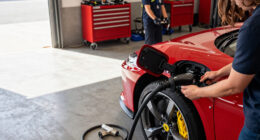
Portable car battery chargers include jump starters for a dead battery and plug-in chargers that replenish or maintain one, so the right choice depends on the problem you need to solve. I rank the NOCO Boost GB150 as the best overall jump starter for buyers who want substantial starting capacity, while the GOOLOO A3 stands out for combining jump-starting with tire inflation. For a slower, at-home charging and maintenance option, the NOCO GENIUS1 serves a different purpose and needs an external power source. The main tradeoffs are starting power versus portability, and added features versus simpler operation. Read on for the full comparison and guidance on matching a charger to your vehicle and routine.

Get business pricing on garage and car supplies
- Business-only prices and quantity discounts
- Tax-exempt purchasing
- Multiple users, one account, clear invoices
Complete the kit


Key Takeaways
- The lineup covers two different jobs: 14 products are jump starters, while the NOCO GENIUS1 is a plug-in 6V/12V battery charger and maintainer, not an emergency jump pack.
- Starting-amp claims alone do not settle the choice: vehicle compatibility, battery condition, cable design, and the maker’s stated engine limits matter alongside peak-current figures.
- Inflator combinations trade simplicity for versatility: the GOOLOO A3, Povasee A6, DEWALT DXAEJ14, and other compressor-equipped models add tire support but bring more functions and bulk than a basic jump starter.
- NOCO’s range makes size and output the key comparison: the GB20, GB40, GBX45, GB70, and GB150 span different power and portability needs rather than offering interchangeable picks.
- The Clore Automotive JNC660 takes a different form factor: its 1700 peak amps and 12V design suit buyers who favor a traditional jump pack over the lithium jump-starter format used by most of this lineup.



| portable car battery charger | Voltage | Battery type | Battery capacity | Engine compatibility |
|---|---|---|---|---|
| NOCO Boost GB150 3000A UltraSa | 12 V | Lithium | — | Up to 9.0L gas; up to 7.0L diesel |
| OXILAM 6000A Portable Jump Sta | 12 V | Lithium-ion | 6000 amp-hours, as listed | — |
| GOOLOO A3 12V 3000A Portable J | 12 V | Lithium polymer | 12000 mAh | Up to 9.0L gas; up to 6.5L diesel |
| Clore Automotive Jump-N-Carry | 12 V | Lead-acid AGM | 22 Ah | — |
| S ZEVZO ET03 4000A Portable Ca | 12 V | Lithium-ion | 20000 mAh | Up to 8.0L gas; up to 7.0L diesel |
| Povasee A6 5000A Portable Jump | 12 V | — | 22800 mAh | Up to 10L gas or 8L diesel |
| TREKURE 5000A Portable Car Jum | 12 V | — | 7200 mAh | Up to 10L gas or 8L diesel |
| NOCO Boost GBX45 1250A 12V Lit | 12 V | — | — | Up to 6.5L gas or 4.0L diesel |
| DEWALT DXAEJ14 1600 Peak Amp J | 12 V | Sealed lead acid | — | — |
| NOCO GENIUS1 1A 6V/12V Smart B | — | — | — | — |
| NOCO Boost GB40 12V 1000A Ultr | 12 V | Lithium | — | — |
| Joltekon 6000A Car Battery Jum | 12 V | Lithium polymer | 10,000 mAh (37 Wh, as stated) | All gas engines; diesel engines up to 10L |
| 4500A Car Jump Starter with 15 | 12 V | Lithium polymer | 7200 mAh | — |
| NOCO Boost GB20 500A UltraSafe | 12 V | Lithium | 2150 mAh | — |
| NOCO Boost GB70 2000A 12V Lith | 12 V | Lithium-ion | 5000 mAh | Up to 8.0L gas and 6.0L diesel |
More Details on Our Top Picks
NOCO Boost GB150 3000A UltraSafe Jump Starter
The NOCO Boost GB150 earns this spot for drivers who want substantial starting capacity in a portable lithium unit without moving to a heavier lead-acid pack. Its 3000A peak current is rated for engines up to 9.0L gas or 7.0L diesel, while spark-proof and reverse-polarity protection can make roadside connections less error-prone. Compared with the S ZEVZO ET03, the GB150 offers a higher stated gas-engine ceiling and a rugged IP65 housing, but the ET03 is far lighter at 1.4 pounds and lists a force-start function for completely dead batteries. The GB150 also works as a power bank and has a 500-lumen light, though its 7-hour recharge time and 7.5-pound weight reduce the appeal for drivers prioritizing quick charging or minimal storage bulk.
Pros:- 3000A peak current is rated for engines up to 9.0L gas and 7.0L diesel.
- Spark-proof and reverse-polarity protections reduce the chance of connection mistakes.
- IP65-rated housing is suited to roadside and outdoor storage conditions.
- Includes a power bank and 500-lumen multi-mode LED flashlight.
Cons:- Listed recharge time is seven hours.
- At 7.5 pounds, it is heavier than compact lithium alternatives such as the S ZEVZO ET03.
- Its higher-capacity feature set may be more than drivers of small cars need.
Best for: Drivers of larger gas or diesel vehicles who want a rugged, portable lithium jump starter with connection-error protections and an emergency light.
Not ideal for: Drivers seeking the lightest glove-box option or a fast-recharging unit; the 7.5-pound body and listed seven-hour recharge time are less convenient.
- Peak current:3000 A
- Voltage:12 V
- Battery type:Lithium
- Engine compatibility:Up to 9.0L gas; up to 7.0L diesel
- Weight:7.5 lbs
- Dimensions:8.19 × 4.88 × 13.7 in
- Water resistance:IP65 rated
- Warranty:1 year
Our verdict“Choose the GB150 if your priority is a rugged 3000A portable starter for a larger engine, not the lowest weight or shortest recharge time.”
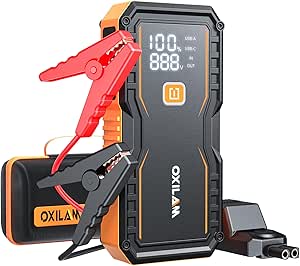
OXILAM 6000A Portable Jump Starter for Gas and 12L Diesel Engines
The OXILAM is the lineup’s strongest stated choice for drivers who need a 6000A peak-current rating and compatibility with diesel engines up to 12L. That engine ceiling exceeds the NOCO Boost GB150’s listed 7.0L diesel limit, making this a more fitting candidate for some large diesel vehicles. It also adds USB and USB-C charging, an 800-lumen light with flashlight, strobe, and SOS modes, and a battery-status display. The tradeoff is that its listing asks owners to charge it above 50% before jump-starting and recharge it every three months during storage, so it calls for more upkeep than a set-and-forget emergency item. Its 8.7 × 4.7 × 3.5-inch format is portable, but the GOOLOO A3 may suit drivers better if onboard tire inflation matters more than the OXILAM’s higher stated output.
Pros:- 6000A peak current and listed compatibility with diesel engines up to 12L.
- Battery-status display helps drivers check charge before an emergency.
- USB and USB-C outputs add portable-device charging.
- 800-lumen light includes flashlight, strobe, and SOS modes.
Cons:- The listing recommends charging above 50% before jump-starting.
- Requires a recharge every three months during storage.
- Unlike the GOOLOO A3, it does not include an air compressor.
Best for: Owners of large diesel vehicles who want a portable lithium starter with a high stated engine limit, battery-status display, and device-charging ports.
Not ideal for: Drivers who want a low-maintenance backup that can sit unused for long stretches, or who need an integrated air compressor for tire emergencies.
- Peak output current:6000 A
- Voltage:12 V
- Battery type:Lithium-ion
- Compatible engines:Gas engines; diesel engines up to 12L
- Battery capacity:6000 amp-hours, as listed
- USB outputs:2 ports; 5V/3A, 9V/2A, 12V/1.5A
- USB-C input:5V/3A, 9V/2A, 12V/1.5A
- LED light:800 lumens; flashlight, strobe, and SOS modes
- Dimensions:8.7 × 4.7 × 3.5 in
Our verdict“Pick the OXILAM for its high stated diesel-engine capacity and versatile charging features if you are willing to monitor its charge during storage.”
GOOLOO A3 12V 3000A Portable Jump Starter with Air Compressor
The GOOLOO A3 is the most useful pick here for drivers who want one portable device to address both a dead battery and low tires. Its 3000A starter is rated for up to 9.0L gas or 6.5L diesel engines, and the BOOST function is intended for very low batteries. The built-in 150 PSI compressor adds five inflation modes, automatic shutoff, and a digital pressure display, giving it a broader roadside role than the NOCO GB150, which focuses on jump-starting, power-bank use, and lighting. That extra utility comes with more settings and gear to manage, and the compressor makes this a different kind of portable kit than a simple pocketable starter like the S ZEVZO ET03. Owners also need to recharge it at least every three months in storage, and charging is limited to 14°F–113°F.
Pros:- Combines a 3000A jump starter with a 150 PSI air compressor.
- BOOST function is designed for very low batteries.
- Compressor has automatic shutoff, a digital pressure display, and five inflation modes.
- Includes USB charging, an LED flashlight, a carrying bag, and inflation accessories.
Cons:- Must be recharged at least every three months during long-term storage.
- Charging is limited to temperatures between 14°F and 113°F.
- Its added compressor features make it less straightforward than a jump-starter-only option such as the NOCO GB150.
Best for: Drivers who want a single emergency kit for jump-starting a car and topping up tires, bike tires, or sports balls.
Not ideal for: Drivers who want the smallest, simplest jump starter or who need to charge the unit outside its 14°F–113°F charging range.
- Peak output current:3000 A
- Voltage:12 V
- Battery type:Lithium polymer
- Battery capacity:12000 mAh
- Engine compatibility:Up to 9.0L gas; up to 6.5L diesel
- Air compressor:150 PSI maximum; 35 L/min airflow
- Inflation modes:SUV, car, bike, ball, and customizable
- Dimensions:4.96 × 5.87 × 2.3 in
- Warranty:18 months
Our verdict“Choose the GOOLOO A3 if tire inflation is as important to your roadside kit as jump-starting, and you can keep up with its storage charging schedule.”
Clore Automotive Jump-N-Carry JNC660 12V Jump Starter, 1700 Peak Amps
The Jump-N-Carry JNC660 takes a different approach from the lithium models in this roundup: its 22Ah AGM battery and 46-inch #2 AWG cables favor a substantial, work-oriented jump pack over easy carrying. The cable length and heavy gauge give users room to position the unit near a vehicle and make connections, while the built-in voltmeter shows the charge of the pack itself. Compared with the NOCO GB150, the JNC660 has a lower peak-current rating and weighs 18 pounds, but its lead-acid construction and long, heavy-duty cables may appeal to drivers who prefer a traditional shop-style unit. It also has a 12V outlet for accessories. The main compromise is clear: this is much less convenient to store or carry than the compact lithium options, and the provided data does not list engine-size compatibility.
Pros:- 46-inch #2 AWG cables provide reach and heavy-duty cable construction.
- 22Ah AGM battery offers a traditional lead-acid jump-pack setup.
- Built-in voltmeter displays the onboard battery’s charge.
- 12V outlet can power compatible accessories.
Cons:- At 18 pounds, it is substantially heavier than lithium options such as the NOCO GB150.
- Its 5.1 × 14.1 × 16.3-inch body takes more storage space than compact jump starters.
- The supplied specifications do not state a compatible engine-size range.
Best for: Drivers, farm users, or workshop owners who value long, heavy-duty cables and an onboard AGM battery over a lightweight emergency pack.
Not ideal for: Commuters who want a compact trunk or glove-box backup, or buyers choosing by a published engine-size compatibility range.
- Peak output current:1700 A
- Voltage:12 V
- Battery type:Lead-acid AGM
- Battery capacity:22 Ah
- Cable length:46 in
- Cable gauge:#2 AWG
- Dimensions:5.1 × 14.1 × 16.3 in
- Weight:18 lbs
- Warranty:1 year
Our verdict“Choose the JNC660 for a cable-focused, traditional AGM jump pack that can stay in a garage or work vehicle, not for lightweight everyday carrying.”
S ZEVZO ET03 4000A Portable Car Jump Starter
At just 1.4 pounds, the S ZEVZO ET03 is the easiest choice in this group to keep close at hand, while its 4000A rating is listed for engines up to 8.0L gas or 7.0L diesel. A force-start function is intended for completely dead batteries, a capability that gives it a different edge from the NOCO GB150, whose stated strength is a rugged IP65 housing and higher gas-engine limit. The ET03 also doubles as a power bank and carries a 500-lumen light with steady, strobe, and SOS modes. Its compactness involves a practical limitation: the force-start function requires a full charge or more than 14V, so it is not a no-preparation solution for a fully depleted pack. USB output is limited to 5V/2A, which is less flexible than the OXILAM’s listed output options.
Pros:- Weighs 1.4 pounds and measures 1.5 × 3.4 × 7.5 inches for easy storage.
- 4000A peak current is listed for up to 8.0L gas and 7.0L diesel engines.
- Force-start function is designed for completely dead batteries.
- Includes two USB outputs, a 500-lumen light, smart cables, and a storage case.
Cons:- Force-start requires the unit to be fully recharged or above 14V.
- USB outputs are limited to 5V/2A.
- Its listed gas-engine limit is lower than the NOCO GB150’s 9.0L rating.
Best for: Drivers who want a lightweight, easy-to-store jump starter with a force-start feature for a fully dead vehicle battery.
Not ideal for: Drivers who need faster USB charging or expect to use force-start without keeping the unit fully charged or above 14V.
- Peak current:4000 A
- Voltage:12 V
- Battery type:Lithium-ion
- Battery capacity:20000 mAh
- Energy capacity:74 Wh
- Engine compatibility:Up to 8.0L gas; up to 7.0L diesel
- USB outputs:2 × 5V/2A
- LED light:500 lumens; steady, strobe, and SOS modes
- Weight:1.4 lbs
Our verdict“Pick the ET03 if low weight and easy storage matter most, provided you keep it charged enough to use its force-start function.”
Povasee A6 5000A Portable Jump Starter with 150 PSI Air Compressor
The Povasee A6 earns this role by pairing a 5000A jump starter with a built-in 150 PSI inflator, so one compact unit can address a weak battery and a low tire. Its LCD and auto-stop function make pressure checks easier to manage than an inflator without a readout, while the stated 35 L/min airflow suits roadside top-ups. Compared with the DEWALT DXAEJ14, it is far lighter and claims compatibility with larger engines, but the DEWALT uses a sealed lead-acid battery and a larger 120 PSI inflator. The A6’s tradeoff is compressor runtime: it may need cooling breaks during extended inflation. I’d also plan to recharge it every two to three months in storage, rather than leaving it unattended for long periods.
Pros:- Combines a 5000A jump starter with a 150 PSI tire inflator.
- LCD display and auto-stop help manage inflation pressure.
- At 1.5 lb, it is much easier to carry than the 17.3 lb DEWALT DXAEJ14.
- Includes LED lighting, SOS signaling, USB charging, and multiple safety protections.
Cons:- The compressor needs cooling breaks during extended use.
- The manufacturer recommends recharging every two to three months.
- Its combined toolset may be unnecessary for buyers who only need battery starting.
Best for: Drivers who want one lightweight emergency unit for jump-starting compatible vehicles and topping up tires on the roadside.
Not ideal for: Drivers who regularly inflate several tires in one session or want a jump starter they can leave stored for long periods without scheduled recharging.
- Peak current:5000 A
- Voltage:12 V
- Battery capacity:22800 mAh
- Engine compatibility:Up to 10L gas or 8L diesel
- Inflator:150 PSI; 35 L/min airflow
- Continuous compressor operation:Up to 25 minutes
- Dimensions and weight:1.9 x 4.2 x 7.7 in; 1.5 lb
- Warranty:24 months
Our verdict“Choose the Povasee A6 if tire inflation matters as much as jump-starting and you are comfortable maintaining its charge and pacing compressor use.”
TREKURE 5000A Portable Car Jump Starter with Magnetic LED Light and Power Bank
The TREKURE 5000A is the pick here for drivers who want a jump starter with a stated force-start mode for fully drained batteries. That capability gives it a different job from the NOCO Boost GBX45, whose listed strengths center on protected starting and USB-C Power Delivery rather than a zero-volt recovery mode. TREKURE also adds a magnetic, multi-mode light, so it can be attached nearby for hands-free work, plus USB power for personal devices. Its claimed 5000A output and compatibility with engines up to 10L gas or 8L diesel are ambitious for a compact unit, though the listed 7200mAh capacity is modest context for anyone comparing it with larger power banks. Force-starting requires a particular connection sequence and a short operating window, so this is not the simplest choice for someone who wants no-fuss operation.
Pros:- Force-start mode is specified for fully drained 0V batteries.
- Magnetic LED light includes lighting, strobe, red strobe, and SOS modes.
- USB power-bank function can charge personal devices.
- Compact body includes a detachable carry loop and 10 listed safety protections.
Cons:- Force-start mode requires a specific connection sequence and must be used within 30 seconds.
- The product information lists conflicting weights: 0.42 kg and 0.8 lb.
- Its 7200mAh capacity is a modest stated power-bank figure compared with the Povasee A6’s 22800mAh.
Best for: Drivers who want a compact jump starter with a specified recovery mode for fully drained batteries and a hands-free magnetic light.
Not ideal for: First-time users who prefer straightforward connections, or buyers who want clearly consistent weight information and a larger stated power-bank capacity.
- Peak current:5000 A
- Voltage:12 V
- Battery capacity:7200 mAh
- Engine compatibility:Up to 10L gas or 8L diesel
- Force-start feature:Specified for fully drained 0V batteries
- Flashlight:Magnetic LED with lighting, strobe, red strobe, and SOS modes
- Listed weight:0.42 kg and 0.8 lb (conflicting figures)
- Safety features:10 protections, including reverse polarity and short circuit
Our verdict“Pick the TREKURE if recovering a fully drained battery and attaching a work light matter more to you than simple, conventional operation.”
NOCO Boost GBX45 1250A 12V Lithium Jump Starter
The NOCO Boost GBX45 stands out among these portable jump starters for its 60W USB-C Power Delivery, which can serve compatible laptops as well as smaller devices. Its 1250A output is more modest than the 5000A figures on the Povasee A6 and TREKURE, and it is rated for engines up to 6.5L gas or 4.0L diesel, so I’d match it to a smaller vehicle rather than choose it for the largest engines in the group. Spark-proof and reverse-polarity protection help reduce connection mistakes, and the seven-mode light adds practical roadside utility. The tradeoff is endurance: the listed maximum is six jump starts per charge. A 48-minute recharge is useful when power is available, but it does not remove the need to plan around that limited starting capacity.
Pros:- 60W USB-C Power Delivery can charge compatible laptops and other devices.
- Spark-proof and reverse-polarity protection help guard against connection errors.
- 100-lumen flashlight offers seven modes, including SOS and strobe.
- Listed recharge time is 48 minutes.
Cons:- Rated for smaller engines than the Povasee A6 and TREKURE.
- Listed for up to six jump starts per charge.
- The 48-minute recharge time still requires access to a suitable power source.
Best for: Owners of smaller gas or diesel vehicles who want a compact jump starter that can also provide high-output USB-C charging.
Not ideal for: Drivers of larger-engine vehicles or anyone who expects many jump starts between recharges; the listed engine limits and six-start maximum are restrictive for those needs.
- Peak output current:1250 A
- Voltage:12 V
- Engine compatibility:Up to 6.5L gas or 4.0L diesel
- USB-C Power Delivery:60 W
- Jump starts per charge:Up to 6
- Recharge time:48 minutes
- Flashlight:100 lumens; 7 modes
- Dimensions and weight:3.62 x 4.96 x 8.23 in; 1.2 kg
Our verdict“Choose the GBX45 for a smaller vehicle if versatile 60W USB-C charging matters more than maximum engine compatibility or repeated starts.”
DEWALT DXAEJ14 1600 Peak Amp Jump Starter with 120 PSI Air Inflator
The DEWALT DXAEJ14 combines a 1600A jump starter with a digital 120 PSI inflator and automatic shutoff, making it a useful fit for drivers who want both functions in a single unit. Unlike the lithium Povasee A6, it uses a sealed lead-acid battery and weighs 17.3 lb; that makes it less appealing to carry far from the car, but it may suit a trunk or garage kit that stays close to the vehicle. Its USB-C and USB-A ports add device charging, while reverse-polarity alerts provide a warning if clamps are connected incorrectly. The main compromises are portability and upkeep: it is much heavier than the A6, needs recharging every 30 days in storage, and should be charged overnight after use. The extension cord is not included.
Pros:- Combines 1600A jump-starting with a digital 120 PSI inflator.
- Automatic shutoff helps stop inflation at the selected pressure.
- USB-C and USB-A ports provide two device-charging options.
- Reverse-polarity alerts warn about incorrect clamp connections.
Cons:- At 17.3 lb, it is much heavier than the Povasee A6.
- Requires recharging every 30 days during storage and overnight charging after use.
- The extension cord for recharging is not included.
Best for: Drivers who want a jump starter and automatic-shutoff inflator in one unit and expect to keep it in a vehicle or garage rather than carry it by hand.
Not ideal for: Anyone prioritizing a lightweight roadside kit or a unit that can sit stored without frequent charge checks.
- Peak output current:1600 A
- Voltage:12 V
- Battery type:Sealed lead acid
- Compatible battery types:WET, GEL, and AGM lead-acid
- Air inflator:120 PSI; digital display with automatic shutoff
- USB outputs:USB-C 25 W; USB-A 15 W
- Dimensions and weight:6 x 11.75 x 13 in; 17.3 lb
- Warranty:Limited 1-year manufacturer warranty
Our verdict“Choose the DXAEJ14 if you want a combined inflator and jump starter for a vehicle kit and can accommodate its weight and charging routine.”
NOCO GENIUS1 1A 6V/12V Smart Battery Charger and Maintainer
The NOCO GENIUS1 serves a different purpose from the portable jump starters in this roundup: it is a plug-in charger and maintainer, not a self-contained unit for starting a car away from household power. Its 1A output suits smaller batteries and long-term care, while support for both 6V and 12V lead-acid and LiFePO4 batteries makes it more versatile across battery types than a jump starter such as the NOCO Boost GBX45. Temperature-adjusted charging and indefinite connected maintenance are useful for vehicles that sit unused, and Force Mode can address a deeply discharged battery. The tradeoff is speed: the listed charge time is 10 hours, and the maximum supported capacity is 30Ah. I’d choose it to maintain a parked vehicle’s battery, not as the only emergency tool in a car.
Pros:- Charges and maintains both 6V and 12V batteries.
- Supports lead-acid battery types and LiFePO4.
- Temperature-adjusted charging and indefinite maintenance support long-term battery care.
- Includes clamps and integrated eyelet terminals for different connection setups.
Cons:- It must be plugged in and cannot serve as a portable jump starter.
- The 1A output can take a long time on larger batteries.
- Maximum supported battery capacity is 30Ah, with a listed 10-hour charge time.
Best for: Owners of motorcycles, seasonal vehicles, or other equipment with batteries up to 30Ah who can plug in and want ongoing maintenance.
Not ideal for: Drivers seeking an emergency, cordless jump starter or a fast charger for larger vehicle batteries.
- Output voltage:12 V
- Supported battery voltage:6V and 12V
- Charging current:1 A
- Battery types:Lead-acid (AGM, gel, flooded, deep-cycle) and LiFePO4
- Maximum battery capacity:30 Ah
- Listed charge time:10 hours
- Cable length:110 in
- Warranty:3 years
Our verdict“Choose the GENIUS1 for slow, ongoing care of a compatible battery near an outlet, not for roadside jump-starting.”
NOCO Boost GB40 12V 1000A UltraSafe Portable Lithium Jump Starter
The NOCO Boost GB40 is a balanced pick for drivers who want a jump starter that stays compact without being limited to small gasoline engines. Its 1000A output is rated for engines up to 6.0L gas and 3.0L diesel, giving it broader coverage than the GB20, while its IP65 housing and polarity protections suit glove-box or trunk storage. NOCO lists up to 20 starts per charge, and the USB-C power bank and seven-mode light add useful backup functions. Compared with the larger GB70, the GB40 is easier to store but is rated for smaller engines and has a less powerful light. Its main tradeoffs are that engine compatibility still has limits and the included charging accessories are sparse. I’d choose it for a typical car or light-truck emergency kit, not as a universal solution for large diesels.
Pros:- Rated for up to 6.0L gas and 3.0L diesel engines
- Up to 20 starts per charge according to the product data
- Spark-proof and reverse-polarity protection
- IP65 housing, USB-C power bank, and seven-mode flashlight
Cons:- Engine compatibility does not cover larger vehicles
- Charging accessories are limited to the included USB-C cable
Best for: Drivers of cars and light trucks who want a compact jump starter with safety protections and a useful engine-compatibility range.
Not ideal for: Owners of gasoline engines above 6.0L or diesel engines above 3.0L, who need a model such as the GB70 with higher stated capacity.
- Battery type:Lithium
- Voltage:12 V
- Peak output:1000 A
- Compatible engines:Up to 6.0L gas and 3.0L diesel
- Starts per charge:Up to 20
- Flashlight:100 lumens; 7 modes
- Ingress protection:IP65
- Dimensions:4.61 x 8.19 x 4.21 in
Our verdict“Choose the GB40 for a compact, safety-focused jump starter for everyday vehicles; step up to the GB70 for larger engines.”
Joltekon 6000A Car Battery Jump Starter with 150 PSI Air Compressor
The Joltekon 6000A pairs a jump starter with a 150 PSI tire inflator, so it can address a flat tire as well as a weak battery without requiring separate devices. Its automatic shutoff and pressure memory are useful when topping up tires, while the display, emergency light, and power-bank function add roadside support. The stated compatibility reaches gas engines and diesel engines up to 10L, a wider diesel range than the NOCO GB40 or GB20. That breadth comes with a tradeoff: the product description does not provide charging or recharge times, and its jump-start and inflation performance claims are not independently verified in the supplied information. Compared with the 4500A compressor model in this list, the Joltekon claims higher peak output and a larger stated battery capacity, but provides fewer detailed measurements about its physical size and operation.
Pros:- Combines a jump starter, tire inflator, power bank, and emergency light
- Automatic inflation shutoff and pressure memory
- Stated compatibility includes diesel engines up to 10L
- Multiple jump-start safety protections
Cons:- Charging and recharge times are not specified
- Jump-start and inflation performance claims are not independently verified in the supplied product data
Best for: Drivers who want one roadside device for jump-starting and tire inflation, especially those with a vehicle within the stated 10L diesel limit.
Not ideal for: Buyers who prioritize clearly documented recharge times, dimensions, or independently verified performance claims.
- Battery type:Lithium polymer
- Voltage:12 V
- Peak output:6000 A
- Battery capacity:10,000 mAh (37 Wh, as stated)
- Engine compatibility:All gas engines; diesel engines up to 10L
- Maximum inflation pressure:150 PSI
- Inflation rate:45 L/min
- Temperature range:-4°F to 140°F
Our verdict“Pick the Joltekon if you want jump-starting and tire inflation in one unit and can accept limited detail about charging and performance.”
4500A Car Jump Starter with 150 PSI Air Compressor
This 4500A jump starter with air compressor is aimed at drivers who want more than battery backup but still want a relatively narrow unit: it measures 7.88 x 1.97 x 3.78 inches and weighs 1200 g. Its 150 PSI inflator includes five modes, four nozzles, several pressure units, and automatic shutoff, making it more adaptable to different inflation jobs than a jump starter alone. The 500-lumen lighting and smart display add practical roadside visibility and status information. Compared with the Joltekon, it lists more concrete inflation controls and dimensions, but its stated peak output and battery capacity are lower. The force-start function is intended for low-voltage batteries, though the supplied data gives no engine-size limits to help buyers match it to a vehicle. It also needs periodic recharging in storage, and the 30-second start window after connecting the smart clip calls for prompt use.
Pros:- 150 PSI compressor has five modes, four nozzles, and automatic shutoff
- Smart display and multiple built-in safety protections
- 500-lumen light includes flashlight, SOS, and strobe modes
- Compact listed dimensions for a jump starter with an air compressor
Cons:- Requires recharging every 2–3 months during extended storage
- Vehicle must be started within 30 seconds after connecting the smart clip
- Product data does not state specific engine-size limits
Best for: Drivers who want a jump starter with a tire inflator, multiple nozzle options, and a compact shape for vehicle storage.
Not ideal for: People who want a long-term set-and-forget emergency device or need clearly stated engine-size compatibility before buying.
- Battery type:Lithium polymer
- Voltage:12 V
- Peak output:4500 A
- Battery capacity:7200 mAh
- Compressor pressure:150 PSI
- Inflation features:5 modes, automatic shutoff, 4 nozzles; PSI/BAR/KPA
- Lighting:500 lumens; flashlight, SOS, white strobe, and red strobe
- Dimensions and weight:7.88 x 1.97 x 3.78 in; 1200 g
Our verdict“Choose this model for a compact jump-starter-and-inflator combination with detailed inflation controls, but not for long-term storage without upkeep.”
NOCO Boost GB20 500A UltraSafe 12V Lithium Jump Starter
The NOCO Boost GB20 is the simplest fit here for drivers of smaller gasoline vehicles who want a compact jump starter from the same safety-focused line as the GB40. Its 500A peak output is rated for gas engines up to 4.0L, so it covers many passenger cars and smaller recreational vehicles but has less headroom than the GB40’s 1000A and diesel compatibility. NOCO lists up to 20 starts per charge, and the IP65 housing, spark-proof design, and reverse-polarity protection support keeping it in a vehicle kit. It also doubles as a USB-C power bank and has a seven-mode light. Compared with the GB40, it is the more limited choice for larger engines; compared with the compressor-equipped models, it offers no tire inflation. The supplied weight information conflicts, so I would not rely on it for a precise weight comparison.
Pros:- Rated for gasoline engines up to 4.0L
- Up to 20 starts per charge according to the product data
- Spark-proof and reverse-polarity protection
- IP65 housing, USB-C power bank, and seven-mode flashlight
Cons:- 500A output and gasoline-only engine rating limit its range compared with the GB40
- Product information lists conflicting weights
Best for: Owners of gasoline cars, motorcycles, ATVs, and other smaller vehicles who want a straightforward portable jump starter.
Not ideal for: Drivers of larger gasoline engines or diesel vehicles, who need more stated engine coverage than the GB20 provides.
- Battery type:Lithium
- Voltage:12 V
- Peak output:500 A
- Battery capacity:2150 mAh
- Compatible engines:Gasoline engines up to 4.0L
- Starts per charge:Up to 20
- Ingress protection:IP65
- Flashlight:100 lumens; 7 modes
Our verdict“The GB20 suits smaller gasoline vehicles and compact emergency kits, while the GB40 is the better fit for larger engines or diesel.”
NOCO Boost GB70 2000A 12V Lithium Jump Starter
The NOCO Boost GB70 is the strongest fit in this group for drivers whose vehicles exceed the GB40 or GB20’s stated engine limits. Its 2000A peak output is rated for up to 8.0L gas and 6.0L diesel engines, and the product data lists up to 40 starts per charge. That added capacity is useful for larger vehicles or drivers who want more starting headroom, while spark-proof and reverse-polarity protections keep the connection process straightforward. The 400-lumen, seven-mode flashlight is brighter than the GB40 and GB20 lights. The tradeoff is a larger, heavier package: at 5 lb, it is less appealing for a small glove box, and recharge time can reach six hours. Unlike the Joltekon and 4500A models, it has no integrated air compressor, so it is focused on starting power rather than tire care.
Pros:- Rated for engines up to 8.0L gas and 6.0L diesel
- 2000A peak output and up to 40 starts per charge
- Spark-proof and reverse-polarity protection
- 400-lumen, seven-mode light and IP65-rated housing
Cons:- Weighs 5 lb, making it less convenient to carry than the GB40 or GB20
- Recharge can take up to 6 hours
- No integrated tire inflator
Best for: Owners of larger gas or diesel vehicles who want a portable jump starter with higher stated output and more starts per charge.
Not ideal for: Drivers seeking the lightest possible emergency kit or a combined jump starter and tire inflator.
- Battery type:Lithium-ion
- Voltage:12 V
- Peak output:2000 A
- Battery capacity:5000 mAh
- Engine compatibility:Up to 8.0L gas and 6.0L diesel
- Starts per charge:Up to 40
- Flashlight:400 lumens; 7 modes
- Weight:5 lb
Our verdict“Choose the GB70 for larger engines and higher starting capacity, but opt for a lighter model if portability matters more than engine coverage.”
How We Picked
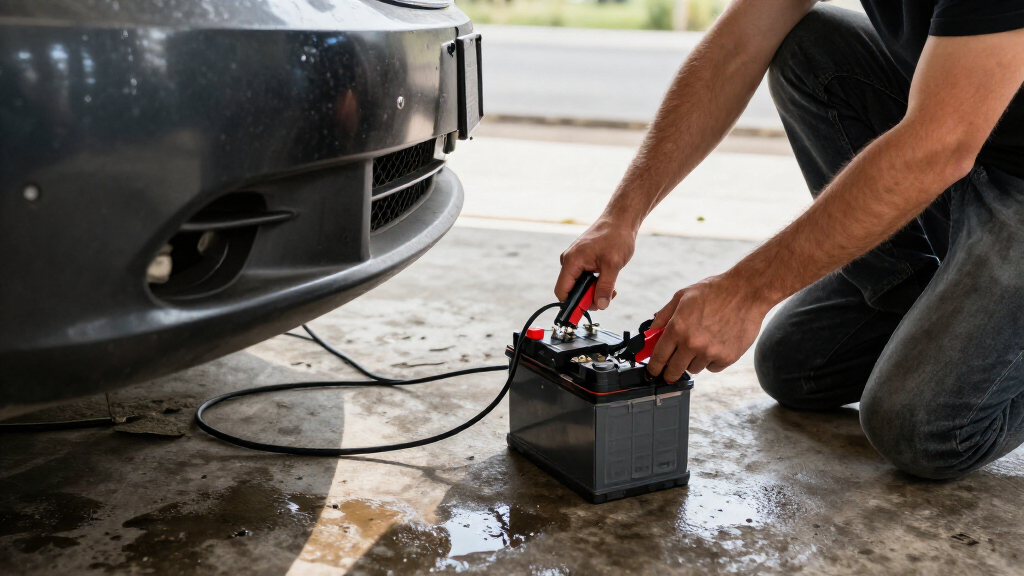
I grouped these products by what they actually do: portable jump starters, jump starters with built-in air compressors, a traditional-style jump pack, and a plug-in charger and maintainer. That distinction matters because a jump pack is for delivering a short burst of power to start a vehicle, while the GENIUS1 requires an external outlet and is intended for charging or maintenance. I compared stated output and vehicle suitability, portability, added functions, charging or maintenance role, and the practical complexity each feature brings. I also treated listed engine limits and voltage compatibility as more useful for fit than peak-amp numbers on their own.
The ranking favors products that have a clear role, useful capability for their intended buyer, and a practical balance of power and convenience. The GB150 leads as a high-output, dedicated jump starter; compressor combinations rank for buyers who value roadside versatility, not as automatic upgrades for everyone. The GB20 and other smaller NOCO models make more sense where compactness or simpler needs outweigh maximum output. Because product specifications and vehicle requirements can vary, I would check the current manufacturer guidance for your engine, battery type, and operating conditions before buying.
| portable car battery charger | Battery type |
|---|---|
| NOCO Boost GB150 3000A UltraSa | Lithium |
| OXILAM 6000A Portable Jump Sta | Lithium-ion |
| GOOLOO A3 12V 3000A Portable J | Lithium polymer |
| Clore Automotive Jump-N-Carry | Lead-acid AGM |
| S ZEVZO ET03 4000A Portable Ca | Lithium-ion |
| Povasee A6 5000A Portable Jump | — |
| TREKURE 5000A Portable Car Jum | — |
| NOCO Boost GBX45 1250A 12V Lit | — |
| DEWALT DXAEJ14 1600 Peak Amp J | Sealed lead acid |
| NOCO GENIUS1 1A 6V/12V Smart B | — |
| NOCO Boost GB40 12V 1000A Ultr | Lithium |
| Joltekon 6000A Car Battery Jum | Lithium polymer |
| 4500A Car Jump Starter with 15 | Lithium polymer |
| NOCO Boost GB20 500A UltraSafe | Lithium |
| NOCO Boost GB70 2000A 12V Lith | Lithium-ion |
Factors to Consider When Choosing Portable Car Battery Chargers
Before choosing among these portable car battery chargers, decide whether you need to start a vehicle away from an outlet, recharge a battery near one, or handle more than one roadside task. That first distinction prevents the most common mismatch: buying a maintainer when you need an emergency jump pack, or paying for a compressor you will rarely use.
1. Decide Whether You Need a Jump Starter or a Plug-In Charger
A portable jump starter stores power onboard and supplies a brief current burst to help start a vehicle; it does not restore a deeply discharged battery the way a charger can. A plug-in charger needs access to household power and replenishes a battery more gradually, while a maintainer is intended to support a battery during storage. Do not treat those jobs as interchangeable just because both products are called battery chargers. If you park outdoors or travel, a jump pack is the more relevant emergency tool. If a vehicle sits for weeks near an outlet, a charger or maintainer may address the recurring problem better. The GENIUS1 belongs to that second group, unlike the 14 jump starters in this lineup.
2. Match Output and Vehicle Limits, Not Just the Biggest Number
Peak-amp figures can help compare jump starters, but they are not a universal measure of how well a model will suit every engine or battery. Check the maker’s stated gas and diesel engine limits, the vehicle’s voltage, and any instructions for battery type or temperature. A higher-output model may make sense for larger engines or broader vehicle use, but it can add size and cost without helping a small commuter car owner. Conversely, choosing a compact unit based only on convenience can leave too little capacity for a larger vehicle or difficult starting conditions. Keep a margin between your vehicle’s needs and the product’s stated limits, and check current specifications before purchase.
3. Weigh Portability Against Extra Functions
A compact jump starter is easier to keep in a glove box or small emergency kit, while a larger model may offer more output or extra equipment. Built-in compressors can be useful when a tire needs air on the roadside, but they add another function to learn and another reason to check the unit’s size and operating instructions. A power bank or work light may also help during a breakdown, though neither replaces a dedicated flashlight or a tire-pressure gauge. Think about where the unit will live and who might need to use it under stress. If you already carry an inflator, a simpler jump starter may be the more sensible choice. If one device needs to cover several roadside tasks, the added bulk can be worthwhile.
4. Check the Practical Details Before an Emergency
A jump starter is only useful if it is charged, its cables can reach the battery terminals, and its instructions are clear to the person using it. Review how the manufacturer handles connection errors and what its safety guidance requires; do not assume that every model has identical protections. Check the manual for charging intervals, storage conditions, and the steps for preparing the unit after long periods unused. A built-in light or screen can make setup easier in low visibility, but it does not remove the need to follow the connection sequence. Before an emergency, learn the procedure at home and confirm the unit has the right cables and adapters for your vehicle. Recheck stored gear periodically rather than assuming it will be ready years later.
5. Choose a Power Source That Fits Your Parking Routine
Jump packs and plug-in chargers solve different location problems, so consider where the vehicle usually sits. A jump starter is self-contained and suited to travel or parking away from an outlet, but its internal battery needs to be kept charged. A charger such as the GENIUS1 can support a battery over time, but only where a suitable power source and safe connection are available. Buyers often choose a maintainer for roadside readiness or expect a jump pack to fix a battery that repeatedly loses charge; neither solves the underlying mismatch. If battery drain recurs, inspect the battery and vehicle charging system rather than relying on repeated jumps. For vehicles stored seasonally, follow battery and charger makers’ guidance for storage and maintenance.
6. Pay for Capabilities You Will Actually Use
Extra output, an air compressor, a power bank, or a more substantial form factor can justify choosing a more capable unit when those features match your routine. They are less compelling if the vehicle is small, the device will rarely leave the garage, or you already own separate roadside equipment. A basic model can be easier to store and operate, but it still needs to meet the vehicle’s requirements. Compare the included functions with the tasks you expect to handle, not with the longest feature list. Also check whether the product provides the accessories and instructions you need, since add-ons may affect convenience. Spending more makes the most sense when it solves a specific limitation rather than simply increasing the spec sheet.
Frequently Asked Questions
Can the NOCO GENIUS1 jump-start my car like the other products here?
No. The GENIUS1 is a plug-in 6V/12V charger and maintainer, not a portable jump starter with an onboard power supply for an emergency start. It needs an appropriate external power source and is designed to charge or maintain a compatible battery. If you need help starting a vehicle away from an outlet, choose one of the jump starters instead. If your battery repeatedly goes flat, charging it may help temporarily, but the battery and vehicle charging system may need diagnosis.
Is a 6000A jump starter automatically better for my car than a smaller model?
Not automatically. Peak-amp figures are only one part of the comparison, and a high number does not by itself confirm compatibility with your engine or battery. Check the product’s stated gas and diesel limits, voltage, instructions, and the needs of your specific vehicle. A smaller unit may be easier to store and sufficient for a compatible car, while a higher-output model may suit a broader or larger-vehicle use case. Choose by the manufacturer’s fit guidance rather than the largest headline figure.
Should I buy a jump starter with a built-in air compressor?
A combination model makes sense if you want one device for starting support and occasional tire inflation, and you have room to store it. Models such as the GOOLOO A3 and DEWALT DXAEJ14 add an inflator function that a basic jump pack does not provide. That versatility can also mean a larger, more feature-heavy device, so it may be unnecessary if you already carry a separate compressor. Check the inflator’s stated capabilities and operating instructions before relying on it for your tire needs. A jump starter’s compressor is not a replacement for routine tire checks.
Which type should I choose if my vehicle sits unused for long periods?
If the vehicle is stored near a suitable outlet, a compatible charger or maintainer may be better suited to supporting the battery over time than a jump pack alone. The GENIUS1 is the lineup’s plug-in maintenance option, while the other products are principally for jump-starting. If the vehicle is stored without access to power, a charged jump starter can provide emergency starting support, but it will not prevent battery discharge. Follow the vehicle and battery makers’ storage advice, and investigate repeated battery drain rather than treating jumps as a long-term fix.
What should I check before using a portable jump starter on a diesel vehicle?
Start by confirming that the exact model lists support for your diesel engine size and matches the vehicle’s voltage and battery requirements. Do not infer diesel suitability from a large peak-amp figure alone; the product’s stated engine limit is the more relevant guide. Read the connection and safety instructions before the battery is flat, and check for any conditions or battery types that affect use. If the vehicle has multiple batteries or a special starting system, consult its manual or a qualified technician. Stop if the battery is damaged, leaking, or otherwise unsafe to handle.
Conclusion
For a dedicated, high-output jump starter, I’d start with the NOCO Boost GB150 as the best overall pick in this group. For best value, compare the simpler NOCO GB40 or GB20 against your vehicle’s stated needs; the right one is the smallest model that still fits, not automatically the one with the lowest output. The best premium-style choice for buyers seeking added roadside functions is a compressor-equipped model such as the DEWALT DXAEJ14 or GOOLOO A3, while those who want a traditional jump-pack format can look at the Clore Automotive JNC660. For beginners, a straightforward jump starter matched to the vehicle is easier to justify than a device with features they may not use; read and practice the instructions before an emergency. For specific needs, choose the NOCO GENIUS1 for outlet-based charging and maintenance, or a compressor combination if tire inflation is part of the job. Confirm current specifications and vehicle compatibility before making the final choice.