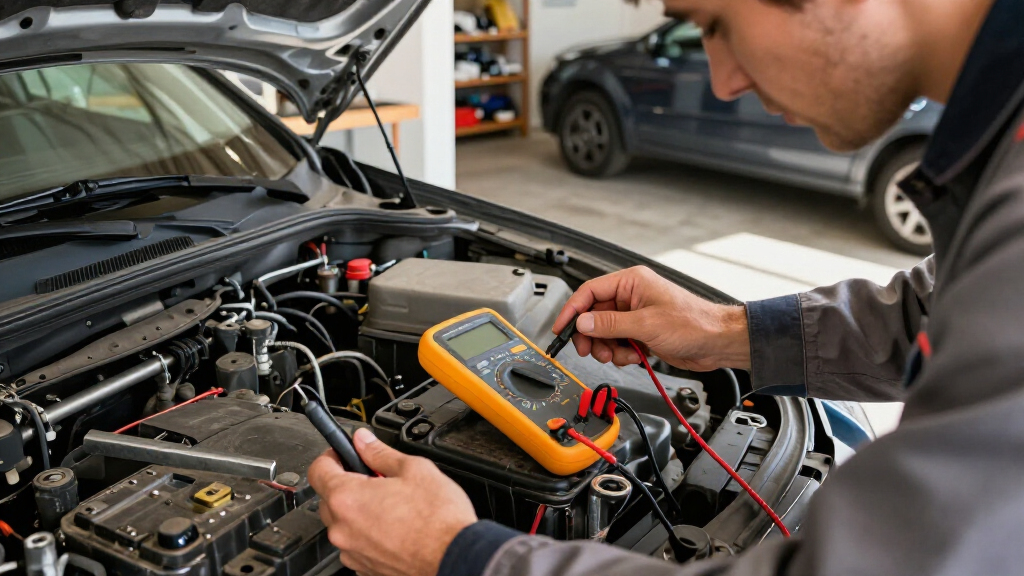
This checklist is for drivers and garage owners who want to make battery care easier to plan. It covers tools for charging, jump-starting, testing, cleaning terminals, holding batteries, and disconnecting power. Start with your routine: consider which tasks you handle yourself and which items would be useful to keep on hand.

Get business pricing on garage and car supplies
- Business-only prices and quantity discounts
- Tax-exempt purchasing
- Multiple users, one account, clear invoices
The sections follow those six jobs, with one named pick in each. Each includes what the slot is for, practical points to consider, and a concise verdict. Use the product names as your starting point, then check the item’s specifications and instructions before deciding whether it suits your vehicle and setup.
Work through the checklist by need rather than assuming every garage needs every item. Match any charger or jump starter to the battery and vehicle requirements, and confirm fit and compatibility for installed hardware. Check before buying, especially when the product name alone does not establish a specific fit or use case.
Smart Battery Charger
A charger is the pick for maintaining or replenishing a battery when charging is part of your routine. The TowerTop 25A Max Pro Battery Charger is identified as a 12V fully automatic smart trickle charger, so the key starting point is confirming that the battery you intend to charge is 12V and that the product instructions cover its chemistry and use. Match voltage and battery type before connecting anything; a product name does not confirm compatibility with every battery.
A common buying mistake is treating “fully automatic” or “trickle” as a substitute for reading operating guidance. Check how the charger is intended to be connected, monitored, and stored, and whether its leads and placement work in your garage. Think through access to a suitable power outlet and the location where charging will take place. Plan the connection and placement around the battery and the charger’s instructions, rather than choosing based only on the headline amperage. If you expect to use it across multiple vehicles, verify each battery’s requirements individually.
What to look for:
- Confirm the battery is 12V and supported by the charger
- Check the instructions for your battery chemistry and charging use
- Review connection, monitoring, and storage guidance
- Make sure the leads reach the intended battery location
- Confirm a suitable power outlet is available
TowerTop 25A Max Pro Battery Charger: 12V Fully Automatic Smart Trickle Charger

The TowerTop 25A Max Pro Battery Charger is a versatile 12V fully automatic smart charger suitable for various battery types, including lead acid and lithium. It features multiple charging modes, engine start assistance, DC power supply, and winter mode, with a user-friendly LCD display and comprehensive safety protections.
Pros:
- Fast and efficient charging with adjustable current settings
- Supports multiple battery types and professional charging modes
- Engine start aid and DC power supply functions for versatile use
- Comprehensive safety protections and user-friendly LCD display
Cons:
- Cannot repair completely dead batteries
- Complex features may be overwhelming for beginners
- Relatively high power consumption during fast charging
Best for: Drivers seeking a 12V fully automatic smart trickle charger
Not ideal for: Owners whose battery requirements are not confirmed as compatible
Bottom line: Choose the TowerTop only after confirming your battery matches its specifications and instructions.
Portable Jump Starter
A portable jump starter is intended to provide a way to attempt a jump start without relying on another vehicle being nearby. The NOCO Boost X GBX155 is named as a 4250A 12V lithium jump starter. Check vehicle and battery fit in the manufacturer’s guidance before relying on those headline details; the product name alone does not establish suitability for every engine or battery setup.
A common mistake is buying a jump starter and leaving it unused until an emergency, without first checking its instructions or readiness requirements. Read the guidance for connection, charging, storage, and use, and make sure you can access the unit and its leads when needed. Consider where it will be stored and whether that spot is practical for your vehicle. Plan for readiness by following the product’s care instructions and checking compatibility before an urgent situation arises. If you drive more than one vehicle, verify the intended use for each rather than assuming the same unit covers them all.
What to look for:
- Confirm suitability for your vehicle and battery in the product guidance
- Review connection and jump-start instructions before use
- Check charging and storage requirements
- Choose an accessible storage location for the unit and leads
- Verify intended use separately for each vehicle
NOCO Boost X GBX155 4250A 12V Lithium Jump Starter

The NOCO GBX155 is a 12V lithium jump starter rated at 4,250 amps, suitable for gas engines up to 10.0L and diesel engines up to 8.0L. It features spark-proof and reverse-polarity protection, USB-C Power Delivery charging and power-bank functionality, and a 500-lumen flashlight with seven modes.
Pros:
- Spark-proof and reverse-polarity protection
- Can jump-start compatible vehicles with gas engines up to 10.0L and diesel engines up to 8.0L
- USB-C port can charge devices and recharge the starter
- Built-in 500-lumen flashlight includes SOS and strobe modes
Cons:
- Weighs 7 pounds
- Requires up to 2.7 hours for a full recharge
Best for: Drivers who want a named 12V lithium jump starter available
Not ideal for: Anyone who has not verified vehicle fit and readiness requirements
Bottom line: Keep the NOCO in consideration once its instructions confirm compatibility with your vehicle.
Battery Load Tester
A load tester belongs on the checklist when you want a tool for checking battery performance under load. The Auto Meter Products SB-5/2 is identified as an 800 Amp variable load battery and electrical tester. Understand the test range and the product’s intended applications before selecting it; the name alone does not explain which battery types, systems, or procedures it supports.
A common buying mistake is assuming that an amp figure tells you whether a tester is appropriate for your vehicle or skill level. Review the instructions, supported battery specifications, and any safety requirements before use. Consider whether the tester’s controls and procedure make sense for the checks you plan to perform, and whether you have a suitable place to work. Follow the test procedure exactly and confirm that your battery falls within the stated limits. If you are unsure how to interpret results or connect the tester, consult the product documentation or a qualified technician rather than guessing.
What to look for:
- Confirm supported battery types and specifications
- Review the tester’s intended applications and test procedure
- Check connection and safety instructions
- Understand how results are interpreted
- Make sure the product suits your experience and workspace
Auto Meter Products SB-5/2 800 Amp Variable Load Battery and Electrical System T

This battery and electrical system tester is designed for automotive and commercial starting batteries, capable of testing 6V and 12V systems. It features load testing, alternator regulation testing, and a 15-second timer, with an analog display and a cooling fan.
Pros:
- Suitable for 6V and 12V automotive and commercial batteries
- Includes multiple testing functions such as load test and alternator regulation
- Analog display provides clear readings
- Compact and portable design
Cons:
- Heavy weight (20 lbs) may affect portability
- Limited to battery and electrical system testing only
- No external volt leads or amp probe included
Best for: Users looking for a named 800 Amp variable load tester
Not ideal for: Buyers who have not checked supported batteries and procedures
Bottom line: Select the Auto Meter tester only when its documentation matches your intended tests.
Battery Terminal Cleaner
Clean, protected terminals are a maintenance concern, and this checklist’s named pick is the CRC 05046 Battery Terminal Protector. Confirm the product’s role before treating it as a cleaner: its supplied name identifies it as a protector, so check the label and instructions for its intended application and whether a separate cleaning product or tool is needed for your task.
A common buying mistake is assuming a protector removes buildup or replaces terminal cleaning. Read the directions for application, compatibility, and preparation, and identify the battery and terminal materials involved. Make sure the product fits your maintenance sequence and that you can follow the stated handling guidance. Use it as directed, and don’t infer cleaning performance from the section heading. If you are assembling a complete terminal-care setup, determine whether you need a cleaner, a protector, or both by consulting product instructions and the condition of the terminals. Avoid applying any product without confirming its intended surfaces and procedure.
What to look for:
- Verify whether the product protects, cleans, or serves another stated role
- Read application and preparation directions
- Confirm compatibility with your battery and terminal materials
- Check handling and storage guidance
- Determine whether a separate cleaning tool or product is needed
CRC 05046 Battery Terminal Protector

This battery terminal protector is designed to prevent corrosion on battery terminals, cables, and connectors. It provides a lead-free, soft protective coating that helps prolong battery life and ensures easier starting.
Pros:
- Protects battery terminals from corrosion
- Prolongs battery life
- Easy to apply
Cons:
- Limited information on durability
- No specific application instructions provided
Best for: Shoppers seeking the named CRC battery terminal protector
Not ideal for: Anyone expecting a protector alone to perform every cleaning task
Bottom line: Check the label to confirm the CRC product’s role in your terminal-care routine.
Battery Hold-Down Kit
A battery hold-down should suit the battery and its mounting location, so fit is central to this slot. The listed pick is called “Battery Organizer Case with Battery Tester, Holds 200+ Batteries.” Confirm what the item is before buying it as vehicle hardware: the supplied name describes an organizer case and battery tester, and does not establish that it is a vehicle battery hold-down kit.
A common buying mistake is relying on a section label when the product name points to a different use. Check the listing and product documentation for dimensions, intended battery types, mounting method, and whether it is designed for installation in a vehicle. Compare those details with the battery and its available mounting space. Verify the actual fit and intended application rather than assuming the item will secure a car battery. If the documentation does not confirm vehicle hold-down use, choose a product whose stated purpose and dimensions match your installation needs.
What to look for:
- Confirm the item is designed as a vehicle battery hold-down
- Check dimensions against the battery and mounting location
- Review the mounting method and included hardware
- Verify intended battery types and installation use
- Compare the listing details with the product name
Battery Organizer Case with Battery Tester, Holds 200+ Batteries

A portable battery storage case with foam slots for organizing AA, AAA, C, D, 9V, and button batteries, plus a BT-168 battery tester. It has a hard EVA exterior, a double zipper, and a handle; batteries are not included.
Pros:
- Foam slots store batteries individually and keep contact ends separated.
- Includes a tester for checking battery charge.
- Portable design has a handle and double zipper.
- Case is described as water-resistant, shockproof, and dustproof.
Cons:
- Batteries are not included.
- The stated capacity depends on battery sizes and types.
Best for: Shoppers who confirm the item’s intended vehicle use
Not ideal for: Anyone needing a confirmed vehicle battery hold-down without further checking
Bottom line: The organizer-case name does not establish hold-down compatibility, so verify the listing and fit first.
Battery Disconnect Switch
A disconnect switch is a hardware choice that should match the vehicle’s electrical setup and the intended installation. The Flaming River FR1003 is named as a battery disconnect big switch. Confirm electrical and mounting fit in its product documentation before choosing it, since the name alone does not specify compatible vehicles, current ratings, or installation requirements.
A common buying mistake is assuming a switch will fit a battery system because it is described as a disconnect. Check the stated electrical ratings, terminal arrangement, mounting dimensions, and instructions, then compare them with your vehicle and planned location. Consider access to the switch and whether installation calls for additional parts or professional help. Follow the installation guidance and use a qualified installer if the wiring or fit is uncertain. Do not treat the product name as confirmation that it is suitable for every vehicle or electrical configuration.
What to look for:
- Check electrical ratings against your system requirements
- Confirm terminal arrangement and connection instructions
- Compare mounting dimensions with the intended location
- Review installation guidance and required hardware
- Verify suitability for your vehicle configuration
Flaming River FR1003 Battery Disconnect Big Switch

The Flaming River FR1003 is a large battery disconnect switch designed for automotive applications. It provides a reliable way to disconnect the battery for safety and maintenance.
Pros:
- Durable and reliable battery disconnect switch
- Easy to install and operate
- Compact packaging suitable for various applications
Cons:
- Limited detailed specifications provided
- No customer reviews or ratings available
Best for: Shoppers whose electrical setup matches the stated specifications
Not ideal for: Buyers who have not confirmed ratings and mounting compatibility
Bottom line: Consider the Flaming River FR1003 after matching its electrical and physical fit to your setup.
Build the checklist in the order that addresses your most immediate needs. Start with items tied to routine battery care or a known maintenance task, then consider emergency jump-starting and testing tools. Before purchasing hardware or chemicals, verify the intended use, fit, and instructions. Let compatibility guide the order: a product that does not match the battery or vehicle is not a useful first buy.
You do not need to assemble the whole list at once. Choose one task, check the product details against your vehicle and battery, and add other items as your garage routine becomes clearer. A careful checklist makes shopping simpler, and the right documentation helps you use each item with confidence.
Black Friday Picks

Vitamix Propel Series 510 Professional-Grade Blender, Black
As an affiliate, we earn on qualifying purchases.