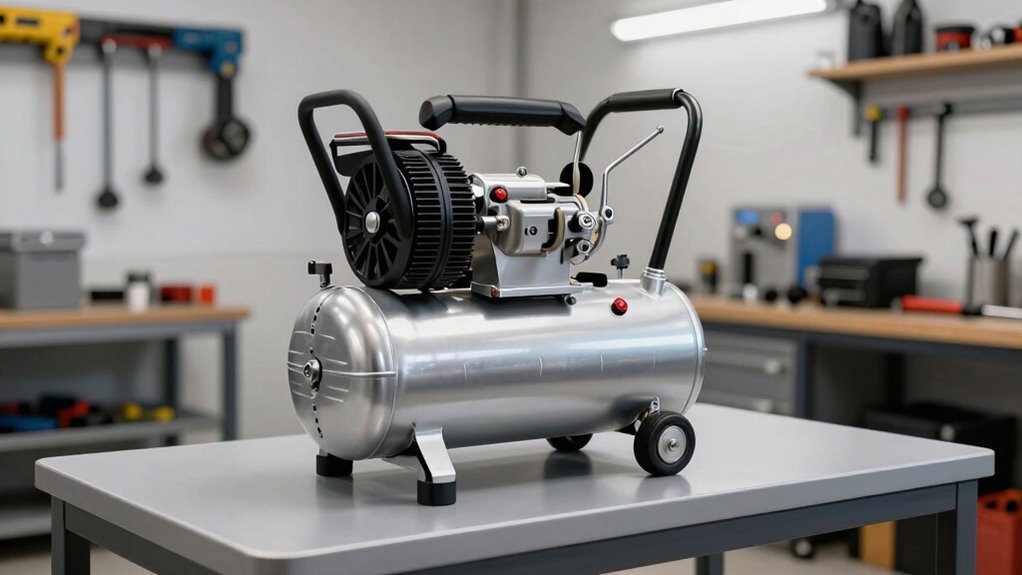
To prevent garage buyer’s remorse, match your compressor’s size to your projects. If you mainly inflate tires or run small tools, go for a portable, smaller tank model with lower CFM. For demanding tasks like spray painting, choose a larger compressor with ample capacity and higher CFM. Balancing power, size, and noise helps you avoid wasting money or struggling with oversized, noisy units. Keep your needs in focus, and you’ll find the perfect fit—plus, there’s more to discover if you keep going.

Get business pricing on garage and car supplies
- Business-only prices and quantity discounts
- Tax-exempt purchasing
- Multiple users, one account, clear invoices
Key Takeaways
- Match compressor capacity (CFM and tank size) to your specific tasks to avoid under- or overestimating needs.
- Prioritize portability for small projects, but ensure the size can handle your most demanding tasks.
- Consider noise levels; quieter models are better for garages near living spaces.
- Understand key specs—CFM for tool compatibility and tank size for work duration.
- Balance space, mobility, and power to select a compressor that fits your workflow and environment.
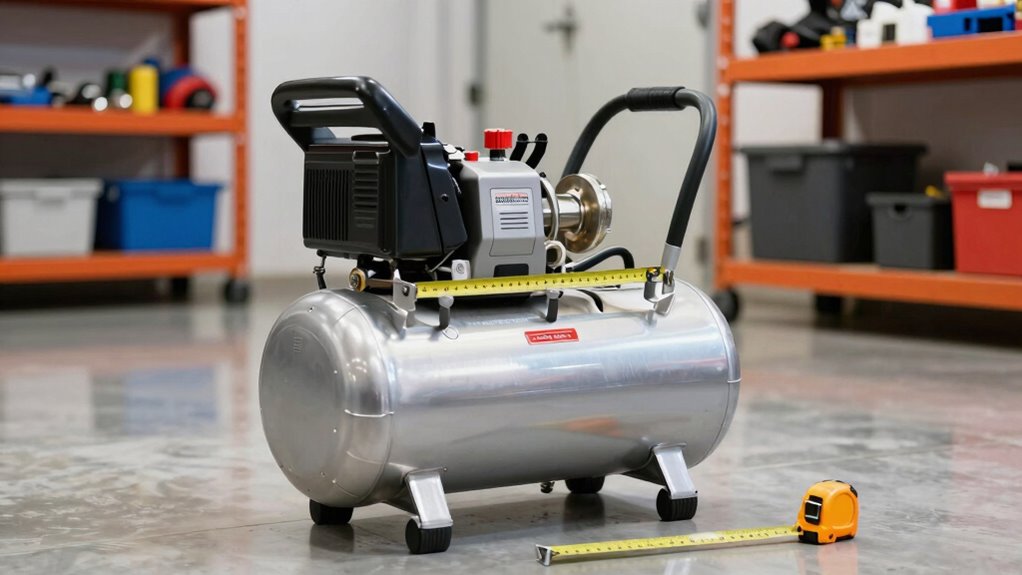
Ever wonder how to choose the right air compressor size for your needs? The key is understanding your tasks and matching them with the right compressor capacity. If you’re shopping for a unit that’s easy to move around, portable options are a smart choice. These compact compressors are lightweight, often come with wheels or handles, and are perfect for small projects or tasks around the garage. However, don’t let their size fool you—they can still deliver enough power for inflating tires, cleaning tools, or powering small air tools. When considering portable options, think about where you’ll use the compressor most often. If you need to move it frequently or store it easily, a smaller, portable model saves space and adds convenience. Just remember, these models typically have smaller tanks, which means you might need to wait for the compressor to catch up if you’re doing continuous work.
Portable air compressors are ideal for small projects, offering convenience, mobility, and sufficient power for light tasks around the garage.
Noise considerations are another essential factor. Smaller, portable compressors tend to be quieter than large, stationary units, making them more suitable if your garage is close to living spaces or if noise is a concern. If you prefer a quieter environment, look for models specifically designed with noise reduction features. These might include sound-insulated covers or lower decibel ratings. Conversely, if you’re planning to use the compressor in a detached garage or outdoor workspace, noise might be less of an issue, so you can prioritize power and tank size instead. Additionally, understanding air compressor specifications can help you make more informed choices to match your workload. Knowing how to interpret these specs is crucial for selecting a unit that balances power and portability. Recognizing the importance of tank size can also influence how long you can work without interruption. Moreover, paying attention to CFM ratings ensures your compressor can handle your specific tasks efficiently.
A helpful tip is to consider the air flow needs of your tools to prevent under- or overestimating your compressor’s capabilities. Choosing the right size also involves balancing compressor capacity with your workload. For light tasks like inflating tires or blowing off dust, a compact, lower-CFM (cubic feet per minute) compressor with a small tank works great. For more demanding chores, such as spray painting or running heavy-duty tools, you’ll need a larger tank and higher CFM ratings. Remember, a bigger compressor might seem appealing, but it can be bulkier, heavier, and more expensive. If portability and noise are more important to you, then a smaller, quieter model could be the better option.
Ultimately, the right compressor size depends on understanding your specific needs, the space you have, and how much you value portability versus power. By carefully considering these factors—especially portable options and noise considerations—you avoid buying a unit that’s either too weak or unnecessarily bulky. This approach helps you make a smart investment, prevents garage buyer’s remorse, and ensures your compressor serves you well for years to come.
portable air compressor for garage
As an affiliate, we earn on qualifying purchases.
As an affiliate, we earn on qualifying purchases.
Frequently Asked Questions
Can I Upgrade My Compressor Later if Needed?
Yes, you can upgrade your air compressor later if needed, but it’s important to take into account air compressor compatibility. When choosing your initial model, check if it allows for easy upgrades or additional tanks. Many compressors offer upgrade options like adding more tanks or higher capacity units. Planning ahead guarantees future upgrades are straightforward, saving you time and money while maintaining ideal performance for your projects.
How Loud Is a Typical Garage Air Compressor?
A typical garage air compressor produces noise levels around 75 to 85 decibels, which can be quite loud. You might notice the noise resembles a lawnmower or a vacuum cleaner. If noise levels bother you, consider models with sound insulation or quieter technology. Remember, lower decibel ratings mean a quieter compressor, making your workspace more comfortable. Always check the decibel rating prior to purchasing to guarantee it fits your noise tolerance.
What Are the Energy Costs of Different Sizes?
Like a trusty steed, your compressor’s size affects energy costs. Smaller models, around 1-2 HP, offer better energy efficiency with lower power consumption, saving you money daily. Larger units, over 5 HP, use more energy, increasing your electric bill but powering heavier tasks. Consider your needs to balance power and cost—choosing the right size prevents waste and keeps energy costs in check.
Are Portable Compressors Suitable for Heavy-Duty Tasks?
Portable compressors aren’t ideal for heavy-duty applications because they typically lack the power and capacity needed for such tasks. If you’re tackling demanding jobs like framing or running large air tools, you’d be better off with a stationary, larger compressor designed for heavy-duty use. However, for light tasks, quick jobs, or portability needs, portable compressors work well and are convenient for smaller-scale projects.
How Often Should I Service My Air Compressor?
You should service your air compressor every 3 to 6 months, depending on usage. Regular maintenance extends its lifespan by up to 50%, saving you money in the long run. Think of it like a car: neglecting maintenance can cause breakdowns, while consistent care keeps it running smoothly. Follow your manufacturer’s maintenance schedules for filters, oil, and belts to guarantee peak performance and durability.
Conclusion
So, next time you’re eyeing that shiny new air compressor, remember this size rule. It’s like finding a hidden gem—just the right fit can make all the difference. Trust me, a quick check now can save you from buyer’s remorse later. Sometimes, the best decision is the one you didn’t rush. Keep that rule in mind, and you’ll enjoy your garage upgrades without the unexpected surprise of a compressor that’s too small or too big.
Halloween Picks
halloween
As an affiliate, we earn on qualifying purchases.