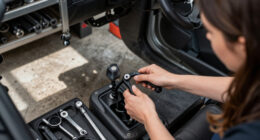
Brake lathes are essential in small shop workflows because they allow you to precisely refurbish and customize brake drums and rotors, ensuring safety and maximum performance. They help you save money by restoring parts instead of replacing them, which is especially useful for vintage or rare vehicles. Their flexibility and control enable quick adjustments, supporting efficient and high-quality work within limited space and budgets. To discover how they can give your shop a competitive edge, keep exploring.

Get garage and car supplies delivered free — and shop member deals
- Fast, free delivery on millions of items
- Access to Prime Big Deal Days deals on October 6–7
- Prime Video, Amazon Music and more included
Key Takeaways
- They enable precise refurbishment of brake drums and rotors, ensuring safety and optimal performance.
- Support in-house reconditioning, saving time and reducing costs compared to outsourcing or replacing parts.
- Offer control and customization for small shops to meet specific fit and surface finish requirements.
- Require minimal space and investment, ideal for small workshops with limited infrastructure.
- Promote sustainability by restoring existing parts, reducing waste, and extending component lifespan.

Have you ever wondered how small shops keep brake drums and rotors in top shape without investing in large, expensive equipment? The answer often lies in the significance of brake lathes. Despite the rise of advanced machinery, these tools remain indispensable for many shops involved in automotive repair and custom fabrication. You see, brake lathes allow you to precisely refurbish and restore brake components, ensuring safety and performance without the need to replace everything outright. This capability is especially critical for shops that want to offer quick, cost-effective repairs, or those working with vintage or rare vehicles where original parts are scarce or expensive.
Using a brake lathe gives you control over the entire process. You can recondition rotors and drums directly in-house, saving time and money. Instead of waiting for parts from suppliers or risking the quality of aftermarket replacements, you can restore what you already have. This is particularly beneficial in custom fabrication projects, where modifications often require precise fitting and surface finishing. A brake lathe enables you to achieve a smooth, even surface that meets your specifications, ensuring peak performance and safety. Plus, the ability to customize brake components on-site means you can adapt and refine your work as needed, maintaining a high level of craftsmanship. Furthermore, tool versatility allows the brake lathe to be used for various sizes and types of brake components, making it a valuable asset in a small shop.
In small shops, space and budget constraints make large-scale, automated machinery less practical. Here, a brake lathe offers a flexible and affordable solution that fits into a compact workflow. It’s a tool that can be operated easily by skilled technicians, and it doesn’t require extensive infrastructure. You can set up a dedicated station for brake work, allowing you to handle a variety of jobs without disrupting your entire shop. This versatility is a key advantage in a fast-paced environment, where quick turnaround times are essential. Additionally, the use of specialized tools like brake lathes helps maintain safety standards and reduces the risk of accidents during repair procedures.
Furthermore, brake lathes support the ethos of automotive repair: preserving parts whenever possible. Instead of discarding a seemingly worn rotor or drum, you can refurbish it, extending its lifespan and reducing waste. This aligns with sustainable practices and appeals to customers who value environmentally conscious service. In addition, for those engaged in custom fabrication, the ability to modify and perfect brake surfaces enhances the quality of your builds and restorations, giving you a competitive edge.
Ultimately, brake lathes still matter because they empower small shops to deliver high-quality, cost-effective, and sustainable services. They enable you to maintain control over your workflow, enhance your craftsmanship, and meet the demands of modern automotive repair without the burden of large investment. That’s why, in many small-scale operations, brake lathes remain an essential tool.
brake lathe machine for automotive repair
As an affiliate, we earn on qualifying purchases.
As an affiliate, we earn on qualifying purchases.
Frequently Asked Questions
How Much Space Does a Brake Lathe Typically Require?
A brake lathe typically requires about 4 to 6 feet of space in your workshop. To keep your workspace organized, you should allocate enough room for safe operation and easy access. Proper tool calibration is essential, so make sure there’s enough clearance for adjustments. By planning your workshop layout carefully, you can optimize space, improve workflow, and maintain safety while working efficiently with your brake lathe.
What Safety Precautions Are Necessary When Operating a Brake Lathe?
When operating a brake lathe, you should wear safety gear like goggles, gloves, and a dust mask to protect yourself from debris and metal shavings. Always check and calibrate the machine before use to guarantee precision and safety. Keep your workspace clear, avoid loose clothing, and stay alert during operation. Proper safety precautions help prevent accidents and ensure your work is accurate and safe.
Can Brake Lathes Handle Different Types of Brake Rotors?
Yes, brake lathes can handle different types of brake rotors, thanks to their machine versatility. You can work with various rotor materials like cast iron, aluminum, or composite, by adjusting the machine settings accordingly. This flexibility allows you to efficiently service multiple rotor types without needing separate equipment, saving time and resources. Just guarantee you select the proper tooling and follow safety procedures for each material.
What Is the Typical Maintenance Schedule for a Brake Lathe?
You should perform regular maintenance on your brake lathe every 3 to 6 months, depending on usage. This includes checking brake lathe calibration to guarantee accurate cuts and inspecting for wear on belts and bearings. Additionally, you’ll want to maintain the rotor surface finish by cleaning the lathe thoroughly and replacing worn components. Proper maintenance helps keep the lathe running smoothly, producing precise cuts and extending its lifespan.
Are Used Brake Lathes a Cost-Effective Option?
Used brake lathes can be a cost-effective option if you prioritize brake lathe efficiency and affordability. They typically cost less than new models, allowing you to save money upfront. While they might need some maintenance, the cost comparison often favors used equipment, especially if you’re operating a small shop. Just make sure you assess their condition thoroughly to avoid hidden repair costs that could offset initial savings.
Conclusion
In the end, brake lathes remain a essential tool in small shops, offering precision and flexibility that modern CNC machines can’t always match. You might feel like you’re stuck in a time warp, but these lathes prove their worth daily. They let you quickly restore or customize brake components without waiting for a parts order or breaking the bank. Sometimes, a good old-fashioned brake lathe is just what you need—no need to reinvent the wheel!
Fall Picks
fall essentials
As an affiliate, we earn on qualifying purchases.