
During aggressive driving, the most critical battery cooling detail is the system’s ability to quickly and effectively transfer heat away from the cells. You need a thermal management system with advanced sensors and dynamic control that responds rapidly to rising temperatures. Liquid cooling loops or air heat exchangers are essential to prevent overheating and thermal runaway. If you’re interested in how modern systems optimize this process and protect your battery during demanding conditions, keep exploring.

Get business pricing on garage and car supplies
- Business-only prices and quantity discounts
- Tax-exempt purchasing
- Multiple users, one account, clear invoices
Key Takeaways
- Real-time temperature monitoring ensures cooling adjusts dynamically to prevent overheating during demanding driving conditions.
- Effective heat dissipation methods, like liquid cooling, are crucial to handle rapid temperature spikes.
- Adaptive control systems optimize cooling effort based on thermal load to maintain battery safety and performance.
- Preventing thermal runaway is critical, requiring robust cooling to manage extreme temperature increases.
- Proper thermal regulation during aggressive driving maintains battery efficiency and extends lifespan under high thermal stress.

Ever wondered how your electric vehicle’s battery stays cool during aggressive driving? The answer lies in the essential process of thermal management. When you’re pushing your car hard—accelerating quickly, climbing steep hills, or maintaining high speeds—the battery generates a lot of heat. Without effective thermal management, this heat can cause your battery to overheat, leading to reduced battery efficiency and even potential damage. That’s why a well-designed cooling system is necessary during these intense moments. It actively regulates the battery’s temperature, making sure it stays within an ideal range, so your vehicle performs reliably and safely.
Effective thermal management keeps your EV battery cool and safe during aggressive driving.
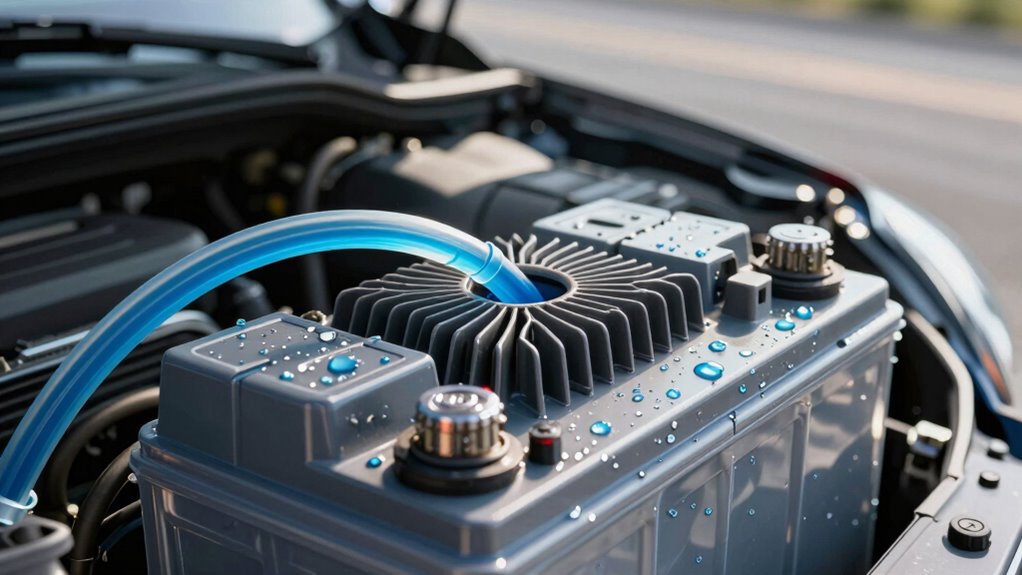
Thermal management isn’t just about preventing overheating; it directly impacts your battery’s efficiency. When your battery runs too hot, its chemical reactions become less effective, which can diminish your driving range and overall performance. Conversely, if it’s too cold, the battery struggles to deliver power efficiently. During aggressive driving, maintaining an ideal temperature becomes even more significant because the demand for power surges, causing rapid temperature fluctuations. Advanced cooling systems—such as liquid cooling loops or air-based heat exchangers—work tirelessly to absorb excess heat and dissipate it quickly. This constant regulation helps keep the battery at a stable, suitable temperature, which translates into better energy retention, more consistent acceleration, and a longer lifespan for your battery.
You might not think about it often, but your vehicle’s thermal management system is constantly working in the background, especially when you’re pushing your car to its limits. It uses sensors to monitor battery temperature in real-time and adjusts cooling efforts accordingly. During aggressive driving, this process becomes even more important because the heat buildup accelerates. Without it, your battery could reach temperatures that cause permanent damage or rapid degradation. An effective cooling system also prevents thermal runaway—a dangerous condition where excessive heat leads to uncontrollable temperature increases, risking safety and vehicle integrity. Moreover, the design of these systems often incorporates thermal conductivity properties to efficiently transfer heat away from critical components. Additionally, advancements in thermal management technology are continually improving the responsiveness and efficiency of these systems, further safeguarding your battery during demanding drives. Properly designed cooling solutions can also incorporate smart control systems that optimize cooling based on driving conditions, enhancing overall safety and performance.
In essence, when you’re driving aggressively, the most important detail in battery cooling isn’t just the presence of a cooling system but how well it manages the thermal load. Proper thermal management safeguards your battery’s health, maximizes efficiency, and ensures your vehicle delivers peak performance without risking damage. So, the next time you hit the gas pedal hard, remember that your car’s cooling system is working behind the scenes, making sure that your battery stays cool, efficient, and ready for the next demanding drive.
electric vehicle battery cooling system
As an affiliate, we earn on qualifying purchases.
As an affiliate, we earn on qualifying purchases.
Frequently Asked Questions
How Does Battery Cooling Impact Overall Vehicle Performance?
Battery cooling considerably boosts your vehicle’s performance by preventing overheating, especially during aggressive driving. Good cooling technology helps maintain ideal battery temperature, ensuring consistent power output. Battery insulation works alongside cooling systems to retain temperature stability. When cooling is effective, your vehicle accelerates smoothly, charges efficiently, and lasts longer. Without proper cooling, you risk reduced range, power drops, and potential battery damage, all of which hinder your driving experience.
Are There Specific Signs Indicating Battery Overheating?
You’ll notice that if your battery temperature climbs above 120°F, it’s a clear sign of overheating. Overheat indicators like warning lights or a sudden drop in performance also signal trouble. Statistically, batteries can lose up to 20% of their capacity if they frequently overheat. Keep an eye on these signs, especially during aggressive driving, to protect your battery’s health and guarantee maximum vehicle performance.
What Maintenance Is Needed for Optimal Cooling System Function?
To keep your cooling system functioning at its best, regularly inspect the battery insulation for damage or wear, making sure it prevents heat transfer. Check the cooling fluid levels and top them off as needed, following manufacturer guidelines. Clean any cooling vents or fans to prevent dirt buildup. Proper maintenance of these components ensures effective heat dissipation, especially during aggressive driving, helping to prevent overheating and extend your battery’s lifespan.
Can Aftermarket Cooling Systems Improve Battery Lifespan?
Think of your battery as a delicate plant needing just the right environment. Aftermarket cooling accessories, like enhanced cooling fans or liquid cooling systems, can act as a shield, protecting your battery from the heat’s harsh embrace. Proper battery insulation complements these upgrades, keeping temperatures steady. Together, they can extend your battery’s lifespan, making it more resilient during aggressive driving, and ensuring your vehicle performs at its peak longer.
How Does Ambient Temperature Affect Cooling Efficiency?
Ambient influence considerably impacts cooling efficiency, especially in temperature regulation. When temperatures are high, your cooling system works harder to maintain ideal battery temperatures, which can lead to reduced performance and lifespan. Conversely, cooler ambient conditions help your cooling system operate more effectively, preserving battery health. During aggressive driving, understanding how ambient temperature affects cooling can help you manage battery performance better and prevent overheating, ensuring your vehicle runs smoothly longer.
Conclusion
As you push your electric vehicle through tight turns and quick accelerations, remember that proper cooling is like a steady hand guiding your battery through a storm. Feel the cool breeze beneath the hood, whispering reassurance as your battery stays calm and efficient. When you master the art of cooling during aggressive drives, you’re not just protecting your battery—you’re ensuring every thrill is smooth, every mile is powered, and your journey remains cool under pressure.
Fall Picks
fall essentials
As an affiliate, we earn on qualifying purchases.