TL;DR

Get business pricing on garage and car supplies
- Business-only prices and quantity discounts
- Tax-exempt purchasing
- Multiple users, one account, clear invoices
Around the turn of the 20th century, electric cars competed with steam and gasoline vehicles, and some manufacturers marketed them to women as quiet and easy to start. Fannie Goodnow, an early adopter, owned a 1908 Bailey Victoria Phaeton and charged it with a General Electric mercury-arc rectifier. The episode shows how early EV adoption depended on practical trade-offs, including charging time, battery limits and a still-developing market.
Electric-car makers marketed their vehicles to women in the early 20th century, emphasizing that they were quieter and easier to start than gasoline cars, according to an IEEE Spectrum report on the period. The account highlights Fannie Goodnow, who owned a 1908 Bailey Victoria Phaeton and charged it with a General Electric device, offering a documented example of women’s involvement in an industry still divided among electric, steam and gasoline power.
At the turn of the 20th century, the U.S. car industry was expanding quickly. The report says there were about 50 American automakers in 1898, and roughly five times as many a decade later. U.S. vehicle production rose from 7,000 in 1901 to 181,000 in 1910. No propulsion system had yet secured dominance: electric cars competed with steam-powered and gasoline vehicles.
Before electric starters became available in 1911, gasoline engines generally had to be started with a hand crank. Once running, they were noisy and produced exhaust. Electric cars could be started by switching on the battery, often with a key, and had no exhaust from an onboard combustion engine. Makers used those differences in marketing, presenting electric vehicles as a convenient option for women. The report says electric cars were also promoted to doctors making nighttime house calls.
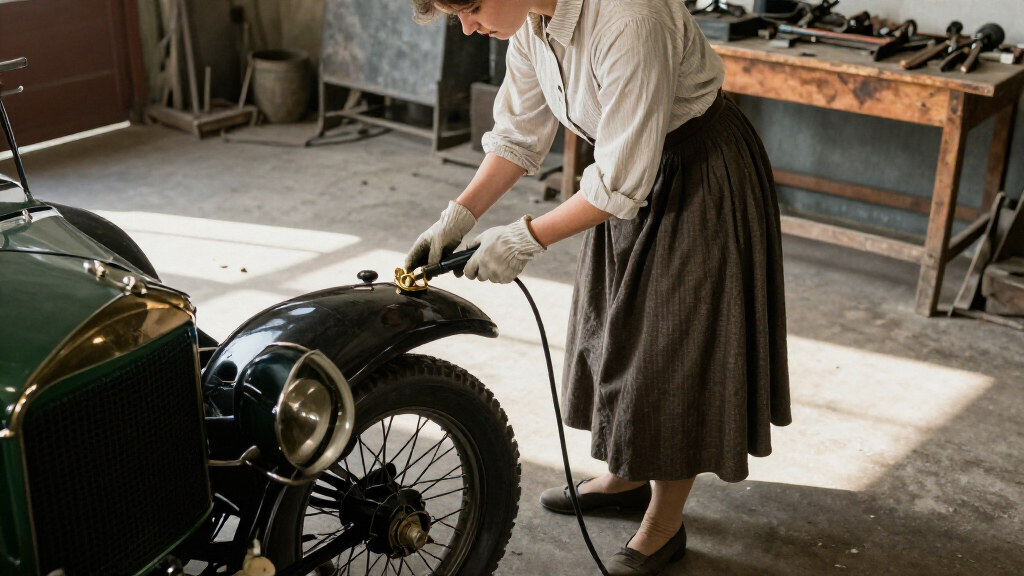
General Electric, which made car chargers using mercury-arc rectifiers, ran advertisements showing stylishly dressed women plugging in their cars. Goodnow’s Bailey Victoria Phaeton was an open, two-seat vehicle. Its charger converted alternating current from the grid into the direct current needed by the battery; charging a drained battery took about 12 hours, according to the report. Goodnow’s car used a 30-cell lead-acid battery, with a reported standard range of about 64 to 80 kilometers.
How Early EVs Found Buyers
The story complicates the idea that electric cars are a recent invention or that women entered motoring only after the market matured. Women were among the consumers targeted during the early competition among vehicle technologies, and Goodnow’s car shows that at least some women bought and used electric vehicles. The surviving example also links consumer adoption to the systems around a car: charging equipment, battery capacity and access to electricity.
The marketing had a practical basis, but it also reflected the gender assumptions of its era. Automakers framed quiet operation and simple starting as advantages for women, while presenting a different appeal to doctors. That was a sales strategy, not evidence that electric cars were inherently suited to one gender. The report does not establish how many women owned early EVs or how representative Goodnow’s experience was.
Products Worth Considering

NOCO Boost GB50 1500A UltraSafe Jump Starter, 12V Lithium Battery Booster

DEWALT 20V MAX XR Hammer Drill and Impact Driver Combo Kit with Two 4Ah Batteries and Charger

NOCO Boost GB150 3000A UltraSafe Jump Starter, 12V Lithium Battery Booster
As an affiliate, we earn on qualifying purchases.
A Market Still Choosing Its Engine
Electric, steam and gasoline vehicles all faced constraints. Steam cars drew on established locomotive technology, but boilers and piping could become hot, and the report notes a risk of fire. Electric cars avoided exhaust and hand cranking, yet drivers had to plan charging, while long-distance travel infrastructure was limited. Carrying extra gasoline was possible; recharging a battery required a suitable power source and time.
Goodnow chose a vehicle from S.R. Bailey & Co., a Massachusetts carriage maker that entered electric-car production as the carriage business weakened. The company announced its move into electric vehicles in December 1906. Its first Victoria Phaeton used a battery designed by Thomas Edison, but the report says that battery leaked and failed to hold a charge. Bailey later switched to batteries made by Gould Storage Battery Co.
By 1910, Edison had a better battery in production, but gasoline cars were gaining ground. The report points to Henry Ford’s Model T as part of the shift toward internal-combustion vehicles. It describes an early market shaped not by a single decisive advantage, but by evolving technology and competing practical limitations.
“Electric carmakers looking for a way to differentiate their products decided that these attributes made their vehicles perfect for women.”
— IEEE Spectrum report
What Goodnow’s Story Cannot Show
The report does not identify why Goodnow chose an electric car, how often she drove it, or whether she used it mainly for local trips. It also does not provide figures for women’s share of early electric-car buyers or show how representative the advertisements were of actual ownership. The marketing is documented, but its reach and effect on sales are not established in the material.
Battery range and charging time are reported for the vehicle and charger described, but they should not be treated as figures for every early electric car. The account also does not specify the exact charging access available to Goodnow at home or elsewhere. Those details matter when judging how practical the car was in daily use.
The Historical Record Ahead
The report is a retrospective account rather than a developing policy or product story, and it does not announce a new research project or event. Readers can place its claims alongside surviving advertisements, vehicle records and museum collections, including material attributed to the Museum of Innovation and Science and Heritage Museums & Gardens. Further records could clarify how widespread women’s early EV ownership was and how drivers managed charging in practice.
For now, the clearest takeaway is limited but specific: manufacturers promoted electric cars to women for their ease of use, and Goodnow owned one in 1908. The scale of that market, and the personal reasons behind individual purchases, remain unresolved by the source report.
Key Questions
Why did early automakers market electric cars to women?
Makers emphasized that electric cars were easy to start and quiet, unlike gasoline cars that then required hand cranking and produced exhaust. The marketing reflected the period’s gender assumptions and does not show that electric vehicles were suited only to women.
Who was Fannie Goodnow?
Goodnow was an early electric-car owner who had a 1908 Bailey Victoria Phaeton. The IEEE Spectrum report says she used a General Electric mercury-arc rectifier to charge it.
How long did the charger take?
The report says the mercury-arc rectifier charger took about 12 hours to charge a drained battery. That figure refers to the charging setup described, not necessarily every early EV.
How far could Goodnow’s car travel?
The report gives a standard battery range of about 64 to 80 kilometers. It also says a larger battery with 50 percent more capacity was available for an additional cost.
Why did electric cars lose ground to gasoline vehicles?
The report describes several pressures, including charging time and limited long-distance infrastructure. It also recounts problems with Edison’s early battery and identifies the Model T as part of gasoline cars’ growing market position. It does not attribute the shift to a single cause.
Source: spectrum.ieee.org