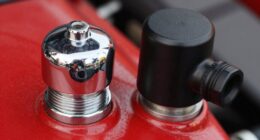
Intake resonance tuning with Helmholtz resonators enhances your engine’s airflow and sound by passively manipulating sound waves in the intake system. These resonators are designed to resonate at specific frequencies, amplifying desirable intake sounds and reducing unwanted noise or turbulence. They help optimize engine efficiency, producing a sharper intake sound and smoother operation. If you keep exploring, you’ll discover how adjusting their size and placement plays a key role in tuning your engine’s performance.
Key Takeaways
- Helmholtz resonators are passive devices that enhance intake acoustics by resonating at specific engine frequencies.
- They amplify desirable intake sounds while suppressing unwanted noise and drone.
- Tuning involves adjusting resonator volume and neck dimensions to match engine intake cycles.
- Proper resonance tuning improves airflow, engine efficiency, and creates a sharper, more engaging engine sound.
- Resonance tuning ensures smoother engine operation with reduced turbulence and better acoustic energy management.

Resonance tuning is the process of adjusting a system so that it naturally oscillates at a desired frequency, maximizing efficiency and sound quality. When it comes to intake resonance tuning, this concept plays a crucial role in optimizing how your engine breathes and sounds. Specifically, Helmholtz resonators are often employed to enhance acoustic amplification and suppress unwanted noise, leading to a more efficient and refined engine performance. By carefully tuning these resonators, you can manipulate sound waves within your intake system, boosting the intake efficiency while reducing the harshness or drone that might otherwise occur.
You might notice that an intake system with well-tuned Helmholtz resonators produces a sharper, more aggressive intake sound, which many enthusiasts find appealing. This acoustic amplification happens because the resonator is designed to resonate at a specific frequency that matches the engine’s intake cycle. When tuned correctly, the resonator amplifies certain sound waves, making the intake noise more pronounced and dynamic without increasing overall noise pollution. This selective amplification enhances the engine’s auditory feedback, giving you a more engaging driving experience. At the same time, the resonator acts as a noise suppressor for unwanted frequencies, which might cause drone or unpleasant vibrations. This noise suppression ensures that your engine sounds refined and less fatiguing during long drives or high-speed runs.
Additionally, understanding the behavior of sound waves within the intake system can help in more precise resonance tuning, leading to better overall performance. Achieving the right resonance involves adjusting the dimensions of the Helmholtz resonator—its volume, neck length, and cross-sectional area—so that it aligns with the engine’s intake frequency. This tuning process requires a good understanding of the system’s dynamics and the target frequency you want to amplify or suppress. When properly calibrated, the resonator works passively, requiring no additional energy, making it a highly efficient solution for improving intake acoustics and noise control. You’ll notice that with precision tuning, your engine not only sounds better but runs more smoothly, as the tuned resonance reduces turbulence and flow disruptions within the intake.
In essence, resonance tuning with Helmholtz resonators isn’t just about sound; it’s about controlling airflow and acoustic energy to optimize engine performance. By maximizing acoustic amplification at desired frequencies and suppressing unwanted noise, you create a more refined, efficient intake system. This balance of sound and silence enhances both the driving experience and the engine’s operational efficiency, making resonance tuning a vital technique for anyone looking to fine-tune their vehicle’s intake acoustics and performance.
Frequently Asked Questions
How Does Temperature Affect Helmholtz Resonator Tuning?
Temperature effects can substantially impact Helmholtz resonator tuning because as temperature rises, material properties like elasticity and density change, altering the resonator’s natural frequency. You might notice that warmer air causes the resonator to tune to a slightly higher frequency, while cooler temperatures lower it. To maintain ideal tuning, you should consider these temperature effects and adjust the resonator‘s dimensions or material choices accordingly.
Can Helmholtz Resonators Be Used in Non-Audio Applications?
You might find it intriguing that Helmholtz resonators can extend beyond musical instruments into innovative acoustic filtering applications. They subtly control sound waves, making them useful in noise reduction, architectural acoustics, and even fluid systems. Their ability to tune resonance makes them valuable for precise frequency management, offering elegant solutions in engineering. So, yes, these resonators serve purposes far beyond audio, quietly enhancing diverse non-audio systems.
What Materials Are Best for Constructing Resonators?
You should choose materials with good acoustic properties and durability for construction techniques, such as metals like aluminum or steel, or plastics like ABS or polycarbonate. These materials provide strength and precise fabrication, essential for effective resonance tuning. Your material selection depends on your specific application and environment, ensuring the resonator performs reliably. Proper construction techniques, including accurate sizing and sealing, are vital for maximum resonance performance.
How Does Size Influence the Resonance Frequency?
Imagine tuning a musical instrument—you change its size to hit the perfect note. Similarly, your resonator’s dimensions directly affect its resonance frequency. Larger resonator dimensions lower the resonance frequency, creating a deeper sound, while smaller ones raise it, producing a higher pitch. When you adjust the size, you control how the resonator interacts with sound waves, making it an essential factor in fine-tuning your intake system’s performance.
Are There Limitations to Using Multiple Resonators Together?
Using multiple resonators together can lead to limitations due to resonator interference, making complex tuning necessary. You might encounter overlapping frequencies that reduce efficiency or cause unwanted noise. To avoid these issues, you need precise adjustments and careful placement. While multiple resonators can enhance tuning, their interactions require careful management to prevent performance loss. Proper design ensures each resonator works harmoniously, achieving ideal intake resonance without interference.
Conclusion
Now that you understand intake resonance tuning with Helmholtz resonators, you can see how they’re like secret tuning forks for your engine’s sound. They help optimize airflow and improve performance, making your engine run smoother and more efficiently. Think of them as the fine-tuned strings of a musical instrument, each precisely adjusted to produce the perfect harmony. Mastering this tech gives you a real edge, turning your vehicle into a finely tuned machine.