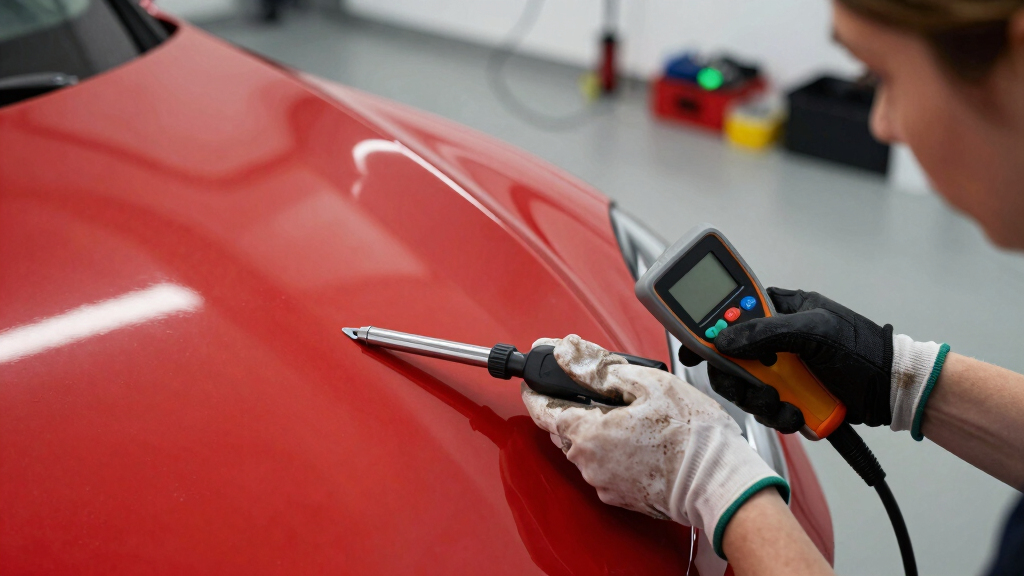
Choosing the best paint thickness gauge for your detailing needs can be challenging, with options varying in features, precision, and price. The Paint Thickness Gauge CM-224Pro stands out as the overall top pick, thanks to its high resolution and auto-detection features. For those seeking affordability without sacrificing accuracy, the GOYOJO Paint Thickness Gauge offers excellent value. Meanwhile, the Paint Thickness Gauge CM-8801FN excels in professional automotive inspections with its reliable auto-detection and calibration. The main tradeoffs involve balancing ease of use, measurement precision, and budget constraints. Keep reading for a detailed comparison to find the best fit for your detailing shop or hobbyist setup.




More Details on Our Top Picks
Paint Thickness Gauge Meter Fe/NFe Probe Coating Thickness Gauge Professional Multifunctional Car Paint Depth Gauge Test Precise HW-300PRO for Car Automatic Detection(black)
This multifunctional gauge stands out for its ability to record multiple data points simultaneously, such as average, maximum, and minimum values, making it ideal for detailed automotive inspections. Compared to the CM-205FN, which offers a simpler, more straightforward measurement, the HW-300PRO provides comprehensive data logging that benefits professional detailers or quality inspectors. The tradeoff is its slightly bulkier size and potentially more complex interface, which might overwhelm beginners. Its dual probe system (F and N) automatically detects substrate properties, reducing manual switching and speeding up inspections. The large LCD display clearly shows readings in µm, mm, or mils, with an accuracy of ±(3%+1um) across a range of 0-2000µm. Because of its multifunctionality, this gauge is best suited for workshops, material surface testing, and detailers who require detailed data collection.
Pros:- Records multiple data points simultaneously for detailed analysis
- Supports up to 50 data entries for statistics, aiding in quality control
- Automatic substrate detection with electromagnetic principles increases measurement accuracy
Cons:- Slightly larger and more complex interface may intimidate new users
- Higher price point compared to basic models like CM-205FN
- Limited to steel, aluminum, and coated metals—less versatile on non-metal surfaces
Best for: Professional detailers and automotive inspectors needing comprehensive data logging and multifunctional testing.
Not ideal for: Beginners or hobbyists who prefer simple, quick measurements without extensive data recording features.
- Measurement Range:0-2000µm
- Display Type:Large LCD
- Accuracy:±(3%+1um)
- Data Storage:Supports 50 data points
- Probes:F and N probes
- Power:Automatic shutdown
Bottom line: This gauge is ideal for detailers who need detailed surface data and automated substrate detection, especially in professional settings.
Paint Thickness Gauge CM-205FN for Cars – Digital Coating Thickness Meter, Auto Fe/NFe Detection, 0.1 μm Resolution, 0–1500 μm (0–59.1 mils), ±(3%+2 μm) Accuracy, Backlit LCD
The CM-205FN shines with its factory calibration and straightforward operation, making it highly suitable for quick vehicle inspections and used car evaluations. In comparison to the HW-300PRO, which offers extensive data recording, the CM-205FN emphasizes ease of use and rapid measurements, ideal for busy detailers and appraisers. Its automatic substrate detection for Fe and NFe simplifies testing on modern vehicles with mixed materials. The device’s measurement range of 0–1500µm allows it to evaluate factory paint and repairs effectively, with a clear backlit LCD ensuring visibility even in low light. However, it’s limited to metal surfaces only, unlike models with broader material detection. Its simple interface and auto-calibration make it a practical choice for professionals who need reliable, fast results without complex data management.
Pros:- Factory calibrated for immediate use, saving setup time
- Automatic detection of ferrous and non-ferrous metals simplifies testing
- Backlit LCD provides clear readings in all lighting conditions
Cons:- Limited to metal surfaces, excluding plastics and composites
- Range tops out at 1500µm, less suitable for very thick coatings
- No data logging or extensive measurement history features
Best for: Automotive detailers and used car inspectors needing fast, reliable paint thickness measurements.
Not ideal for: Detailers requiring detailed data logs or measurement on non-metal surfaces like plastics or composites.
- Measurement Range:0-1500µm
- Resolution:0.1µm
- Accuracy:±(3%+2µm)
- Display:Backlit LCD
- Detection:Auto Fe/NFe
- Power:Batteries included
Bottom line: This gauge offers fast, accurate, and easy testing ideal for busy professionals inspecting automotive coatings on metal panels.
Paint Thickness Gauge for Cars, Digital Car Paint Tester with Auto Fe/NFe/Zn Detection, Portable Mil Coating Thickness Tester for Used Car Buyers, Auto Detailers and Workshops
This digital gauge offers fast substrate recognition with built-in magnetic induction and eddy current technology, making it highly versatile for detecting steel, aluminum, and galvanized coatings. Compared with the CM-224Pro, which targets more detailed professional evaluation, this model emphasizes portability and quick detection, making it suitable for used car buyers and mobile detailers. Its ability to identify multiple metal types in less than half a second streamlines the inspection process, although it’s limited to metallic surfaces and can’t measure non-metallic coatings. The device’s lightweight design and IP40 protection enable outdoor use, and its measurement range of 0–2000µm covers most automotive paints and repairs. While it provides reliable results swiftly, it lacks extensive data storage or advanced features for detailed analysis, making it perfect for straightforward inspections.
Pros:- Instant substrate recognition with magnetic and eddy current tech
- Lightweight and portable for field use
- Fast measurement speeds support efficient inspections
Cons:- Limited to metallic surfaces, cannot test plastics or composites
- No advanced data storage or logging features
- Does not provide detailed analysis or historical data
Best for: Used car buyers and mobile detailers needing quick, on-the-spot substrate detection.
Not ideal for: Detailers requiring detailed data logging or testing non-metallic surfaces like plastics and composites.
- Measurement Range:0-2000µm
- Detection:Fe, NFe, Zn
- Response Time:<0.5 seconds
- Portability:Lightweight, IP40
- Power:9V battery
- Material Limitations:Metal surfaces only
Bottom line: Ideal for quick, reliable metal substrate detection during mobile or used car inspections without the need for extensive data management.
Car Coating Thickness Meter for Used Car Buyers, Paint Mil Thickness Meter Gauge Check The Car’s Original Coating Auto Car Paint Meter
The RDINSCOS XWJ provides a reliable, affordable solution for those new to paint thickness testing or on a tight budget. Its automatic detection of steel and aluminum substrates simplifies the testing process, making it suitable for used car buyers wanting to verify paint consistency. Compared to higher-end models like the CM-224Pro, this device has fewer advanced features but offers solid performance. Its measurement range of 0–1500µm and simple interface make it accessible for casual users. The device’s durability and included calibration kit are helpful, though it lacks the extensive data logging or multi-point measurement capabilities found in more professional-grade gauges. This model makes a lot of sense for entry-level detailers or buyers who want quick, basic assessments without additional fuss.
Pros:- Automatic detection of steel and aluminum substrates
- Affordable price for entry-level users
- Includes calibration kit and storage bag for durability
Cons:- Limited to metallic surfaces, no testing on plastics or composites
- Fewer advanced features, such as data logging or multiple readings
- Range stops at 1500µm, less suitable for very thick coatings
Best for: Used car buyers and novice detailers seeking an easy, cost-effective coating thickness tester.
Not ideal for: Professional detailers requiring detailed data logs or testing on non-metal surfaces.
- Measurement Range:0-1500µm
- Substrate Detection:Fe, Al
- Resolution:0.01 mils (0.1µm)
- Display:Digital LCD
- Power:9V battery
- Materials Tested:Metal only
Bottom line: A budget-friendly, reliable choice for casual and used car inspections focusing on metallic coatings.
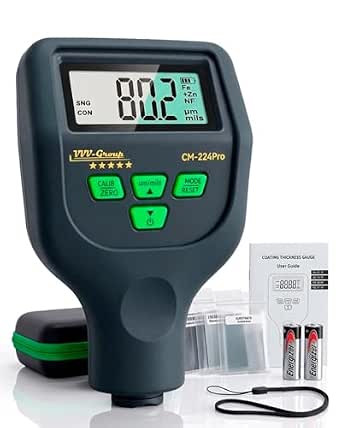
Paint Thickness Gauge – CM-224Pro Automotive Coating Thickness Meter 0–59.1 mils (0–1500 µm), 0.01 mils (0.1 µm) Resolution, Fe/NFe/Zn Auto Detection, Auto Calibration
The CM-224Pro is tailored for professional automotive inspectors, offering precise measurement from 0 to 59.1 mils with a resolution of 0.01 mils, ensuring detailed comparison across vehicle panels. Compared with models like the HW-300PRO, which emphasizes data collection, the CM-224Pro focuses on rapid, accurate, and repeatable measurements, supporting high-volume workflow in dealerships or body shops. Its automatic detection of Fe, NFe, and Zn substrates simplifies testing on modern vehicles, reducing manual adjustments. The device’s robust design and clear backlit display enhance usability in various lighting conditions. Its main tradeoff is the narrower measurement range compared to some models, which limits testing very thick or heavily repaired coatings. This makes it ideal for detailed panel analysis and quality control during refinishing processes.
Pros:- High measurement accuracy with 0.01 mil resolution
- Automatic substrate detection simplifies testing
- Supports quick panel-to-panel comparison for professional workflows
Cons:- Limited to 0–59.1 mils, less suitable for very thick coatings
- No extensive data logging features
- Narrow measurement range restricts use on heavily repaired surfaces
Best for: Automotive professionals and inspectors performing detailed panel-by-panel coating evaluations and refinishing checks.
Not ideal for: Casual users or hobbyists seeking a simple, inexpensive gauge without high precision or professional features.
- Measurement Range:0-59.1 mils (0-1500µm)
- Resolution:0.01 mils (0.1µm)
- Detection:Fe, NFe, Zn
- Display:Backlit LCD
- Operation Temp:-4°F to 122°F (-20°C to 50°C)
- Design:Portable, professional
Bottom line: This device provides precise, professional-grade measurements ideal for detailed panel assessments and refinishing verification.
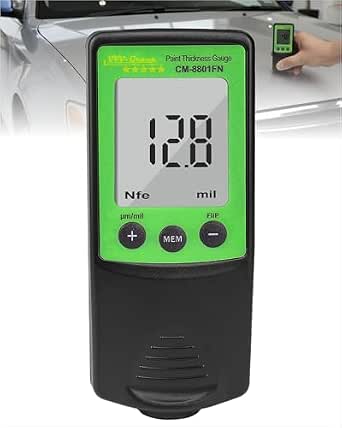
Paint Thickness Gauge CM-8801FN for Cars – Digital Coating Thickness Meter, Auto Fe/NFe Detection, 1 μm Resolution, 0–1250 μm (0–49 mils), ±(3%+2 μm) Accuracy, Automotive Inspection Tool
This device stands out for its precise 1 μm resolution and auto Fe/NFe detection, making it ideal for modern vehicles with mixed materials. Compared to the Mcbazel model, it offers more advanced substrate recognition, streamlining the inspection process. Its dual technology ensures accurate readings on steel, aluminum, and copper, which is crucial for verifying OEM paint and detecting bodywork. However, its focus on metal surfaces means it’s not suitable for plastic bumpers or composites, a key limitation for detailers working on diverse parts. The intuitive LCD and flip screen facilitate quick assessments in field conditions, making it perfect for dealerships and used-car inspections. The tradeoff is that it’s slightly more expensive than simpler gauges, but the added features justify the cost for serious professionals.
Pros:- High-precision 1 μm resolution for detailed measurements
- Automatic Fe/NFe substrate detection simplifies use on mixed materials
- Dual technology (magnetic induction + eddy current) ensures stable readings
Cons:- Limited to metal surfaces; not suitable for plastics or composites
- Higher price point compared to basic models
Best for: Automotive detailers and inspectors needing fast, reliable metal surface measurements across multiple vehicle panels.
Not ideal for: Detailers focusing on plastic, fiberglass, or composite parts, since this device is designed exclusively for metal substrates.
- Measurement Range:0–1250 μm
- Resolution:1 μm
- Accuracy:±(3%+2 μm)
- Detection:Auto Fe/NFe
- Technology:Magnetic induction + eddy current
- Display:Flip LCD
Bottom line: This gauge is a top choice for professionals who need quick, accurate coating thickness measurements on metal panels, despite its limited scope for non-metal parts.
GOYOJO Paint Thickness Gauge for Cars, 0-2000μm (0-79 mils) Coating Thickness Meter, Auto Fe/Al/Zn/Fe(C) Detection, 0.1μm Resolution, ±(2%+1μm) Accuracy for Paint Inspection
This model offers a broad measurement range up to 2000 μm and a 0.1 μm resolution, making it suitable for both thin OEM paint and thicker repair layers. Its auto substrate recognition (Fe, Al, Zn, Fe(C)) adds versatility, comparable to the CM-8801FN but with a slightly wider scope. The inclusion of multiple modes—Single, Continuous, and Average—helps users identify repaint zones or uneven coatings efficiently. While it lacks the flip screen of the CM-8801FN, its backlit display ensures visibility in various lighting conditions. Its affordability makes it appealing for hobbyists and intermediate detailers who need reliable measurements without the premium price tag. The main tradeoff is that it may not deliver the ultra-fine precision of the CM-8801FN, but for general automotive use, it provides excellent value.
Pros:- Wide measurement range up to 2000 μm for various paint thicknesses
- Auto substrate recognition for multiple metal types
- High 0.1 μm resolution for detailed measurements
Cons:- Lacks advanced features like flip screen found in high-end models
- No external probe support for heavy coatings
Best for: Intermediate detailers and used-car inspectors seeking a reliable, multi-metal coating gauge at an accessible price.
Not ideal for: Highly specialized professionals needing ultra-fine resolution or advanced diagnostics beyond standard automotive coatings.
- Measurement Range:0–2000 μm
- Resolution:0.1 μm
- Accuracy:±(2%+1 μm)
- Detection:Fe/Al/Zn/Fe(C)
- Modes:Single, Continuous, Average
- Display:Backlit LCD
Bottom line: A well-rounded, cost-effective choice for detailed inspections on multiple metal substrates, with some limitations in resolution compared to premium tools.
Mcbazel Paint Thickness Tester Meter Gauge, Magnetic Car Paint Coating Tester, Car Body Damage Detector, Waterproof Crash Test Check Tool for Used Car Inspection
This pen-shaped gauge excels in portability and ease of use, requiring no batteries thanks to its magnetic tip, making it ideal for outdoor or quick field checks. Its micrometer-scale readability and durable design allow for reliable detection of paint and filler layers beneath the surface, similar to the Mcbazel’s simplicity but with a focus on ruggedness and immediate use. While it doesn’t feature digital readouts or substrate recognition, it offers a straightforward, no-fuss approach for spotting bodywork or repainting issues. Its main advantage is its waterproof construction and compact size, perfect for mobile inspections or casual detailers who need a basic but dependable tool. The tradeoff is that it lacks advanced digital features and cannot distinguish between different metals or coatings precisely, limiting its use for detailed professional diagnostics.
Pros:- No batteries needed, highly portable
- Waterproof and durable for outdoor use
- Simple magnetic tip for quick detection
Cons:- Limited to basic paint and filler detection, no digital readout
- Cannot differentiate between metal types or coatings
Best for: Mobile detailers, used-car buyers, and hobbyists needing a quick, battery-free paint check tool in any environment.
Not ideal for: Professional detailers requiring digital readouts, detailed substrate detection, or high-precision measurements.
- Type:Magnetic, battery-free
- Measurement Range:Unknown
- Accuracy:Micrometer scale
- Waterproof:Yes
- Design:Pen-shaped
- Application:Paint and filler detection
Bottom line: A practical, rugged, and battery-free tool ideal for quick inspections in the field, though not suited for detailed professional analysis.

How We Picked
To determine the best paint thickness gauges for detailers, I evaluated each product based on accuracy, ease of use, build quality, versatility in detecting different coatings, and value for money. Devices with auto-detection and calibration features were prioritized because they reduce user error and improve efficiency. I also considered the range of measurement, resolution, and whether the gauge is suitable for professional or hobbyist use. Products were ranked by how well they balance performance with affordability, ensuring that both entry-level and experienced detailers find suitable options.Factors to Consider When Choosing Best Paint Thickness Gauges For Detailers
When selecting a paint thickness gauge, it’s important to consider several factors to match your specific detailing needs. First, measurement accuracy and resolution directly impact how precisely you can assess coatings, crucial for quality repairs or inspections. Second, auto-detection and calibration features simplify operation and reduce errors, especially for frequent use. Third, the measurement range should align with your typical projects—whether working on cars, motorcycles, or other surfaces. Fourth, build quality and durability matter, as these devices often need to withstand workshop environments. Lastly, consider your budget and whether investing in premium features will provide tangible benefits for your work.Accuracy and Resolution
Precise measurements are vital for professional detailing, particularly when evaluating paint thickness for repairs or restorations. Look for gauges offering at least 0.1 μm resolution to detect subtle differences. Higher resolution and auto-detection features help reduce guesswork, especially when measuring small variations in coatings. However, keep in mind that extremely high accuracy often comes with a higher price tag, so balance your needs based on the complexity of your projects.
Auto-Detection and Calibration
Devices with auto-detection of different metal substrates and auto-calibration features make measurements more reliable and less user-dependent. This is particularly important for detailers working on various vehicles or surfaces, where manual calibration can introduce errors. Consider whether the gauge offers automatic detection of Fe, NFe, or other metals, as this adds versatility and saves time during inspections.
Measurement Range
The measurement range should cover the typical thicknesses encountered in your work. For automotive detailers, a range up to 2000 μm is often sufficient, but professionals restoring classic cars might need a wider span. Choosing a gauge with a broad range ensures you won’t outgrow it quickly and allows for flexibility across different projects.
Build Quality and Ease of Use
Durability matters because these tools are frequently used in workshop environments. Look for models with sturdy construction, waterproofing, and ergonomic design. Ease of use—such as clear digital displays, simple controls, and minimal setup—can speed up workflows and reduce frustration, especially if you’re working on multiple vehicles daily.
Value and Cost
While premium gauges offer advanced features, they also come at higher costs. Evaluate whether the added features justify the price based on your workload. For hobbyists or part-time detailers, a mid-range or budget model might suffice, but full-time professionals should consider investing in higher-end options that provide greater accuracy and durability for long-term reliability.
Frequently Asked Questions
How accurate are paint thickness gauges for used car inspections?
Paint thickness gauges are generally quite accurate within their specified tolerances, often around ±(3%+2 μm). They are useful for detecting repaint layers or mismatched coatings, but their accuracy can be affected by surface conditions and calibration. For used car inspections, a reliable gauge helps identify areas of concern but should be complemented with visual inspection and other diagnostics for a comprehensive assessment.
Can I use a single paint thickness gauge on different types of vehicles?
Yes, most paint thickness gauges are versatile enough to be used across various vehicles, including cars, motorcycles, and even boats. However, ensure the device covers the measurement range needed for your specific projects. Auto-detection features that identify metal types are especially helpful when switching between different vehicle types or surfaces, maintaining measurement accuracy across diverse applications.
Is it worth paying extra for auto-calibration features?
Auto-calibration features save time and reduce user error, making them worthwhile for professional detailers or those handling high volumes of inspections. While they add to the upfront cost, the increased consistency and ease of use can lead to better results and less frustration. For casual hobbyists, manual calibration may suffice, but for ongoing use, auto features tend to improve overall reliability.
What measurement range do I need for automotive detailing?
For most automotive applications, a measurement range of up to 2000 μm (roughly 79 mils) covers typical paint and clear coat thicknesses. If you work on restoration or vintage vehicles, check that the gauge can handle thicker coatings or corrosion layers. Choosing a gauge with a slightly broader range than you currently need provides future-proofing for different projects.
Are waterproof or rugged models worth the extra cost?
Waterproof and rugged models are highly valuable if you work in environments where equipment may be exposed to water, dust, or rough handling. They tend to last longer and require less maintenance, which can justify the higher initial investment. For busy shops or outdoor work, these features help maintain accuracy and reduce downtime caused by damage or wear.
Conclusion
The best overall paint thickness gauge for most detailers is the Paint Thickness Gauge CM-224Pro thanks to its precision and auto-detection features. If you prioritize value, the GOYOJO Paint Thickness Gauge offers solid performance at a lower price point. For professionals requiring durability and advanced detection, the Paint Thickness Gauge CM-8801FN stands out. Beginners or hobbyists should consider more straightforward, budget-friendly options, while those working on restorations or high-end vehicles will benefit from models with wider measurement ranges and rugged build quality. Select based on your workload, budget, and the level of precision necessary for your projects.