If you’re seeking a 3D printer for automotive parts, your options range from high-speed, multi-material machines to budget-friendly models. The Bambu Lab P1S stands out for rapid, reliable prints, making it ideal for prototyping. The Flashforge AD5X offers multi-color capabilities, perfect for detailed, multi-material parts. However, tradeoffs often involve balancing print size, material compatibility, and ease of use. Continue reading for a detailed comparison that will help you pick the best fit for your automotive projects.

Get business pricing on garage and car supplies
- Business-only prices and quantity discounts
- Tax-exempt purchasing
- Multiple users, one account, clear invoices
Complete the kit


Key Takeaways
- The top-ranked printers excel in speed and multi-material capabilities, essential for complex automotive parts.
- Print size and build volume are critical, especially for larger automotive prototypes or parts.
- Ease of use and reliable calibration significantly reduce production downtime and errors.
- Materials compatibility, especially with high-strength filaments, impacts the durability of printed automotive components.
- Higher-end models tend to offer more advanced features but at a substantial cost, so balancing budget and requirements is key.
| Bambu Lab P1S 3D Printer – Ready-to-Use FDM 3D Printer |  | Best Overall for Speed and Multi-Color Flexibility | Max Colors: 16 (requires Bambu Lab AMS) | Max Print Speed: 500 mm/s | Acceleration: 20000 mm/s² | VIEW ON AMAZON | See Our Full Breakdown |
| FLASHFORGE Adventurer 5M 3D Printer |  | Best for Rapid Prototyping with Automated Features | Build Size: 220 x 220 x 220 mm | Max Travel Speed: 600 mm/s | Extruder Temp: 280°C | VIEW ON AMAZON | See Our Full Breakdown |
| Flashforge AD5X Multi-Color 3D Printer | 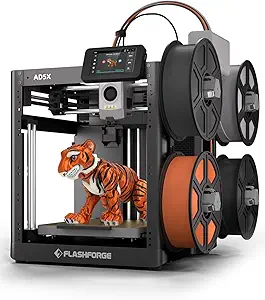 | Best for Multi-Color Printing with High-Speed Performance | Build Volume: 220 x 220 x 220 mm | Max Speed: 600 mm/s | Max Extruder Temp: 300°C | VIEW ON AMAZON | See Our Full Breakdown |
| Flashforge Creator 5 Pro 4-Toolhead 3D Printer |  | Best for Multi-Material, Industrial-Grade Projects | Toolheads: 4 independent | Toolhead Change Time: 7 seconds | Heated Chamber: Up to 65°C | VIEW ON AMAZON | See Our Full Breakdown |
| Snapmaker U1 3D Printer, 4-Toolhead with 5-Second Tool Changer |  | Best for Large-Scale, Multi-Color, Multi-Material Projects | Build Volume: 270 x 270 x 270 mm | Printing Speed: Up to 500 mm/s | Toolheads: 4 | VIEW ON AMAZON | See Our Full Breakdown |
| FlashForge AD5M 3D Printer Fully Auto Calibration with Max 600mm/s Speed, All-Metal CoreXY Structure, 220x220x220mm Print Size |  | Best for High-Speed, Reliable Automotive Parts Production | Product Dimensions: 15.83 x 14.29 x 17.64 inches | Item Weight: 22 pounds | Print Size: 220x220x220mm | VIEW ON AMAZON | See Our Full Breakdown |
| 3d printer for automotive part | Max Speed | Weight |
|---|---|---|
| Bambu Lab P1S 3D Printer | — | — |
| FLASHFORGE Adventurer 5M 3D Pr | — | — |
| Flashforge AD5X Multi-Color 3D | 600 mm/s | 24.2 pounds |
| Flashforge Creator 5 Pro 4-Too | 600 mm/s | 39 pounds |
| Snapmaker U1 3D Printer | — | 59 pounds |
| FlashForge AD5M 3D Printer Ful | 600mm/s | — |
More Details on Our Top Picks
Bambu Lab P1S 3D Printer – Ready-to-Use FDM 3D Printer
The Bambu Lab P1S stands out for its impressive print speed of up to 500mm/s, which significantly reduces production time—an advantage over the slower Flashforge AD5X or Creator 5 Pro. Its fully enclosed design and automatic bed leveling make it accessible for users seeking consistent quality with minimal fuss. However, multi-color printing requires the optional Bambu Lab AMS, adding complexity and cost compared to the plug-and-play multi-color options of the Flashforge AD5X or Snapmaker U1. The high-speed capability makes it ideal for rapid prototyping of automotive parts, but it’s not suited for filament types like carbon fiber or glass fiber reinforced polymers, limiting its use for heavy-duty industrial materials. Overall, this printer is best for those prioritizing speed, multi-color capabilities, and ease of setup in a versatile, enclosed environment.
Pros:- Exceptional print speed of up to 500mm/s reduces lead times
- Fully enclosed body improves temperature stability and filament compatibility
- Automatic bed leveling simplifies setup and enhances first-layer quality
- Supports multi-color printing with up to 16 colors via optional AMS
Cons:- Multi-color printing depends on an additional module, increasing cost and complexity
- Not suitable for carbon or glass fiber reinforced filaments, limiting industrial use
Best for: Prototypers and small-scale manufacturers needing fast, multi-color printing of automotive parts with high throughput
Not ideal for: Users requiring advanced composite filament support or working with fiber-reinforced materials, as it’s not compatible with such filaments
- Max Colors:16 (requires Bambu Lab AMS)
- Max Print Speed:500 mm/s
- Acceleration:20000 mm/s²
- Design:Fully enclosed
- Bed Leveling:Automatic
- Setup Time:15 minutes
Our verdict“This printer is ideal for users seeking fast, multi-color, enclosed printing for small-to-medium automotive prototyping projects.”
FLASHFORGE Adventurer 5M 3D Printer
The Flashforge Adventurer 5M offers a compelling blend of speed and automation, supporting speeds up to 600mm/s with fully automatic bed leveling, making it well-suited for quick turnaround of automotive prototypes. Its direct drive extruder and quick nozzle change capability offer workflow advantages over the Bambu Lab P1S, especially for users who value fast material switches. However, its build volume of 220 x 220 x 220mm can be limiting for larger parts, unlike the more spacious Snapmaker U1. While it excels in speed and ease of use, it doesn’t support multi-color printing natively, which could be a drawback for complex, multi-material parts. This makes it a good choice for fast, reliable prototyping where size isn’t a primary concern.
Pros:- Fully automatic bed leveling ensures consistent first layers
- High-speed motion support up to 600mm/s accelerates workflows
- Fast 3-second nozzle changes enhance material flexibility
- Remote monitoring via Flash Studio app adds convenience
Cons:- Limited build volume restricts large part production
- No native multi-color support, limiting complex multi-material designs
Best for: Engineers and designers needing quick, automated, high-speed prototypes of small to medium automotive parts
Not ideal for: Large-scale production or multi-color multi-material projects requiring more extensive build volume and color options
- Build Size:220 x 220 x 220 mm
- Max Travel Speed:600 mm/s
- Extruder Temp:280°C
- Auto Leveling:Yes
- Nozzle Change Time:3 seconds
- Setup Time:Under 10 minutes
Our verdict“This printer is best for those prioritizing speed, automation, and compact size for fast automotive prototyping.”
Flashforge AD5X Multi-Color 3D Printer
The Flashforge AD5X combines high-speed printing up to 600mm/s with multi-color capabilities supporting up to four colors simultaneously, which sets it apart from single-color options like the Snapmaker U1 or Bambu Lab P1S. Its 220 x 220 x 220mm build volume may be limiting for larger automotive components but is adequate for many prototypes. The one-click auto leveling and automatic filament handling streamline operations, although the multi-color workflow can be more complex than single-color setups, requiring careful tuning. Its slightly heavier weight at 24.2 pounds reflects its sturdy build but could be less portable. This model suits environments needing multi-color, high-speed, multi-material features in a contained footprint.
Pros:- Supports up to four colors simultaneously for complex designs
- High-speed printing up to 600mm/s accelerates project timelines
- One-click auto leveling and filament handling streamline workflow
- Remote control via Flash Maker app adds flexibility
Cons:- Limited build volume for larger automotive parts
- Multi-color setup adds workflow complexity compared to single-color printers
Best for: Design teams and small manufacturers needing multi-color, high-speed prototyping of detailed automotive parts
Not ideal for: Large parts or production requiring extensive build volume and fiber-reinforced material support
- Build Volume:220 x 220 x 220 mm
- Max Speed:600 mm/s
- Max Extruder Temp:300°C
- Auto Leveling:Yes
- Supported Colors:Up to 4
- Weight:24.2 pounds
Our verdict“Ideal for multi-color automotive prototyping where speed and color versatility are key, but larger parts may need separate equipment.”
Flashforge Creator 5 Pro 4-Toolhead 3D Printer
The Flashforge Creator 5 Pro excels in multi-material and multi-color printing thanks to its four independent toolheads and rapid 7-second FlashSwap changer. Its active heated chamber reaching 65°C allows for warping-free printing of engineering-grade materials like ABS, PC, and PA—an edge over single-material setups like the Snapmaker U1. While its 600mm/s max speed rivals industrial printers, the 39-pound weight and bulky dimensions make it less suitable for tight spaces. Customer ratings indicate some mixed experiences, possibly due to the complexity of multi-tool operation. This model fits well in dedicated workshops focused on high-volume, multi-material manufacturing of automotive parts.
Pros:- Four independent toolheads enable multi-material, multi-color printing without purging
- Active heated chamber prevents warping of engineering plastics
- Fast tool switching with 7-second FlashSwap minimizes downtime
- Built-in filtration and HD camera aid in quality control
Cons:- Heavy and large footprint limits portability and small workspace suitability
- Some users report mixed results, indicating a learning curve or reliability issues
Best for: Industrial environments and advanced prototyping facilities needing multi-material, multi-color, and warp-free printing
Not ideal for: Casual or hobbyist users with limited space or those requiring simple single-material workflows
- Toolheads:4 independent
- Toolhead Change Time:7 seconds
- Heated Chamber:Up to 65°C
- Max Speed:600 mm/s
- Filtration:Dual HEPA 13 + activated carbon
- Weight:39 pounds
Our verdict“This printer suits high-end, multi-material production environments where speed and material flexibility justify its size and weight.”
Snapmaker U1 3D Printer, 4-Toolhead with 5-Second Tool Changer
The Snapmaker U1 offers significant flexibility with four preloaded toolheads and a rapid 5-second tool changer, supporting complex multi-material and multi-color printing at speeds up to 500mm/s. Its 270 x 270 x 270mm build volume exceeds many competitors, making it suitable for larger automotive parts or multiple smaller components in one run. The smart calibration and touchscreen controls simplify operation, even for those new to multi-tool systems. The major tradeoff involves its weight of nearly 60 pounds, making it less portable, and the multi-tool setup can introduce workflow complexity. Nonetheless, it’s a strong choice for workshops focused on multi-material, multi-color prototyping or small batch production.
Pros:- Four preloaded toolheads with rapid 5-second tool change
- Large build volume supports bigger parts or multiple parts in one run
- Supports a wide range of filaments including PVA, TPU, ABS, and more
- Smart calibration and touchscreen controls ease complex multi-material setups
Cons:- Heavy weight and size may limit placement flexibility
- Multi-tool system adds complexity and potential setup time for beginners
Best for: Workshops and engineers requiring large, multi-material, multi-color parts with fast tool swapping
Not ideal for: Users with limited space or those who prefer single-extruder simplicity over multi-tool versatility
- Build Volume:270 x 270 x 270 mm
- Printing Speed:Up to 500 mm/s
- Toolheads:4
- Tool Change Time:5 seconds
- Supported Materials:PLA, PVA, TPU, PETG, ABS, ASA, PA, PC
- Weight:59 pounds
Our verdict“Best for demanding projects requiring large, multi-material, multi-color parts with quick tool exchanges in a dedicated workspace.”
FlashForge AD5M 3D Printer Fully Auto Calibration with Max 600mm/s Speed, All-Metal CoreXY Structure, 220x220x220mm Print Size
The FlashForge AD5M stands out for its impressive ability to print at speeds up to 600mm/s, making it ideal for quickly producing automotive prototypes and parts. Unlike the Bambu Lab P1S, which emphasizes ease of use and ready-to-go setup, the AD5M offers a robust all-metal CoreXY framework that ensures consistent, precise results even at high speeds. The automatic one-click leveling simplifies setup, but the complex features and weight could overwhelm newcomers or those needing portability. Its quick-release nozzle system is a clear advantage for frequent maintenance, yet the limited details on power supply might concern users wanting complete transparency. Compared to the FLASHFORGE Adventurer 5M, the AD5M’s higher speed and more industrial build make it more suitable for demanding automotive applications.
Pros:- Automated one-click leveling reduces setup time
- High-speed printing up to 600mm/s accelerates production
- All-metal CoreXY structure offers durability and precision
- Remote management via app adds convenience
Cons:- Complex features may intimidate beginners
- Heavy weight limits portability
- Limited specific info on power supply could concern some users
Best for: Manufacturers or hobbyists who need fast, reliable production of automotive parts with minimal setup time
Not ideal for: Beginners or those prioritizing portability and simple operation, due to its complexity and weight
- Product Dimensions:15.83 x 14.29 x 17.64 inches
- Item Weight:22 pounds
- Print Size:220x220x220mm
- Max Speed:600mm/s
- Nozzle Diameters:0.25/0.4/0.6/0.8 mm
- Power Supply:Included (not specified)
- Connectivity:Wi-Fi, network monitoring
- Material Compatibility:PETG, others
Our verdict“This printer is best suited for experienced users needing high-speed, dependable automotive parts production with advanced features.”
How We Picked
The selection process focused on printers that can handle the demands of automotive parts, emphasizing performance, build quality, material versatility, and reliability. We prioritized printers with proven speed, precision, and multi-material support, as these are crucial for manufacturing durable, functional automotive components. Ease of calibration and maintenance were also key factors, given the need for consistent quality in production. The rankings reflect the best balance of these factors, helping users find a model suited to both professional and enthusiast automotive applications.Factors to Consider When Choosing 3d Printer For Automotive Parts
Choosing a 3D printer for automotive parts requires understanding several key factors. Unlike general 3D printing, automotive applications demand high strength, precise dimensions, and often the ability to work with specialized materials. Evaluating these aspects alongside usability and budget will ensure you select a machine that can produce reliable, durable parts consistently.Print Size and Build Volume
Automotive parts can be large or complex, so a printer with a generous build volume is often necessary. However, larger print beds typically mean higher costs and potentially more maintenance. Consider your typical part size and choose a printer that balances capacity with affordability, ensuring it can handle your most common projects without excess unused space or unnecessary expense.
Material Compatibility and Durability
Automotive components often require high-strength, temperature-resistant, or impact-resistant materials. Not all printers support advanced filaments like carbon fiber composites or nylon. Verify the printer’s compatibility with these materials and assess whether it can produce parts that meet the mechanical and thermal demands of automotive use, rather than just basic plastics.
Print Speed and Precision
Speed can be a major factor when producing multiple or complex parts, but it should not come at the expense of accuracy. Precision is vital for fitting automotive components properly. Look for printers that offer high-resolution printing and consistent calibration to avoid dimensional inaccuracies, which can compromise the function or safety of your parts.
Ease of Calibration and Maintenance
Frequent calibration issues can lead to failed prints or inaccurate parts, especially with complex automotive components. A printer with automated calibration features reduces setup time and errors. Additionally, user-friendly maintenance procedures and accessible parts can save time and money over the long run.
Cost and Total Value
While high-end machines deliver advanced features, they come at a premium. Balance your budget against features like print volume, material options, and speed. Sometimes, investing a bit more upfront yields better durability and reliability, reducing replacement or upgrade costs later. Consider your long-term needs and how much value each feature provides for your automotive projects.
Frequently Asked Questions
Can I print automotive parts with standard 3D printers?
Standard 3D printers can produce basic automotive prototypes or small parts, but they often lack the strength, temperature resistance, and precision needed for functional automotive components. To create durable, reliable parts, you’ll typically need a printer that supports high-performance materials and offers high accuracy. Otherwise, parts may fail under stress or temperature, limiting their practical use.
What materials should I look for in a 3D printer for automotive parts?
Look for printers compatible with materials like ABS, Nylon, PETG, or carbon fiber composites. These materials provide the necessary strength, impact resistance, and thermal stability for automotive applications. Not all printers support these advanced filaments, so verifying material compatibility is essential to ensure your printed parts meet the required performance standards.
Is a larger build volume always better for automotive printing?
While a bigger build volume allows for larger parts or multiple components in one print, it also tends to increase the cost and complexity of the machine. If most of your parts are small or medium-sized, a smaller, more precise printer might serve better, offering higher resolution and easier handling. Larger printers are advantageous for big prototypes but may not be necessary for all automotive projects.
How important is multi-material support for automotive parts?
Multi-material support is quite valuable when creating complex automotive parts that require different properties, such as combining rigid and flexible materials or integrating color. It enables more realistic prototypes and functional components. However, such printers are typically more expensive and require more maintenance, so consider whether your projects demand this level of versatility before investing.
What are the key maintenance considerations for 3D printers used in automotive parts production?
Regular calibration, nozzle cleaning, and filament management are essential to maintain print quality. For printers used extensively with high-performance materials, parts like the extruder or cooling systems may need frequent replacement. Choosing a model with accessible, straightforward maintenance procedures can save time and reduce unexpected downtime, especially when producing parts on a schedule.
Conclusion
For most users seeking a versatile, reliable machine, the Bambu Lab P1S offers an excellent balance of speed, precision, and material support, making it the best overall choice. Budget-conscious hobbyists may prefer the Flashforge Adventurer 5M for its affordability and ease of use. Professionals requiring maximum build volume and multi-material capabilities should consider the Flashforge Creator 5 Pro or the Snapmaker U1. Beginners just starting out might benefit from simpler models, while those focused on high-strength, functional parts should prioritize machines supporting advanced materials. Each choice hinges on your specific project needs and budget constraints.
Halloween Picks
halloween
As an affiliate, we earn on qualifying purchases.