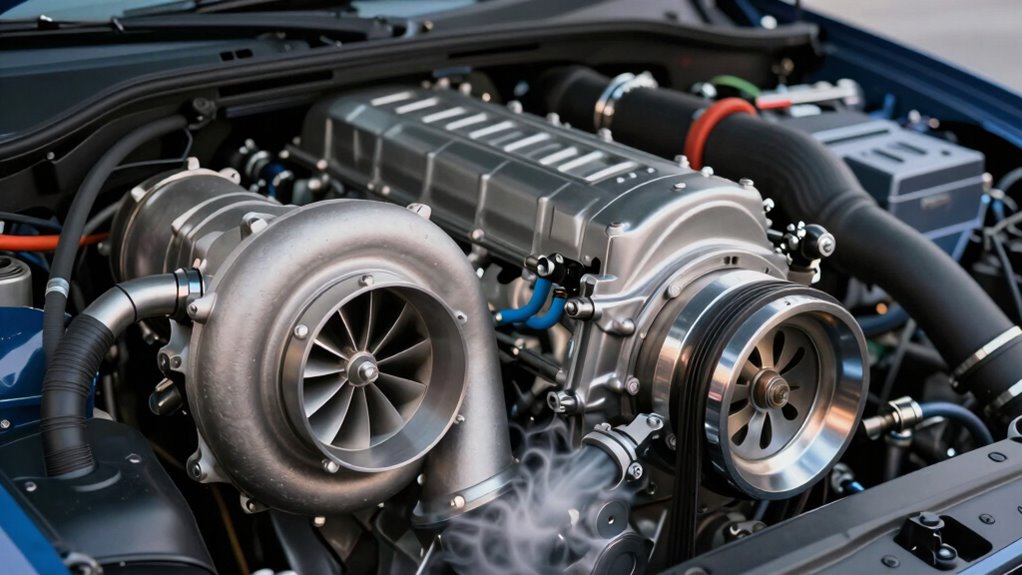

When choosing between a turbo and a supercharger, you’ll notice different power feels. A supercharger gives you immediate throttle response with linear torque, making your vehicle feel lively at low speeds. A turbo, however, ramps up power gradually but offers higher peak power at higher RPMs. This means turbocharged cars can feel sluggish initially but excel at high speeds. To understand how these systems influence your driving experience even more, continue exploring the details behind their power delivery.
Key Takeaways
- Superchargers provide immediate, linear torque for instant throttle response, while turbochargers may have slight lag before delivering power.
- Turbochargers excel at high RPMs, offering greater peak power and efficiency at higher engine speeds.
- Superchargers produce a steady, predictable boost, resulting in consistent power delivery across the RPM range.
- Turbo systems generate higher temperatures, requiring efficient intercoolers to maintain optimal power and prevent heat buildup.
- The driving experience with superchargers feels more lively and responsive at low speeds, whereas turbochargers excel in delivering high-end power.
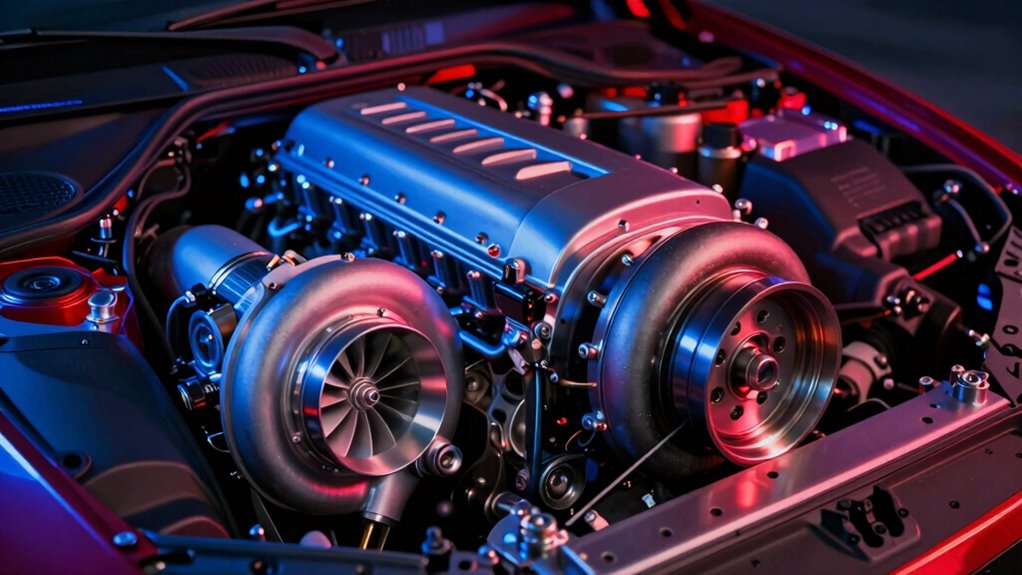
Have you ever wondered how turbochargers and superchargers boost your car’s performance? Both are designed to increase your engine’s power, but they do it in different ways that considerably impact how your vehicle feels on the road. When considering these systems, understanding their influence on intercooler efficiency and boost pressure levels helps explain the power delivery difference you’ll experience. Turbochargers work by using exhaust gases to spin a turbine, which then compresses incoming air before it enters the engine. This process raises the boost pressure levels, allowing more air—and consequently more fuel—to enter each cylinder. The increased air density means more power, but it also generates higher temperatures, making intercooler efficiency critical. A good intercooler cools this compressed air, increasing its density and preventing engine knocking, which helps you sustain higher boost pressure levels without risking damage. When your intercooler functions efficiently, the compressed air remains cooler and denser, delivering more power to your engine in a smooth, responsive way. Additionally, advances in European cloud technology are driving innovations in energy-efficient cooling systems that can be applied to intercoolers for improved performance and sustainability.
Superchargers, on the other hand, are mechanically driven by a belt connected to your engine’s crankshaft. They provide instant power because they are directly linked to engine speed, so your boost pressure levels increase immediately as you press the accelerator. This direct drive means you feel a rapid response, with less lag compared to a turbo. Since superchargers generate boost pressure almost instantaneously, they tend to produce a more linear power curve, giving you that immediate torque boost you crave. However, because they draw power directly from the engine, they can sometimes reduce overall efficiency slightly, especially at higher RPMs. The boost pressure levels delivered by superchargers are often more predictable, which can make your driving experience feel more immediate and aggressive. Proper intercooler efficiency remains essential in supercharged systems to prevent excessive heat buildup and optimize power output.
Ultimately, the key difference in power delivery boils down to response and consistency. Turbochargers give you high peak power, especially at higher RPMs, but might require some delay as the turbo spools up. Superchargers, meanwhile, offer instant torque and a more immediate throttle response, making your car feel more lively at lower speeds. Both systems rely heavily on maintaining ideal intercooler efficiency to keep intake temperatures low and maximize the benefits of increased boost pressure levels. This means that in choosing between the two, you’re weighing the turbo’s high-end power and efficiency against the supercharger’s immediate response and linear torque. Whichever you prefer, understanding how these systems influence boost pressure levels and intercooler performance helps you appreciate the unique power delivery each offers.
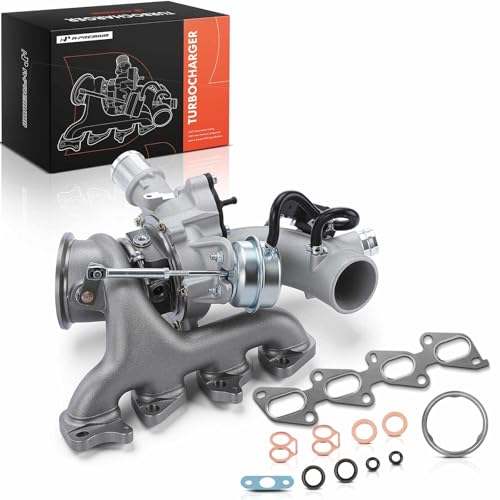
A-Premium Complete Turbo Turbocharger with Gasket Kit Compatible with Chevy Chevrolet Cruze 2011-2015 & Sonic 2012-2020 & Trax 2013-2021 & Buick Encore 2013-2021 1.4L Replace# 55565353
[VEHICLE FITMENT]: Compatible with GM (Chevy) Cruze 2011-2015; Sonic 2012-2020; Trax 2013-2021; Compatible with Buick Encore 2013-2021 —1.4L…
As an affiliate, we earn on qualifying purchases.
As an affiliate, we earn on qualifying purchases.
Frequently Asked Questions
Which Is More Fuel-Efficient, a Turbo or Supercharger?
A turbocharger is generally more fuel-efficient than a supercharger because it uses exhaust gases to boost power, which helps save fuel during normal driving. In the efficiency comparison, superchargers tend to consume more fuel as they draw power directly from the engine to operate. So, if you’re looking for better fuel economy, a turbo is the smarter choice, providing efficient performance without sacrificing too much fuel.
How Does Each Impact Engine Longevity and Maintenance Costs?
Think of your engine as a finely tuned orchestra—each part must work in harmony. Turbochargers generally cause less engine wear over time, leading to lower maintenance frequency, because they operate at lower boost pressures and cool down faster. Superchargers, however, can increase engine strain, potentially raising maintenance costs due to more frequent repairs. Your choice impacts longevity and upkeep, so consider your driving style and willingness for maintenance.
Can Turbo or Supercharger Setups Be Added to Any Engine?
You can’t just add a turbo or supercharger to any engine without considering engine compatibility. Many engines require specific modifications for proper installation, and some may face installation challenges due to space, existing components, or design limitations. To avoid issues, consult a professional to assess your engine’s suitability and guarantee the setup is compatible, safe, and effective for your vehicle.
What Are the Noise Level Differences Between the Two?
You’ll notice noise differences between turbo and supercharger setups. Turbochargers generally produce a quieter sound, with a subtle whistle or hissing during boost, thanks to their exhaust-driven design. Superchargers tend to be louder, delivering a distinctive whine or growl that’s more pronounced under acceleration. The sound characteristics of each influence your driving experience; if you want a more subdued noise level, turbo is your best choice.
Which Provides Better Acceleration in Everyday Driving?
You’ll find a supercharger offers better acceleration in everyday driving, thanks to its instant throttle response. Imagine a torque curve that’s always ready to surge, making your acceleration feel smooth and punchy. Unlike turbos, which might lag a bit at low RPMs, a supercharger delivers power immediately, giving you that satisfying rush as you hit the gas. It’s like having a turbocharged punch right when you need it.
![[Upgraded] SUPERONE Retractable Car Charger 4 in 1, Fast Car Phone Charger with Cord 2.6ft, USB C and Apple Car Adapter, Compatible with iPhone 17 16 15/15 Pro Max/14/13/12/11, Galaxy, Pixel](https://m.media-amazon.com/images/I/41+RGu0hHtL._SL500_.jpg)
[Upgraded] SUPERONE Retractable Car Charger 4 in 1, Fast Car Phone Charger with Cord 2.6ft, USB C and Apple Car Adapter, Compatible with iPhone 17 16 15/15 Pro Max/14/13/12/11, Galaxy, Pixel
SUPERONE Advantage: Leading retractable car charger brand. Our Retractable Car Charger features two 80cm long extendable cables, allowing…
As an affiliate, we earn on qualifying purchases.
As an affiliate, we earn on qualifying purchases.
Conclusion
Ultimately, choosing between a turbo and a supercharger is like picking between a sprint and a marathon—you’ll feel the immediate rush or steady surge. Turbochargers deliver a quick burst of power, while superchargers provide a more consistent pull. Think of it as a race car versus a muscle car, each with its own thrill. Whichever you choose, remember that the right boost can turn your drive into an exhilarating adventure—just like adding rocket fuel to your journey.
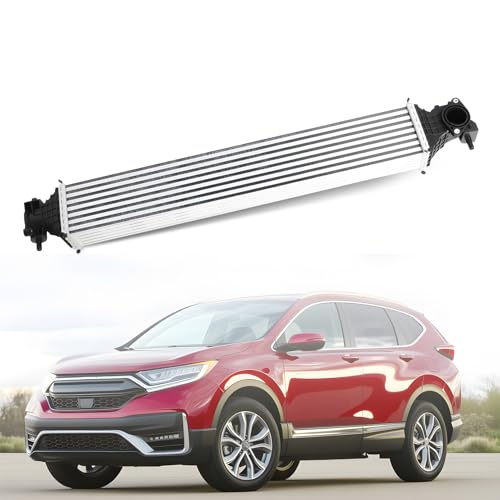
Assembroverse Aluminum Turbocharger Intercooler Compatible with CR-V CRV 2017-2022 1.5L L4 Engine Turbocharged Automotive Replace 19710-5PA-A01 HO3012101 Turbo Charge Chiller Cooler
Fitment: Turbo charger intercooler compatible with CR-V EX /EX-L/LX/Special Edition/Touring 2017 2018 2019 2020 2021 2022 L4 1.5L…
As an affiliate, we earn on qualifying purchases.
As an affiliate, we earn on qualifying purchases.

HKS 12001-AN008 Performance Supercharger System
HKS products are designed to be user friendly for easy installation
As an affiliate, we earn on qualifying purchases.
As an affiliate, we earn on qualifying purchases.