Choosing among the best turbo options for a Chevy small-block V8 starts with a distinction that listings often blur: most of these products are turbochargers, not complete, engine-specific kits. My leading pick for a broad street-and-strip build is the maXpeedingrods T76 T4, whose V8 compatibility, moderate stated power ceiling, and included gaskets make it a more grounded starting point than the largest units here. For a higher-output combination, the FIWARY T76 offers a published 600–1,000 HP capacity and useful flange details, while the VIV Autoparts 7875 is aimed at large-cubic-inch builds seeking a similar high-power range.

Get business pricing on garage and car supplies
- Business-only prices and quantity discounts
- Tax-exempt purchasing
- Multiple users, one account, clear invoices
The main tradeoff is turbo size versus usable response: a large compressor may support a bigger power goal, but it does not guarantee good spool, a suitable match, or an easy installation on your particular small-block. The lineup also includes the GT45, which has a stated 600 HP capacity but is heavy and broadly specified, and a GT35 package with oil lines and a common T3 inlet that may appeal to fabricators. I rank these by how clearly their supplied details help a Chevy V8 buyer plan a matched system—not by treating an advertised horsepower figure as a promise of engine output.
Complete the kit


Key Takeaways
- The maXpeedingrods T76 T4 is my most balanced starting point in this group: it explicitly covers V6 and V8 engines above 3.0L, has a stated 500 BHP ceiling, and includes gaskets, but still needs custom-system planning.
- FIWARY publishes useful T4, V-band, compressor, and turbine measurements alongside a 600–1,000 HP claim; that makes it easier to evaluate for a serious build, not automatically a bolt-on Chevy kit.
- VIV Autoparts targets the highest-output end with a 78mm billet compressor and 75mm turbine, but its oil-cooled journal-bearing design calls for careful oiling and heat management.
- The GT45’s 600 HP claim and 4.0L–6.0L range sound broad, yet its 38.4-pound weight and sparse installation information make fitment and support a major part of the decision.
- The GT35 package supplies oil feed and return lines and uses a T3 inlet, but its supplied compatibility description focuses on four- and six-cylinder engines, so small-block V8 buyers should verify the exact turbo and application before choosing it.
| maXpeedingrods T76 T4 Turbocharger with Gaskets for V6/V8 Engines Above 3.0L |  | Best Overall | Model: T76 T4 Basic VL Series | Listed compatibility: Six- and eight-cylinder engines above 3.0L | Claimed maximum: 500 BHP | VIEW LATEST PRICE | See Our Full Breakdown |
| FIWARY T76 T4 Turbocharger 0.96 A/R 76mm Compressor Universal V6 V8 3.5L+ Engine |  | Best for a Higher-Output Custom Build | Model: T76 T4 .96 A/R | Turbine A/R: 0.96 | Compressor wheel: 76.6mm inducer; 102.3mm exducer | VIEW LATEST PRICE | See Our Full Breakdown |
| VIV Autoparts Billet T78 7875 Turbocharger T4 A/R .96 A/R .75 3-inch V-Band Oil Cooled |  | Best for Large-Cubic-Inch, High-Power Builds | Model: T4-96 7875BILLET-96-1 | Compressor wheel: 78mm billet | Turbine wheel: 75mm | VIEW LATEST PRICE | See Our Full Breakdown |
| maXpeedingrods GT45 T4 Turbocharger for 4.0L-6.0L Engines |  | Best for a Broad Displacement Range | Model: GT45 T4 | Listed engine range: 4.0L–6.0L | Claimed maximum: 600 HP | VIEW LATEST PRICE | See Our Full Breakdown |
| maXpeedingrods GT35 Turbo Kit with T3 Flange for 2.5-6.0L Engines |  | Best for a T3-Flange Fabrication Project | Model: GT35 | Listed engine range: 2.5L–6.0L; description specifies four- and six-cylinder engines | Exhaust inlet: T3 flange | VIEW LATEST PRICE | See Our Full Breakdown |
| turbo kits for Chevy small-block V8 | Model | Compressor wheel | Weight |
|---|---|---|---|
| maXpeedingrods T76 T4 Turbocha | T76 T4 Basic VL Series | Forged aluminum alloy | 23 lb |
| FIWARY T76 T4 Turbocharger 0.9 | T76 T4 .96 A/R | 76.6mm inducer; 102.3mm exducer | — |
| VIV Autoparts Billet T78 7875 | T4-96 7875BILLET-96-1 | 78mm billet | 22.8 lb |
| maXpeedingrods GT45 T4 Turboch | GT45 T4 | Forged aluminum alloy | 38.4 lb |
| maXpeedingrods GT35 Turbo Kit | GT35 | — | — |
More Details on Our Top Picks
maXpeedingrods T76 T4 Turbocharger with Gaskets for V6/V8 Engines Above 3.0L
I put this T76 first because its listing gives a comparatively useful starting point for an SBC project without presenting itself as a complete bolt-on system. It explicitly covers six- and eight-cylinder engines above 3.0L, gives a 500 BHP maximum rating, and includes gaskets. Those details make it easier to shortlist than the GT45, whose broader 4.0L–6.0L range comes with less fitment context, or the GT35 package, whose compatibility description does not name V8s.
The hardware is straightforward: a T4 inlet, ductile-iron turbine housing, forged-aluminum compressor wheel, and copper-alloy journal bearing. The listing also provides temperature ratings for the housing and wheel, which help a builder understand the stated material limits, though they do not replace a full operating plan. At 23 pounds, this is no lightweight part; the exhaust system and mounting points need to support it without stressing a manifold or connection.
Its stated 500 BHP ceiling makes it a less extreme proposition than the FIWARY T76 and VIV 7875, both advertised for as much as 1,000 HP. That can be an advantage for someone who does not need a very large turbo, but the listing omits key sizing data such as A/R and compressor-wheel dimensions. I would not select it on the number alone. The included gaskets are a small convenience, not a full installation kit; expect to source and design the rest of the hot-side, oil plumbing, charge piping, fuel delivery, and tuning.
Compared with the GT45, this T76 is substantially lighter and states V8 compatibility more directly. Compared with FIWARY’s T76, it has less published geometry but a lower claimed power ceiling and included gaskets. That makes it my most approachable overall pick for a builder seeking a moderate-output direction who can verify turbo matching and fabricate the rest of the system.
Pros:- Listing explicitly covers V6 and V8 engines above 3.0L.
- Includes gaskets, unlike several standalone turbo options here.
- T4 flange and forged-aluminum compressor wheel are clearly identified.
- At 23 pounds, it is lighter than the listed GT45 and GT35 package.
Cons:- The 500 BHP figure is a listing claim, not a guaranteed Chevy small-block output.
- No A/R or wheel dimensions are supplied for precise turbo matching.
- A 23-pound turbo still needs sound manifold and exhaust support.
Best for: SBC owners seeking a relatively moderate-output T4 turbo starting point and willing to build or commission the surrounding system.
Not ideal for: Buyers who need a complete vehicle-specific kit, a confirmed small-block turbo match, or detailed compressor and turbine sizing before purchase.
- Model:T76 T4 Basic VL Series
- Listed compatibility:Six- and eight-cylinder engines above 3.0L
- Claimed maximum:500 BHP
- Turbine inlet:T4
- Turbine housing:Ductile iron
- Compressor wheel:Forged aluminum alloy
- Bearing:Copper-alloy journal bearing
- Weight:23 lb
- Warranty:1-year limited warranty
Our verdict“I recommend this as the lineup’s most balanced starting point, provided you verify sizing and treat it as one component of a custom SBC system.”
FIWARY T76 T4 Turbocharger 0.96 A/R 76mm Compressor Universal V6 V8 3.5L+ Engine
FIWARY takes the second spot because it supplies the most useful sizing information among the two T76 options. Its listing names a 76.6mm compressor inducer, 102.3mm exducer, 0.96 A/R turbine housing, T4 flange, and V-band outlet. That gives an experienced builder more to compare with a particular small-block combination than the maXpeedingrods T76 listing, which offers a broad V8 fitment statement but does not provide wheel dimensions or A/R.
The claimed 600–1,000 HP capacity points toward a more ambitious setup than the maXpeedingrods T76’s 500 BHP claim. That gap matters only if the rest of the engine and vehicle support the goal: a large turbo on a small-block can trade low-rpm response for flow at higher engine speeds. The 0.96 A/R and 76mm compressor are data points for a tuner or turbo specialist to assess, not a promise of quick spool or a specific power result.
Its T4 inlet and 2.5-inch V-band outlet can help define the exhaust connection, while the four-inch inlet sets a substantial intake-pipe requirement. The oil-cooled floating-bearing design will need a correctly planned feed and drain, plus attention to heat and oil condition. The listing mentions a 12-month warranty, but warranty coverage does not remove the need to confirm application details before fabrication.
Compared with the VIV 7875, FIWARY also advertises up to 1,000 HP but supplies more explicit compressor and turbine measurements, while VIV gives a billet compressor description and a stronger shaft-material detail. Compared with my overall pick, FIWARY is better documented for a custom high-output build but less conservative in its stated power range. I would shortlist it when the build has a clear high-rpm goal and a knowledgeable fabricator; I would skip it as a casual, minimal-modification upgrade.
Pros:- Provides compressor and turbine wheel measurements plus turbine A/R.
- T4 inlet and V-band outlet are identified for exhaust-system planning.
- Listing covers V6 and V8 engines from 3.5L to 6.0L.
- Advertised power capacity reaches the high-output range.
Cons:- The broad 600–1,000 HP claim does not establish a matched SBC result.
- Oil cooling and floating bearings demand sound lubrication and heat planning.
- Universal fitment can require custom manifold, piping, and tuning work.
Best for: Experienced SBC builders and fabricators who need a large T4 turbo with published wheel, A/R, and outlet dimensions to evaluate.
Not ideal for: First-time turbo buyers, stock-engine owners expecting easy low-rpm response, or anyone needing a verified, vehicle-specific installation kit.
- Model:T76 T4 .96 A/R
- Turbine A/R:0.96
- Compressor wheel:76.6mm inducer; 102.3mm exducer
- Turbine wheel:73.5mm inducer; 64.3mm exducer
- Inlet:4 inches
- Outlet and flange:2.5-inch V-band outlet; T4 turbine flange
- Cooling and bearing:Oil cooled; floating bearing
- Claimed capacity:600–1,000 HP
- Weight and warranty:22.8 lb; 12 months
Our verdict“I would choose FIWARY over the less-documented T76 when a serious builder needs published sizing details for a custom high-output combination.”
VIV Autoparts Billet T78 7875 Turbocharger T4 A/R .96 A/R .75 3-inch V-Band Oil Cooled
The VIV Autoparts 7875 is the lineup’s clearest choice for a builder aiming at a large-cubic-inch, high-output SBC. Its listing gives a 78mm billet compressor, 75mm turbine wheel, T4 inlet, 0.96 turbine A/R, and claimed 800–1,000 HP range. Those numbers place it beyond the more restrained maXpeedingrods T76 in advertised capacity and make it a poor default for someone who values quick street response over high-rpm airflow.
VIV also specifies a 42 CrMo shaft rotor and says the unit is balanced and endurance tested before packaging. Those are useful construction claims, but they cannot establish how the turbo will behave in a particular engine bay or how long it will last under a specific duty cycle. The listing’s 0.75 compressor A/R and 0.96 turbine A/R add context for a specialist matching the unit to displacement, camshaft, exhaust, and intended rpm range.
The drawbacks are practical. This is an oil-cooled, journal-bearing turbo, not a complete turbo system. The builder must account for oil feed and drain routing, heat management, intake and exhaust plumbing, wastegate arrangements, and an appropriate fuel and ignition strategy. Compared with FIWARY’s T76, VIV has a larger stated compressor and a high-strength shaft description, but FIWARY supplies more exact wheel measurements and a 2.5-inch V-band outlet. Compared with the overall-pick T76, VIV asks for a more committed build and a stronger reason to prioritize airflow over tractability.
I rank it below FIWARY for general high-output selection because fewer dimensional details are supplied, not because the advertised power range is lower. For a purpose-built, high-rpm small-block with professional matching, its large compressor and turbine are relevant. For a street car with an unspecified combination, those same dimensions make the risk of an ill-matched setup harder to overlook.
Pros:- 78mm billet compressor and 75mm turbine suit an ambitious airflow target.
- T4 inlet and A/R figures provide useful matching information.
- 42 CrMo shaft rotor is specified in the listing.
- Advertised capacity is aimed at high-output applications.
Cons:- Its large sizing may not suit a responsive street-oriented SBC combination.
- Oil-cooled journal-bearing design needs careful oiling and heat control.
- Sold as a turbocharger rather than a full installation system.
Best for: Builders planning a high-output, large-cubic-inch small-block and working with a tuner or turbo specialist.
Not ideal for: Street-focused buyers seeking a simple upgrade, low-rpm response, or an all-in-one kit with installation components.
- Model:T4-96 7875BILLET-96-1
- Compressor wheel:78mm billet
- Turbine wheel:75mm
- Compressor and turbine A/R:0.75 and 0.96
- Inlet and outlet:4-inch inlet; 3-inch V-band outlet
- Claimed power range:800–1,000 HP
- Bearing and cooling:Journal bearing; oil cooled
- Shaft:42 CrMo high-strength material
- Weight:22.8 lb
Our verdict“I would reserve this for a deliberately high-output small-block build where its large frame can be matched to the engine and intended rpm range.”
maXpeedingrods GT45 T4 Turbocharger for 4.0L-6.0L Engines
The GT45 earns a place for its stated 4.0L–6.0L engine range and 600 HP capacity, which overlap with many Chevy small-block displacements. That makes it a plausible candidate to investigate for a larger V8, but the listing’s broad compatibility does not tell me whether it matches a particular SBC’s camshaft, compression, exhaust, or rpm target. I rank it behind the T76 options because they give a more direct V8 fitment statement or more detailed sizing information.
Its ductile-iron turbine housing, forged-aluminum compressor wheel, and copper-alloy journal bearing describe a conventional basic configuration. These materials are relevant to heat exposure, airflow, and serviceability, but the listed features do not create a complete installation or establish a performance curve. At 38.4 pounds, it is the heaviest standalone turbo in this group. That weight makes manifold strength, bracing, and stress on exhaust connections worth planning before the unit is positioned in a vehicle.
Compared with the maXpeedingrods T76, the GT45 has a higher stated maximum capacity but weighs more and comes with less installation convenience: the T76 listing includes gaskets, while this one does not specify them. Compared with the FIWARY T76, GT45 has a simpler compatibility range but lacks published wheel dimensions and A/R. A buyer who already has a builder to identify a suitable match may value its broad displacement claim; a buyer trying to size a turbo from listing data will have less to work with.
I would treat this as a candidate turbo, not a Chevy-specific solution. Check flange and housing dimensions, compressor and turbine maps or other seller documentation, wastegate setup, and lubrication requirements before purchase. The product information does not name variable geometry or advanced anti-surge features, so shoppers seeking those should compare other purpose-built designs rather than assume they are present.
Pros:- Listed engine range includes 4.0L–6.0L applications.
- Advertised maximum capacity is 600 HP.
- Forged-aluminum compressor wheel and ductile-iron turbine housing are specified.
- Copper-alloy journal bearing uses a conventional, serviceable design.
Cons:- At 38.4 pounds, it needs a strong mounting and exhaust-support plan.
- Listing omits wheel dimensions and A/R for matching.
- No vehicle-specific Chevy small-block installation details are provided.
Best for: SBC owners with a 4.0L–6.0L build who have professional help to verify turbo sizing and can support a heavy turbo.
Not ideal for: Buyers who need detailed compressor sizing, included installation parts, or a light and well-documented fitment choice.
- Model:GT45 T4
- Listed engine range:4.0L–6.0L
- Claimed maximum:600 HP
- Turbine inlet:T4
- Turbine housing:Ductile iron
- Compressor wheel:Forged aluminum alloy
- Bearing:Copper-alloy journal bearing
- Weight:38.4 lb
- Dimensions:12.2 × 11.02 × 13.39 inches
Our verdict“I would shortlist the GT45 only after a builder confirms its sizing and mounting needs for the exact small-block combination.”
maXpeedingrods GT35 Turbo Kit with T3 Flange for 2.5-6.0L Engines
This GT35 is the lineup’s most package-oriented option: the listing includes oil feed and return lines and identifies a familiar T3 exhaust inlet plus a four-bolt, three-inch outlet. Those details may help a fabricator assemble a custom project, and the 0.63 turbine A/R and 0.7 compressor A/R offer some starting points for discussion. I rank it fifth because its stated compatibility is for four- or six-cylinder engines from 2.5L to 6.0L, not Chevy small-block V8s.
That qualification matters more than the broad displacement number. The product title mentions engines up to 6.0L, but the description does not clearly identify V8 fitment. A small-block buyer should confirm the exact turbo model and intended engine configuration with the seller rather than infer suitability from displacement alone. The kit’s T3 flange also differs from the T4 inlet used by the T76, GT45, FIWARY, and VIV options, so it may require a different manifold or an adapter and should not be treated as interchangeable.
The listed A/R figures and trim numbers are helpful, but this entry provides little information about a power range, wheel dimensions, or whether all plumbing and installation hardware are included beyond the oil lines. Its 41.4-pound listed weight is also substantial for a GT35-labelled package, so I would verify exactly what that figure covers and plan proper support. The listing itself recommends professional installation and potential modifications, and it does not include installation instructions.
Compared with the T76 overall pick, the GT35 package brings oil lines and a T3 configuration but has less explicit V8 compatibility. Compared with the GT45, it offers more installation-related parts but lacks a stated power ceiling and a clearly named V8 application. It makes the most sense for a fabricator who has already confirmed fitment and specifically wants the T3 layout; most SBC buyers should begin with a more explicitly V8-oriented option.
Pros:- Includes oil feed and return lines.
- Uses a T3 inlet flange and lists a four-bolt, three-inch outlet.
- Provides turbine and compressor A/R figures.
- Could suit a custom project where the T3 layout is already planned.
Cons:- Published compatibility focuses on four- and six-cylinder engines, not V8s.
- No power-capacity figure or wheel dimensions are supplied.
- Installation instructions are not included, and modifications are expected.
Best for: A fabricator who has verified the specific V8 application and wants a T3-flange turbo package with oil feed and return lines.
Not ideal for: Buyers who need clear Chevy small-block compatibility, complete installation instructions, or a documented power target.
- Model:GT35
- Listed engine range:2.5L–6.0L; description specifies four- and six-cylinder engines
- Exhaust inlet:T3 flange
- Exhaust outlet:Four-bolt, 3 inches
- Turbine A/R:0.63
- Compressor A/R:0.7
- Included lines:Oil feed and return lines
- Listed weight:41.4 lb
- Installation information:Instructions not included; professional installation and modifications recommended
Our verdict“I would buy this for a Chevy small-block only after confirming V8 suitability and the exact contents with the seller or installer.”
How We Picked
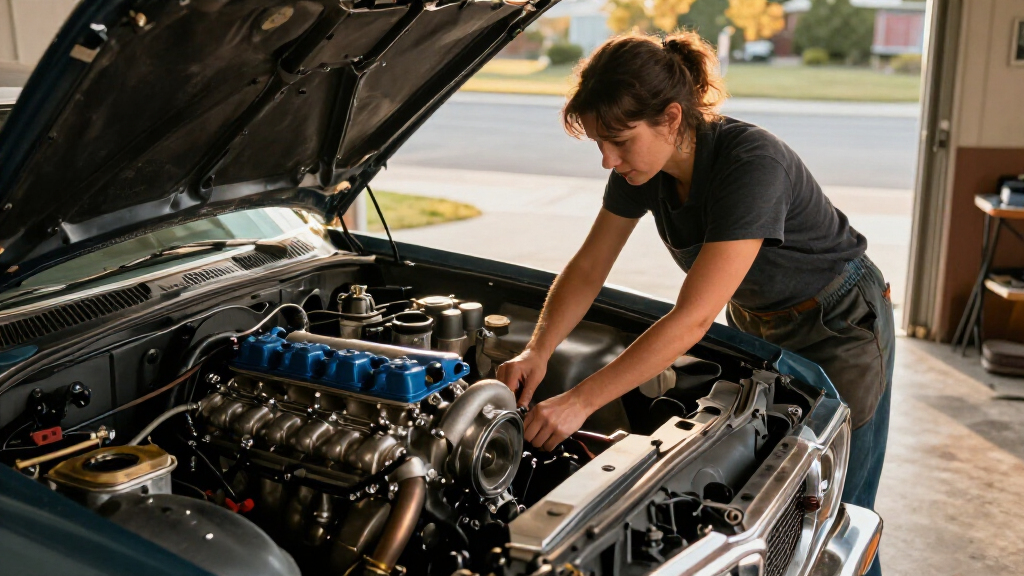
I ranked these five products for one specific job: helping a buyer plan a turbocharged Chevy small-block V8, rather than choosing a universal turbo by headline power figure alone. None of the listings establishes a vehicle-specific, complete small-block installation. I treated every option as a component or partial package that needs confirmation against the engine, exhaust layout, fuel system, and intended use.
My comparison weighs four practical factors. First is stated engine compatibility: a listing that explicitly mentions V8s or a relevant displacement range is more useful than one whose stated fitment is aimed elsewhere. Second is sizing and information quality, including flange, A/R, wheel, and inlet or outlet details when supplied. Third is what arrives in the package: included gaskets or oil lines can reduce sourcing work, but do not make a system complete. Fourth is the tradeoff between output ambition, installation complexity, and the support required for a heavy turbo.
I did not treat advertised horsepower capacity as verified power on a Chevy small-block, nor assume that a universal flange means the turbo will fit a particular chassis. Turbo matching depends on displacement, camshaft, compression, exhaust manifold, target boost, rpm range, fuel, and tuning. That is why the more detailed T76 listings rank above the GT45 and GT35 package for most SBC shoppers, while the VIV 7875 earns a distinct role for builders whose goals justify its large frame. Buyers should confirm specifications and fitment with the seller or builder before ordering.
| turbo kits for Chevy small-block V8 | Model |
|---|---|
| maXpeedingrods T76 T4 Turbocha | T76 T4 Basic VL Series |
| FIWARY T76 T4 Turbocharger 0.9 | T76 T4 .96 A/R |
| VIV Autoparts Billet T78 7875 | T4-96 7875BILLET-96-1 |
| maXpeedingrods GT45 T4 Turboch | GT45 T4 |
| maXpeedingrods GT35 Turbo Kit | GT35 |
Factors to Consider When Choosing Best Turbo Kits For Chevy Small-block V8s
A turbo choice for a Chevy small-block is only one part of a system. I would use the details below to narrow down a candidate, then confirm fitment and turbo matching with a qualified builder before ordering.
Start with the complete engine combination
Displacement alone does not determine which turbo suits a small-block. A 350-cubic-inch engine with a mild cam, moderate compression, and street-focused rpm range can need a different match from a stroked engine built to operate at high rpm. The camshaft, cylinder heads, compression ratio, exhaust manifold design, fuel, intended boost, and target power all shape the decision. That is why the broad engine ranges on the GT45 and GT35 listings are not enough to confirm fitment.
I would write down the engine specification and intended use before comparing products. A turbo selected around the full combination is more useful than one chosen from a maximum horsepower claim alone. Ask the builder or seller what information they need to confirm the turbo’s suitability, and request any missing wheel or compressor-map data that can support the choice.
Treat advertised horsepower as a ceiling claim, not a result
The products list capacities ranging from 500 BHP for the maXpeedingrods T76 to as much as 1,000 HP for FIWARY and VIV. Those figures are not equivalent measurements, and they do not promise a particular output on a Chevy small-block. A turbo’s usable range depends on its airflow characteristics and operating conditions, while the engine’s ability to make and survive power depends on its own components and calibration.
I would use the claims to separate broadly moderate and ambitious options, then ask for technical support to confirm the match. The T76 with a 500 BHP claim is a more restrained starting point on paper than a 7875 advertised for 800–1,000 HP. It is still not automatically the right option for every street build, and a larger advertised capacity is not a reason by itself to choose a larger turbo.
Check flange, A/R, and piping before buying
These listings mix T3 and T4 exhaust inlets and different outlet arrangements. The GT35 uses a T3 inlet and a four-bolt, three-inch outlet, while the T76, GT45, FIWARY, and VIV models specify T4 inlets. FIWARY lists a 2.5-inch V-band outlet; VIV lists a three-inch V-band outlet. These are not interchangeable details: they affect the manifold, downpipe, and adjoining exhaust design.
A/R values can help a specialist evaluate a candidate, but they should not be read as a standalone ranking. The GT35 lists 0.63 turbine A/R, FIWARY and VIV list 0.96, and the other entries do not provide the same information. Ask how the turbo will behave with your engine and planned rpm range, and confirm measurements and connection standards before fabricating pipes or purchasing a manifold.
Plan oiling, heat, mounting, and maintenance
All five listings describe journal- or floating-bearing designs and do not present a water-cooled alternative in the supplied details. Oil feed and drain routing, appropriate oil supply, heat shielding, and access for service belong in the installation plan. The GT35 says oil lines are included; the T76 includes gaskets. Those additions are helpful but do not amount to a complete system, and the other required parts still need to be identified.
Weight also deserves attention. The GT45 is listed at 38.4 pounds and the GT35 package at 41.4 pounds, while the other three turbos are listed around 22.8–23 pounds. Confirm what each weight includes, then have the installer consider support for the turbo and stress on the manifold and exhaust connections. Poor support or unsuitable oiling can undermine an otherwise promising component choice.
Budget time for the supporting system and calibration
None of these listings establishes a complete, vehicle-specific Chevy small-block turbo kit. Depending on the vehicle and engine, a build may still need manifolds, wastegate and control components, downpipe, charge piping, intercooling, oil plumbing, fuel-system changes, sensors, and a suitable engine calibration. The details vary with the installation; confirm package contents rather than assuming that a product called a kit contains every part required.
Installation and tuning are not afterthoughts. A turbocharger can only work as part of a properly matched and calibrated combination. If this is your first boosted V8, I would put a professional builder or tuner into the planning stage and select a product they can support, instead of choosing the highest advertised capacity and solving fitment afterward.
Choose the right level of documentation
The FIWARY T76 is the easiest option here to evaluate by published sizing because it lists wheel measurements, A/R, and connection details. The VIV 7875 names its compressor and turbine sizes and shaft material, while the maXpeedingrods T76 gives clearer V8 compatibility and includes gaskets but omits wheel dimensions and A/R. The GT45 supplies a broad displacement range but little geometry, and the GT35 requires extra care because its stated cylinder compatibility does not name V8s.
For a buyer who already has a specialist, missing details may be solvable through seller documentation. For a DIY buyer trying to estimate fitment from a product page, incomplete specifications increase uncertainty. I would make documentation part of the purchase decision: ask for exact dimensions, included components, and application guidance before committing to a turbo or designing around it.
Frequently Asked Questions
Are these complete Chevy small-block turbo kits?
No listing here establishes a complete, vehicle-specific Chevy small-block installation. The maXpeedingrods GT35 description includes oil feed and return lines, and the maXpeedingrods T76 includes gaskets, but those items do not cover every component a turbo system may need. I would confirm the package contents, manifold fitment, wastegate arrangement, piping requirements, oil plumbing, fuel-system needs, and tuning plan before ordering.
Which option is the best starting point for a typical SBC build?
I place the maXpeedingrods T76 first for its explicit V6 and V8 compatibility above 3.0L, included gaskets, and lower stated capacity than the large-output FIWARY and VIV units. That makes it a more balanced starting point on paper, not a universal match. The right turbo still depends on the exact engine, desired response, power goal, exhaust layout, and tuning plan, so I would have those details checked before purchase.
Can I choose a turbo based only on its horsepower claim?
No. A listed capacity is not a guaranteed result on a Chevy small-block and does not tell the whole story about response, efficiency, or engine suitability. The products also give different levels of technical information, and their claims may not be directly comparable. I would use the numbers to set broad expectations, then match the turbo to displacement, camshaft, compression, exhaust, intended rpm range, fuel system, and a professional calibration plan.
What is the difference between the T3 and T4 options here?
The GT35 listing identifies a T3 exhaust inlet, while the other four products specify T4. That connection affects which manifold or adapter the turbo can use, along with the layout of the exhaust system. It does not mean one flange is automatically better for every SBC. Confirm the exact flange dimensions and manifold compatibility with your builder, and do not assume that the T3 GT35 fits a small-block just because its listed displacement range reaches 6.0L.
Which option should I consider for a high-output small-block?
FIWARY and VIV are the most clearly aimed at high-output applications in this group, with listings that reach 1,000 HP. FIWARY provides more exact wheel and connection dimensions, while VIV specifies a 78mm billet compressor, 75mm turbine, and 42 CrMo shaft. I would not treat either claim as a proven SBC result or select a large turbo without a specialist’s match to the engine and intended rpm range. For a street-focused build, a high advertised capacity may bring compromises rather than an advantage.
Conclusion
For the buyer who wants the most balanced shortlist option, I would start with the maXpeedingrods T76 T4, then verify its missing sizing details with the builder. If your project is a carefully planned high-output combination, compare FIWARY’s T76 measurements with the VIV 7875’s larger wheel sizes and confirm which better suits the engine’s rpm range. Choose the GT45 only if a specialist approves its fit and you can support its listed weight. Consider the GT35 package only after confirming that its stated fitment applies to your V8 and that the T3 layout works with your manifold plan.
My main recommendation is to select the turbo around the whole Chevy small-block combination, not a headline capacity or a broad displacement claim. None of these products is shown here as a complete, vehicle-specific SBC kit, so budget for fabrication, supporting parts, and calibration. If you cannot get firm answers on fitment and sizing, pause before ordering and ask a qualified turbo builder to review the combination.