
TL;DR

Get garage and car supplies delivered free — and shop member deals
- Fast, free delivery on millions of items
- Access to Prime Big Deal Days deals on October 6–7
- Prime Video, Amazon Music and more included
A cordless impact wrench combines rotational force with rapid impacts to loosen or tighten fasteners. Choosing the right one involves matching drive size, torque, battery platform, and safety features to your needs. Proper use and safety precautions are essential for effective and safe operation.
If you’ve ever struggled with rusty lug nuts or stubborn bolts, you know how powerful a good impact wrench can be. But not all impact wrenches are created equal. Picking the right one means understanding what makes these tools tick — and what pitfalls to avoid.
In this guide, you’ll learn how to match drive sizes, torque ratings, batteries, and features to your specific tasks. Whether you’re a DIY enthusiast or a professional mechanic, knowing the ins and outs will save you time, money, and frustration.
Match drive size to your typical fasteners; avoid adapters that can reduce efficiency.
Torque ratings are approximate; choose a tool with enough power for your most common tasks.
Battery platform compatibility and capacity influence runtime and performance more than size alone.
Prioritize ergonomics and weight for comfort during extended use.
Use impact-rated sockets and accessories to prevent shattering and injury.
What Does a Cordless Impact Wrench Actually Do?
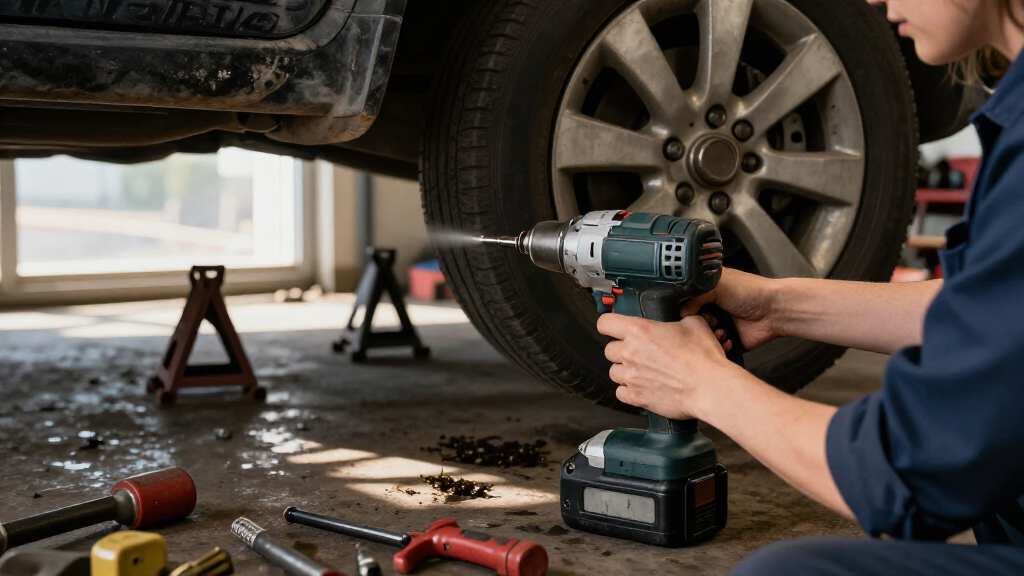
A cordless impact wrench is a tool that combines powerful rotational force with rapid hammering impacts. It’s designed to loosen or tighten large fasteners, like lug nuts or industrial bolts. Unlike a drill, it uses a square-drive anvil that accepts sockets — making quick work of stubborn nuts that refuse to budge.
Imagine changing a tire on a freezing winter night. The impact wrench’s punchy impacts and high torque make breaking loose rusted, seized fasteners possible — without the noise and hassle of an air compressor. It’s like a high-powered handshake that can loosen even the most stubborn joints.
Popular uses include wheel removal, machinery maintenance, assembly of steel structures, or farm equipment repairs. But remember — it’s not a substitute for a torque wrench when precise tightening is critical.
cordless impact wrench 1/2 inch drive
As an affiliate, we earn on qualifying purchases.
As an affiliate, we earn on qualifying purchases.
Choosing the Right Drive Size for Your Jobs
Drive size determines what kind of fasteners you can handle and how much torque you can deliver. It’s essential to choose the correct size because it impacts both your efficiency and the safety of your work. Using an undersized impact for heavy-duty tasks can result in tool strain or failure, while an oversized impact on delicate fasteners can cause damage or over-tightening.
For example, a 1/4-inch drive is lightweight and suitable for small fasteners, but it may lack the torque needed for larger jobs. Conversely, a 1/2-inch drive offers a good balance of power and versatility for most automotive and general tasks. Larger drives like 3/4-inch or 1-inch are reserved for industrial applications, where the fasteners are substantial and require significant force.
Choosing the right drive size isn’t just about matching the fastener; it’s about ensuring the tool’s torque capacity aligns with your typical workload. An adapter might let you fit larger sockets onto smaller drives, but it can introduce wobble, reduce torque transfer efficiency, and increase wear, leading to potential safety hazards. Therefore, selecting a drive size that matches your most common fasteners maximizes performance and minimizes risk.
For instance, if you frequently work on cars, a 1/2-inch impact wrench with appropriate sockets will handle most lug nuts and bolts efficiently. For heavy machinery or trucks, a larger drive like 3/4-inch may be necessary to handle the size and torque demands safely.
How Much Torque Do You Really Need?
Manufacturers often advertise impressive torque figures, but understanding what these numbers mean in real-world terms is crucial. Impact wrenches typically quote two torque ratings: the fastening torque (the maximum torque the tool can apply to tighten a fastener) and the breakaway torque (the force needed to loosen a fastener that is already tight). Recognizing the difference helps you avoid overbuying or underestimating your needs.
For example, a 1/2-inch impact wrench with a breakaway torque of 1,200 ft-lb might seem like overkill for most tasks. However, this high torque allows for rapid loosening of rusted or seized fasteners, reducing manual effort. But, in practice, the actual torque delivered depends on factors like battery charge, socket size, and fastener condition. Overestimating torque can lead to over-tightening or damaging fasteners, especially smaller ones, which might strip threads or break.
Most DIYers and mechanics find that a tool capable of delivering 700-1,000 ft-lb of breakaway torque is sufficient for typical automotive jobs, such as removing lug nuts or bolts. Larger trucks or industrial applications may require models exceeding 1,500 ft-lb, but these come with increased weight and cost, and often more complexity in handling.
It’s important to match your torque needs with your typical workload. Excessive power may seem advantageous, but it can cause damage to fasteners, studs, or surrounding components, and increase safety risks from sudden tool reactions. Conversely, a tool with insufficient torque will struggle with stubborn fasteners, leading to frustration and inefficiency. Finding the right balance ensures you have enough power to do the job without risking damage or injury.
Compact, Mid-Torque, or High-Torque — Which One Fits You?
Impact wrenches come in various sizes and power levels, each suited to different kinds of tasks. Recognizing the tradeoffs helps you choose a tool that fits your work environment and physical capacity. Compact models are lightweight and easy to maneuver, making them ideal for confined spaces like engine bays or intricate assembly tasks. Their lower weight reduces fatigue during prolonged use, though they may have limited torque output.
Mid-torque tools strike a balance—they are powerful enough for most automotive repairs and general maintenance, yet manageable in weight and size. They excel at tasks like wheel removal, suspension work, and assembly where moderate torque is needed without sacrificing handling.
High-torque wrenches are designed for the most demanding jobs—rusted fasteners, heavy industrial bolts, or large machinery. They provide maximum power but tend to be heavier and more cumbersome, which can lead to fatigue and potential over-tightening if not carefully controlled. Using a high-torque impact for delicate or routine tasks can cause damage or injury, so selecting the right level is crucial.
Imagine trying to loosen a stubborn bolt on a farm tractor. A high-torque impact makes quick work of the task, saving time and effort. But if you’re changing a car tire, a compact or mid-torque model is more appropriate, offering enough power while maintaining control and ease of use.
The key is to match your typical workload and physical comfort with the impact wrench’s power class. Overestimating power needs can lead to unnecessary weight and fatigue, while underestimating can cause frustration and prolong job times. Balance is essential for safety, efficiency, and comfort.
Battery Platform: Why Compatibility Matters More Than You Think
The battery platform is a critical factor in your overall experience with cordless impact wrenches. A compatible battery system not only affects runtime but also influences the tool’s power delivery, weight, and ease of use. Using batteries from different brands or incompatible voltage systems can lead to poor performance or even damage to the tool. Choosing a system that integrates seamlessly with your existing tools can save money and streamline your workflow.
Most brands utilize 18V or 20V lithium-ion batteries, which are generally interchangeable within the same brand. However, capacity ratings, such as 2 Ah versus 5 Ah, directly impact runtime and power consistency. Higher capacity batteries provide longer working periods and better performance under load, but they also tend to be heavier, which can affect handling and fatigue.
Understanding your typical work demands is crucial. If you often perform extended tasks, investing in higher-capacity batteries makes sense, despite the added weight. For quick, occasional jobs, smaller batteries may suffice. Also, consider the overall system’s compatibility with other tools you own or plan to buy, as this can lead to cost savings and convenience in the long run.
In summary, choosing the right battery platform involves balancing capacity, weight, and compatibility. A larger battery isn’t always better if it hampers maneuverability, but insufficient power can limit your work. Think about your typical workload, storage space, and future tool plans to make an informed decision that enhances your productivity and safety.
Controlling Speed and Power: Features That Save Time and Damage
Impact wrenches equipped with variable speed triggers and multiple modes give users precise control over power delivery. This flexibility is essential because it allows you to adapt to different fasteners and applications, reducing the risk of overtightening or damaging delicate components. For example, a low-speed or soft-start mode can help you position fasteners accurately before applying full torque, preventing cross-threading or stripping.
Features like automatic shutoff during tightening prevent over-torqueing, which can damage fasteners or cause injury. Reverse shutoff functions make it easier to remove fasteners without excessive reaction forces. LED work lights improve visibility in dark or tight spaces, reducing errors and increasing safety.
Having these controls means you can work faster and more accurately, especially in confined or complex environments. For instance, a mechanic working in a cramped engine bay benefits from a tool that can switch to low speed for delicate adjustments, then ramp up for high-impact fastening. Similarly, construction workers can speed up assembly tasks by using high-torque modes when appropriate, saving time and effort.
However, while electronic controls enhance safety and efficiency, they do not replace the need for a calibrated torque wrench when precise torque specifications are critical. Proper understanding and use of these features can prevent damage, prolong tool life, and improve overall job quality.
Socket Retention Styles — Which One Is Best for You?
Socket retention mechanisms are crucial for safe and efficient operation, especially in fast-paced environments. The main styles include friction ring (hog ring), detent pin, and pin-and-o-ring systems, each with distinct advantages and tradeoffs. Understanding these helps you choose the best for your specific needs and ensures safety during operation.
- Friction ring (hog ring): Offers quick socket changes, making it ideal for tasks like tire changes where speed is essential. These systems rely on a spring-loaded ring that securely holds the socket, allowing rapid swaps with minimal effort. However, they may be less secure under heavy load or when working overhead, so regular inspection is recommended.
- Detent pin: Provides a more secure connection, suitable for heavy-duty or precision work. The socket is held in place by a spring-loaded ball that engages with a notch or hole in the socket. While slightly slower to change, this style reduces the risk of accidental disconnection during demanding tasks.
- Pin-and-o-ring: Used mainly in industrial-grade tools, combining the security of pin systems with additional retention via rubber O-rings. This ensures maximum socket retention in tough environments, but may add complexity to socket changes.
Choosing the right retention style depends on your workflow speed, safety requirements, and the environment. Quick-change systems improve productivity but may sacrifice some security, while more secure options might slow down your workflow but reduce the risk of accidents. Regularly inspecting retention mechanisms for wear or damage is vital to prevent socket slippage, which can lead to injury or damage to components.
Ultimately, selecting and maintaining the appropriate socket retention system ensures smoother operation, safety, and longevity of your tools and accessories.
Size, Weight, and Ergonomics Matter More Than You Think
An impact wrench’s size, weight, and ergonomic design significantly influence user fatigue, safety, and precision. Lightweight, well-balanced tools reduce arm and hand fatigue during prolonged use, allowing for better control and reducing the risk of slips or accidents. The overall weight, especially with the battery attached, can make a difference in how easily and safely you can handle the tool over extended periods.
Grip comfort, trigger placement, and vibration control are also crucial. An uncomfortable grip or poorly placed trigger can cause hand fatigue or accidental activation, increasing fatigue and potential injury. Vibration dampening features help reduce the risk of repetitive strain injuries and improve handling accuracy.
Imagine working on a truck wheel for an hour. A heavy, poorly balanced impact wrench can tire your arm quickly, decreasing control and increasing safety hazards. Conversely, a lightweight, ergonomic tool maintains your strength and precision, leading to better work quality and less fatigue.
Prioritizing ergonomics and weight doesn’t mean sacrificing power—modern designs incorporate both, making powerful yet comfortable tools accessible. When trying out a new impact wrench, consider how it feels in your hand, how natural the grip is, and whether the controls are intuitively placed. These factors contribute to safer, more efficient work, especially during long sessions or repetitive tasks.
Latest Innovations in Cordless Impact Wrenches
Manufacturers are continuously pushing the boundaries of impact wrench technology to deliver more power, longer runtimes, and enhanced usability. Recent innovations include the adoption of advanced brushless motors, which provide higher efficiency and durability, translating into more torque and longer tool life. High-capacity batteries—some exceeding 4 Ah—offer extended runtime, making cordless tools more suitable for demanding professional applications.
Design trends now favor more compact, lightweight models that don’t compromise on power, allowing users to work in tight spaces without fatigue. Electronic features like smart controls enable customization of impact intensity, and integrated heat management systems help extend battery life and prevent overheating during prolonged use.
Connected tools are emerging, allowing users to track usage, customize settings, and receive maintenance alerts via apps. Specialized models—such as stubby, right-angle, mid-torque, or industrial-grade impact wrenches—are becoming more accessible, providing tailored solutions for specific tasks and environments. This evolution means users can select tools that precisely match their needs, enhancing productivity, safety, and ease of use.
Overall, these innovations deliver more power in smaller packages, smarter controls to optimize performance, and longer-lasting batteries—making cordless impact wrenches more versatile and reliable than ever before.
Cordless vs. Pneumatic Impact Wrenches: Which Is Better?
Cordless impact wrenches excel in portability, quick setup, and consistent performance across various locations. They are ideal for roadside repairs, remote job sites, or situations where mobility and ease of use are priorities. No need for compressors or air hoses, which simplifies logistics and reduces setup time. Advances in battery technology mean they can deliver high torque comparable to pneumatic tools, making them suitable for many demanding tasks.
Pneumatic tools, however, remain favored in professional shops due to their lightweight feel, simplicity, and high continuous power output. They can operate for hours with minimal maintenance, provided a reliable compressor and proper lubrication are available. Pneumatics often offer higher durability and are well-suited for high-volume industrial environments where constant use is required.
The choice depends on your work environment and needs. If you prioritize mobility, quick turnaround, and less infrastructure, cordless is advantageous. For high-volume, continuous tasks in a controlled setting, pneumatic tools may be more efficient and cost-effective. Consider factors like job site conditions, available power sources, and maintenance capacity when making your decision.
Both types have their place, and many professionals even use a combination of both depending on the task. The key is to match the tool’s strengths to your specific work conditions, safety considerations, and long-term operational costs.
Impact Wrench vs. Impact Driver — Know the Difference
Impact wrenches and impact drivers are often confused, but they serve distinctly different purposes. An impact wrench uses a square-drive and delivers high torque for large fasteners like lug nuts and industrial bolts. It’s designed for heavy-duty fastening and removal tasks. An impact driver, with a hex chuck, is primarily intended for screws and light fasteners, offering rotational impact but generally less torque. They are not interchangeable because each is optimized for specific applications.
For example, trying to tighten lug nuts with an impact driver is like using a screwdriver to drive nails—it’s not designed for that level of force or size. Conversely, an impact wrench can’t handle small screws or bits efficiently, nor does it offer the finesse needed for delicate fastening tasks. Using the wrong tool can lead to damage, stripped fasteners, or safety hazards.
While adapters exist to connect impact drivers to sockets, they often reduce efficiency and may introduce wobble or slippage, especially under high torque loads. This can compromise safety and damage fasteners or tools. Therefore, understanding these differences ensures you select the right tool for each task, optimizing performance and safety while prolonging your tools’ lifespan.
Using Impact-Ready Sockets and Accessories Safely
Impact-rated sockets and accessories are specially engineered to withstand the repeated shocks and high torque of impact wrenches. They are made from tougher, more ductile materials with thicker walls compared to standard chrome sockets, which prevents shattering or deformation during use. Using non-impact-rated sockets on impact wrenches can lead to catastrophic failure, risking injury and damaging the fastener or tool.
Regular inspection of sockets, extensions, and adapters is vital. Look for cracks, chips, or signs of wear—damage can compromise their integrity under impact. Replacing damaged accessories maintains safety and ensures consistent performance. Properly securing sockets and accessories before use prevents slippage or accidental drops, especially during overhead or critical work.
In heavy-duty applications, impact-rated accessories are not just recommended—they are essential for safety. They help prevent accidents caused by shattered tools or flying debris, and they protect your investment by extending the lifespan of your accessories. Always follow manufacturer guidelines for compatibility and maintenance to keep your setup safe and reliable.
Best Practices for Tightening and Loosening Lug Nuts
Proper procedures during wheel installation and removal are critical to ensure safety, prevent damage, and prolong the lifespan of fasteners. The process involves a sequence of steps designed to avoid uneven stress, cross-threading, or over-tightening, which can lead to costly repairs or safety hazards.
- Begin by hand-threading lug nuts to avoid cross-threading, ensuring they are properly aligned.
- Use the impact wrench to snug the nuts, but do not fully tighten—this prevents overtightening and helps maintain even torque distribution.
- Follow the manufacturer’s specified tightening sequence, typically criss-cross, to evenly distribute load across the wheel hub and prevent warping or misalignment.
- Use a calibrated torque wrench to tighten each lug nut to the manufacturer’s recommended torque setting, ensuring proper clamping force without risking damage.
- After driving the vehicle for a short distance, recheck the torque to confirm all lug nuts remain at the correct specification, accounting for settling or uneven tightening.
Skipping steps or relying solely on impact wrenches without torque calibration can lead to uneven loading, cracked studs, or compromised safety. Following these best practices ensures secure wheel attachment, minimizes repair costs, and enhances safety during vehicle operation.
Safety First: Protect Yourself and Your Tool
Impact wrenches are powerful tools that demand respect and proper safety precautions. Always wear appropriate eye protection to guard against flying debris, socket shrapnel, or broken parts. Hearing protection is also recommended during extended use, as impacts and noise levels can cause hearing damage over time.
Ensure loose clothing, jewelry, or long hair are secured to prevent entanglement. Keep your hands and body clear of rotating parts, and brace yourself against reaction forces—impact wrenches can unexpectedly twist or jump, especially if a fastener suddenly releases or slips.
Regularly inspect batteries for swelling, corrosion, or damage. Do not use compromised batteries, as they pose safety risks and can damage the tool. Store batteries in a cool, dry place and follow manufacturer instructions for charging and storage to maximize lifespan and safety.
Remember, impact tools generate noise, vibration, and sudden movements. Respect these hazards by using personal protective equipment and working in a safe environment. Proper handling and safety awareness extend the lifespan of your tools and protect you from injury.
Common Myths About Cordless Impact Wrenches — Busted!
There are many misconceptions about impact wrenches that can lead to poor purchasing decisions or unsafe use. One common myth is that the highest torque rating always equals the best tool. In reality, high torque might be overkill for some tasks and can cause damage if used improperly. Smaller, lighter impact wrenches with controlled torque are often more suitable for delicate or frequent work, offering better control and safety.
Another misconception is that “more impacts per minute” automatically translate to more power. While a higher impact rate can increase the tool’s aggressiveness, it doesn’t necessarily mean better performance or safety. Excess impacts can lead to faster wear, increased noise, and potential damage to fasteners or components. It’s about the quality and control of impacts, not just quantity.
Many users assume that larger batteries provide more torque. However, performance depends heavily on motor design, electronics, and how well the battery can supply current under load. A smaller, well-designed battery with a high-quality motor can outperform larger, cheaper batteries in real-world applications.
Understanding these myths helps you choose the right tool, avoid overpaying for unnecessary features, and use your impact wrench safely and effectively. Don’t be deceived by hype—select tools based on actual needs, performance, and safety considerations.
Frequently Asked Questions
How much torque do I need for typical automotive work?
For most car repairs, a mid-torque 1/2-inch impact wrench with around 700-1,000 ft-lb of breakaway torque will handle lug nuts and bolts comfortably. Larger trucks or stubborn fasteners may require more.Can I loosen rusted, seized nuts with a cordless impact wrench?
Yes, provided the tool has sufficient real-world torque and the battery is charged. Factors like corrosion or thread-locking compounds can still make removal challenging.Should I tighten lug nuts with an impact wrench?
Use the impact wrench for initial seating, then finish with a calibrated torque wrench to ensure proper tightness, preventing damage or safety issues.Is a 3/8-inch or 1/2-inch impact wrench better?
For general automotive work, a 1/2-inch is more versatile. A 3/8-inch is more compact and better suited for confined spaces.How do I know if my impact socket is impact-rated?
Impact-rated sockets are made from tougher, more ductile materials, with thicker walls designed to withstand repeated impacts. Always inspect your sockets regularly for cracks or deformation, and replace damaged ones to maintain safety and performance.Conclusion
A cordless impact wrench is a powerful ally in your toolkit, but only if you pick the right model and respect its limits. Focus on matching size, torque, and battery to your specific needs — and always prioritize safety. With the right care, this tool can make tough jobs easier and faster, turning what once took hours into a quick, satisfying turn.
So, next time you face a stubborn bolt or rusted nut, ask yourself: do I have the right impact wrench for the job? If not, it’s worth investing in one that combines power, control, and safety — your hands and your projects will thank you.
Fall Picks
fall essentials
As an affiliate, we earn on qualifying purchases.