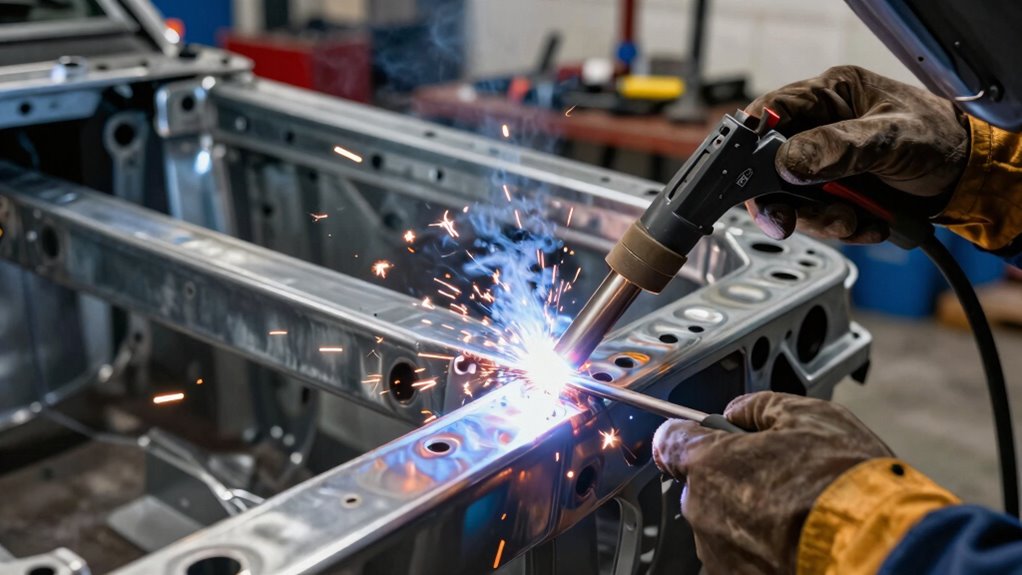

MIG welding offers you fast, efficient automotive repairs thanks to its easy operation and continuous wire feed, which speeds up your workflow. It’s versatile enough to handle thin sheets or thick parts, making it ideal for various projects. Regular maintenance keeps your welder performing at its best, ensuring clean, high-quality welds. Plus, safety precautions protect you from fumes and sparks. Keep going to discover how mastering these tips can boost your welding results even more.

Get business pricing on garage and car supplies
- Business-only prices and quantity discounts
- Tax-exempt purchasing
- Multiple users, one account, clear invoices
Key Takeaways
- MIG welding offers high speed and efficiency, enabling quick completion of automotive repairs and customizations.
- Its ease of use reduces the learning curve, allowing faster skill development for automotive applications.
- Continuous wire feed and adjustable settings facilitate seamless transitions between different automotive projects.
- Routine maintenance ensures consistent performance, minimizing delays during automotive repair tasks.
- Proper safety practices and equipment maintenance prevent downtime caused by malfunctions or safety issues.
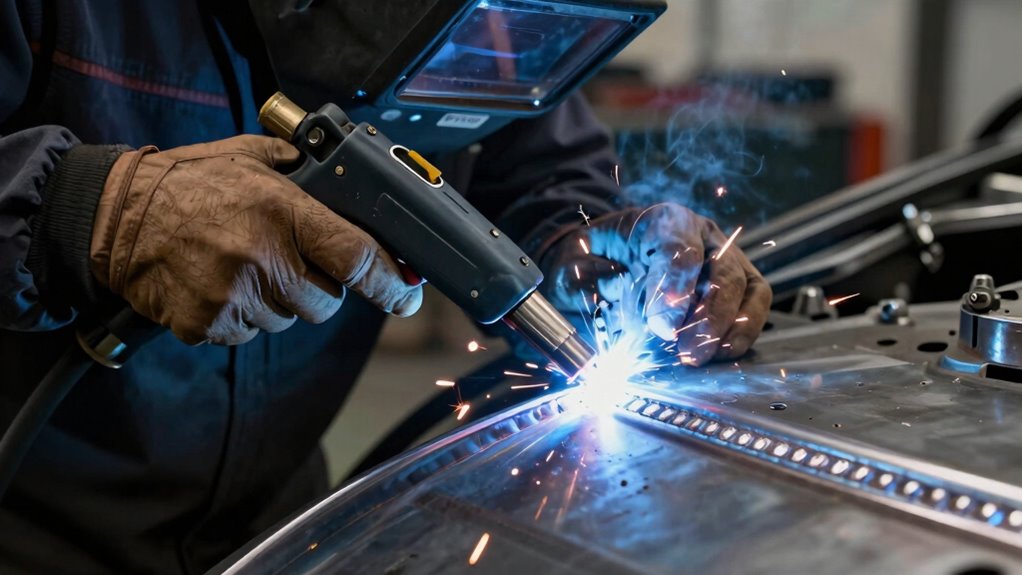
MIG welding offers several advantages that make it a popular choice for both beginners and experienced welders. When you’re working on automotive projects, speed and efficiency are essential, and MIG welding delivers on both fronts. Its ease of use allows you to quickly get started, minimizing the learning curve. The process involves feeding a continuous wire electrode through a welding gun, which simplifies the procedure and helps you complete tasks faster. This means you spend less time setting up and more time focusing on the actual work, making it ideal for fast automotive repairs and customizations.
One of the key benefits of MIG welding for automotive applications is its versatility. Whether you’re working on thin sheet metal or thicker components, you can easily adjust the settings to suit different materials. This flexibility allows you to switch between projects without hassle, keeping your workflow smooth. Plus, the clean welds produced by MIG welding reduce the need for extensive post-weld cleanup, saving you even more time. As you work, keeping your equipment well-maintained becomes *essential*, not just for safety but also for consistent results. Regularly inspecting and cleaning your welding gun, ensuring proper wire feed, and checking shielding gas levels help prevent common issues like poor weld quality or equipment failure. Incorporating proper maintenance practices can extend the lifespan of your tools and ensure optimal performance.
Welding safety should always be a top priority, especially when you’re working on automotive projects where the environment can be cluttered or poorly ventilated. Proper safety gear—such as gloves, a welding helmet, and protective clothing—guards you against sparks, UV radiation, and hot metal. Additionally, maintaining your equipment reduces the risk of malfunctions that could compromise safety. For example, a well-maintained power source and clean torch components help prevent electrical faults and overheating. Staying attentive to equipment maintenance not only keeps your welds consistent but also prolongs the lifespan of your tools. Incorporating proper ventilation is also crucial to protect yourself from fumes and airborne particles generated during welding.
Understanding welding techniques and how they impact your results can elevate your craftsmanship and improve efficiency. In the fast-paced world of automotive repair, the combination of ease of use, efficiency, and safety makes MIG welding a clear advantage. Its straightforward operation allows you to tackle projects swiftly without sacrificing quality. Additionally, exploring advanced welding methods can help experienced welders refine their skills and adapt to more complex tasks. Proper equipment maintenance also plays a vital role in ensuring your welding process remains reliable and safe over time. By prioritizing welding safety and routine equipment maintenance, you can work confidently, knowing that your welds are strong and your workspace remains safe. Whether you’re fixing a fender or fabricating a custom part, MIG welding helps you get the job done quickly and reliably, making it a smart choice for automotive work where time is always of the essence.
MIG welding machine for automotive repair
As an affiliate, we earn on qualifying purchases.
As an affiliate, we earn on qualifying purchases.
Frequently Asked Questions
What Are the Safety Precautions When Using a MIG Welder?
When using a MIG welder, you should wear protective gear like gloves, a welding helmet, and long sleeves to shield your skin from sparks and UV rays. Always keep fire hazards in mind by clearing the area of flammable materials and having a fire extinguisher nearby. Make sure your workspace is well-ventilated to prevent inhaling harmful fumes. Following these safety precautions helps prevent accidents and injuries during welding.
How Does Wire Gauge Affect Welding Quality?
Wire gauge greatly influences welding quality by affecting wire feed consistency and electrode compatibility. Thinner wire (higher gauge) provides smoother feed and better control, ideal for detailed work, while thicker wire (lower gauge) supplies more deposited metal for heavy-duty tasks. Selecting the appropriate wire gauge guarantees stable feeding, reduces defects, and enhances weld strength. Always match wire gauge with your welder’s specifications to attain the best results and maintain electrode compatibility.
Can MIG Welders Be Used for Aluminum?
Absolutely, MIG welders can be used for aluminum, but you need the right setup. Think of it as your Swiss Army knife—versatile and adaptable. Aluminum compatibility requires a spool gun or a dedicated aluminum wire feed, along with a shielding gas like pure argon. This setup boosts your welding versatility, ensuring clean, strong welds on aluminum sheets. Just remember, using the proper equipment makes all the difference.
What Maintenance Is Required for MIG Welding Equipment?
You need to regularly clean your MIG welding equipment, checking for dirt or debris that can affect performance. Keep the welding techniques sharp by inspecting the wire feed and guaranteeing proper gas flow. Additionally, calibrate your equipment periodically to maintain ideal settings. Proper maintenance extends your welder’s life, improves weld quality, and ensures consistent results, especially when handling fast automotive projects.
Are There Portability Options for MIG Welders?
You bet, there are portability options for MIG welders. With a portable design and mobility features like wheels and compact size, you can take your welder almost anywhere. These features make your work easier, especially when moving around a busy shop or working on-site. It’s like having your cake and eating it too—getting power and convenience in one package. This way, you’re always ready to tackle projects on the go.
Conclusion
So, as you’ve seen, choosing a MIG welder for automotive work isn’t just about speed—it’s about precision and reliability, echoing the very essence of the craft. Coincidentally, many seasoned mechanics find that the ease of use and versatility of MIG welders often align perfectly with their needs, almost as if it was meant to be. In the end, embracing this tool can transform your workflow, making every job feel a little more effortless and a lot more satisfying.
Fall Picks
fall essentials
As an affiliate, we earn on qualifying purchases.