
To choose spring rates and damping for heavy EVs, you need to take into account the weight distribution and battery placement, which influence how much support and control your suspension requires. Heavier vehicles demand higher spring rates to prevent excessive body roll and sag, while damping adjustments help control the vehicle’s response and comfort. Keep in mind that a stiffer chassis may require softer suspension tuning. Continue exploring to understand how to optimize these settings for safe and stable handling.
Key Takeaways
- Increase spring rates proportionally to the added weight from larger batteries to maintain ride stability.
- Adjust damping settings to control body motion and ensure comfort under higher load conditions.
- Consider chassis stiffness; stiffer chassis allows for softer suspension settings, improving ride quality.
- Prioritize proper weight distribution, especially with high or rearward battery placement, to optimize handling.
- Use suspension components rated for increased load capacities to ensure safety and durability.
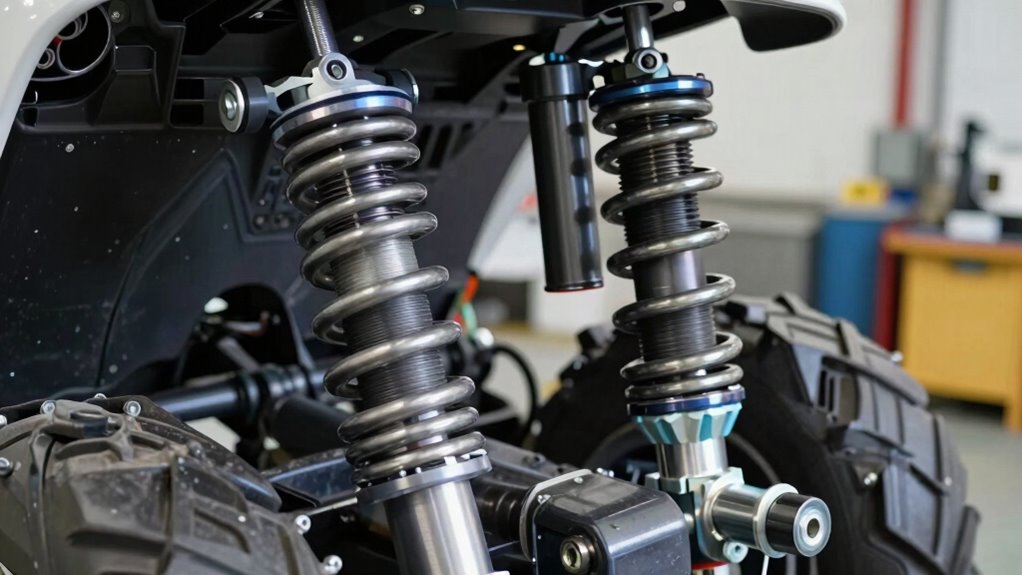
As electric vehicles (EVs) become heavier due to larger batteries and advanced technology, their suspension systems must adapt to handle the increased load. The placement of the battery considerably influences how you should approach suspension tuning. If the battery is mounted low and centrally within the chassis, it lowers the vehicle’s center of gravity, reducing body roll and improving stability. Conversely, a higher or more rearward placement can shift weight distribution, necessitating adjustments in spring rates and damping to maintain ride comfort and handling. Understanding this placement helps you select suspension components that can support the additional weight without compromising performance. Proper weight distribution is crucial for optimizing handling and safety in heavy EVs.
Battery placement affects suspension tuning, influencing stability and handling in heavier EVs.
Chassis stiffness plays a vital role in how well your suspension manages the added mass of a heavy EV. A stiffer chassis provides a more solid platform, minimizing flex and ensuring that suspension movements translate directly into predictable handling. If your chassis is relatively flexible, you’ll need to compensate by choosing higher spring rates and damping settings to prevent excessive body movement and maintain control. Conversely, a rigid chassis allows for softer suspension tuning, which can enhance ride comfort without sacrificing stability. When customizing suspension for a heavy EV, you must consider the chassis’s stiffness to find the best balance between ride quality and road handling.
Frequently Asked Questions
Can Aftermarket Suspension Parts Improve Heavy EV Ride Comfort?
Yes, aftermarket suspension parts can improve your heavy EV’s ride comfort. By upgrading suspension components, you can better manage the electric vehicle weight, reducing harshness and improving handling. Suspension upgrades allow you to select spring rates and damping that suit the added weight, resulting in a smoother, more controlled ride. Customizing your suspension helps you enjoy a comfortable drive while maintaining stability and safety.
How Does Axle Weight Distribution Affect Suspension Choices?
Did you know that improper axle load distribution can reduce suspension lifespan by up to 30%? When selecting suspension, consider how axle weight impacts your vehicle’s weight balance. Heavier loads on one axle demand stiffer spring rates and damping to prevent sagging or uneven handling. You should match your suspension to your axle load, ensuring peak performance and safety, especially for heavy EVs where weight distribution can markedly influence ride quality.
Are Adaptive Damping Systems Suitable for Heavy EVS?
Adaptive damping systems are suitable for heavy EVs because they automatically adjust to changing road conditions, providing a smoother ride and improved stability. As a heavy vehicle, your EV benefits from these systems by optimizing comfort and handling, especially during acceleration, braking, or uneven terrain. You’ll find adaptive damping enhances ride quality, reduces wear on suspension components, and helps maintain control, making it a smart choice for managing the weight and dynamic demands of heavy EVs.
What Maintenance Is Required for Heavy EV Suspension Systems?
You should regularly inspect your heavy EV’s suspension system, focusing on shock absorbers and load capacity. Keep an eye out for leaks, wear, or damage to shock absorbers, and verify the springs are intact and not sagging. Routine maintenance includes checking for corrosion, tightening bolts, and replacing worn components. Proper care prolongs suspension life, maintains ride quality, and ensures your vehicle handles heavy loads safely.
How Does Terrain Influence Spring Rate Selection for EV Suspensions?
Think of terrain as the heartbeat of your adventure, shaping your suspension needs. When facing terrain variability, you should select spring rates that absorb shocks and maintain stability. For off-road durability, opt for firmer springs that handle bumps and uneven surfaces. This guarantees your EV’s suspension adapts seamlessly, providing comfort and control. By understanding terrain influences, you enhance your vehicle’s resilience and ride quality in any environment.
Conclusion
When selecting spring rates and damping for your heavy EV, think of crafting a smooth, balanced dance. Imagine your suspension as a gentle cradle, softly cradling the vehicle’s weight while maintaining lively responsiveness. By fine-tuning these settings, you create a harmonious ride that absorbs life’s bumps gracefully, guiding you effortlessly over every road. Ultimately, it’s about shaping a ride that feels as natural as a flowing river—quiet, steady, and perfectly in tune.