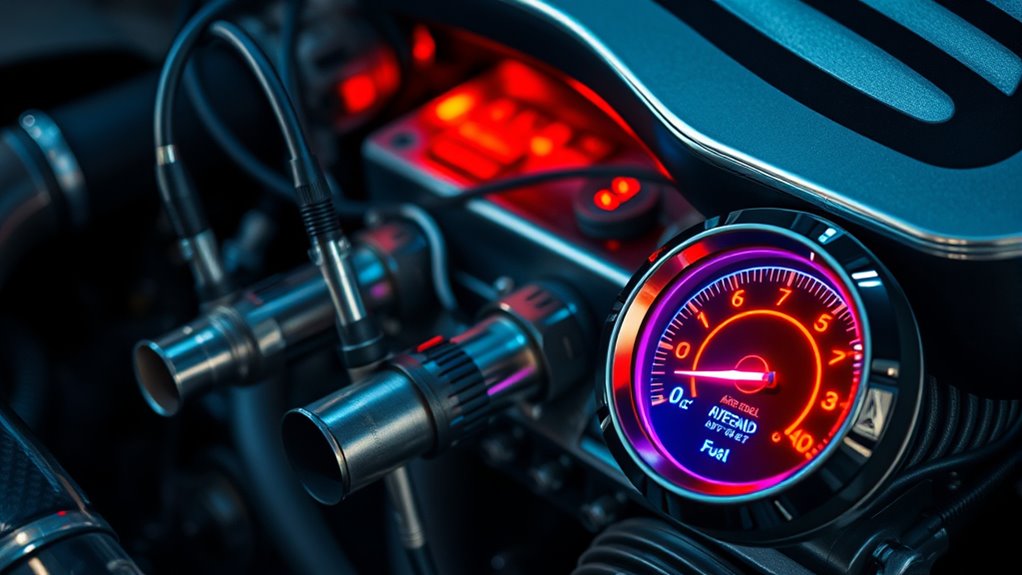

O₂ sensors and wideband gauges help you monitor your engine’s fuel mixture in real-time, ensuring ideal performance and emissions. They gather precise data on the air-fuel ratio, allowing your engine control unit to adjust fuel delivery for efficiency and power. Proper calibration and maintenance keep these sensors accurate and reliable, preventing issues and extending their lifespan. Keep exploring to discover how these tools can maximize your vehicle’s tuning and engine health.
Key Takeaways
- O₂ sensors and wideband gauges monitor exhaust gases in real-time to ensure optimal air-fuel mixture.
- Wideband gauges provide precise, broad-range air-fuel ratio readings for accurate mixture assessment.
- Proper calibration of sensors maintains measurement accuracy, preventing drift and ensuring reliable data.
- Accurate mixture monitoring helps optimize engine performance, reduce emissions, and prevent damage from improper fueling.
- Regular sensor maintenance and calibration are essential for consistent readings and effective mixture control.
Have you ever wondered how your vehicle’s engine manages to run efficiently while keeping emissions in check? The secret lies in maintaining the perfect air-fuel ratio, a delicate balance that guarantees exceptional performance and minimal pollution. This is where O₂ sensors and wideband gauges come into play. These devices constantly monitor the exhaust gases, providing real-time data that helps your engine control unit (ECU) adjust fuel delivery for maximum efficiency. Understanding how they work gives you insight into the importance of sensor calibration and precise mixture control.
Maintaining optimal air-fuel ratios with calibrated sensors ensures peak engine performance and lower emissions.
The air-fuel ratio is essential because it determines how completely your engine burns fuel. A mixture that’s too rich (more fuel than air) can cause increased emissions, lower fuel economy, and potential engine damage. Conversely, a lean mixture (more air than fuel) might improve efficiency but can lead to misfires or damage if too extreme. O₂ sensors measure the oxygen content in the exhaust gases, giving the ECU feedback on whether the mixture is rich or lean. This feedback loop allows the vehicle to adjust fuel injectors dynamically, maintaining an ideal balance.
Sensor calibration plays a critical role in guaranteeing these sensors provide accurate readings. Over time, O₂ sensors can drift from their original calibration due to contamination or aging. If they aren’t properly calibrated, the data they send becomes unreliable, leading to poor fuel mixture adjustments. That’s why regular calibration or replacement of sensors is necessary for keeping your engine running smoothly and efficiently. Wideband gauges, in particular, excel at providing a precise reading of the air-fuel ratio across a broader range of conditions compared to narrowband sensors. They give you a more detailed view of the mixture, especially during tuning or high-performance driving.
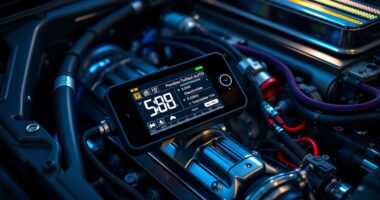
With a dependable wideband gauge, you can see exactly how your engine is performing and make adjustments if needed. This is especially useful if you’ve modified your vehicle or want to maximize fuel economy or power. Proper sensor calibration ensures that the gauge reflects the true mixture, preventing misinterpretations that could lead to improper tuning. When the sensors are correctly calibrated and functioning well, your engine can consistently deliver the best possible balance—maximizing fuel efficiency while reducing harmful emissions. Regularly checking and maintaining sensor calibration can also extend the lifespan of your sensors and improve overall engine performance.
Frequently Asked Questions
How Often Should O₂ Sensors Be Replaced?
You should replace your O₂ sensors every 60,000 to 100,000 miles, depending on your vehicle’s sensor lifespan and suggested replacement intervals. Over time, sensors can become less accurate, affecting fuel efficiency and emissions. Regularly check for warning lights or poor engine performance, and follow your vehicle manufacturer’s recommendations. Replacing sensors at appropriate intervals guarantees peak performance and helps maintain your vehicle’s emissions compliance.
Can Wideband Gauges Improve Fuel Economy?
Imagine your engine running smoothly, like a well-tuned orchestra. Wideband gauges can definitely improve your fuel efficiency by providing precise air-fuel ratio readings, helping you optimize performance. Regular sensor calibration guarantees accuracy, so you get reliable data. With better insights, you can adjust your driving or tuning habits, saving fuel and reducing emissions. In short, these gauges keep your engine’s harmony intact, boosting efficiency and saving you money.
Are O₂ Sensors Compatible With All Engine Types?
O₂ sensors aren’t compatible with all engine types. You’ll need to check sensor calibration and engine compatibility before installation. Some engines, especially older or specialized models, may require specific sensor types or additional modifications. Always verify that the sensor matches your engine’s specifications to guarantee accurate readings and peak performance. Proper compatibility and calibration are vital for your sensor to function correctly and improve your vehicle’s efficiency.
What Are Common Signs of Sensor Failure?
You’ll notice sensor failure through diagnostic indicators like check engine lights, rough idling, or poor fuel economy. Signs of sensor deterioration include increased emissions, sluggish acceleration, or engine stalling. Sometimes, you might see inconsistent readings on your gauge. If these symptoms appear, it’s a good idea to have your sensor checked promptly, as failing sensors can cause poor engine performance and increase emissions, affecting your vehicle’s efficiency and compliance.
How Do Environmental Conditions Affect Sensor Accuracy?
Environmental conditions profoundly impact sensor accuracy. Temperature effects can cause sensors to drift or give false readings if they aren’t properly calibrated for specific conditions. Extreme heat or cold may affect sensor response times and calibration stability, leading to inaccurate mixture readings. To maintain accuracy, you should regularly check sensor calibration and consider environmental factors, ensuring your sensor operates within its ideal temperature range for precise monitoring.
Conclusion
Now, imagine your engine breathing easy, its mix perfectly balanced like a clear sky after a storm. O₂ sensors and wideband gauges act as your vigilant guides, constantly monitoring and fine-tuning your fuel mixture. With these tools, you stay in control, ensuring smooth runs and peak performance. Keep your engine’s lungs healthy, and it will reward you with power and efficiency, turning every drive into a seamless, exhilarating journey.