The best automotive shop air compressors balance usable airflow, electrical demands, noise, and space—not just tank size. My best overall pick is the Ingersoll Rand 2340L5-V, a 5 HP two-stage model suited to demanding shop work; the Ingersoll Rand SS3L3 is a strong 60-gallon choice, while the 13.2-gallon ultra-quiet model favors noise-sensitive garages. The main tradeoff is between compact, often oil-free units for lighter tasks and larger compressors built to support sustained tool use. Power supply, duty cycle, and maintenance needs can matter as much as the advertised capacity. Read on for the full breakdown and guidance on matching a compressor to your tools and workspace.

Get business pricing on garage and car supplies
- Business-only prices and quantity discounts
- Tax-exempt purchasing
- Multiple users, one account, clear invoices
Complete the kit


Key Takeaways
- The Ingersoll Rand 2340L5-V leads for demanding shop use because its 5 HP, two-stage design is aimed at sustained work; buyers must account for its larger installation and power requirements.
- The 60- and 80-gallon models favor fixed shop setups, but tank size alone does not prove that a compressor can keep up with a tool; compare delivered airflow at the tool’s operating pressure.
- Small portable units solve different problems from stationary machines. The VEVOR 2.1-gallon model suits limited, intermittent tasks, not long sessions with air-hungry tools.
- Quiet and oil-free designs prioritize convenience, but those features do not automatically mean higher airflow or better fit for every automotive tool.
- Electrical compatibility is a major dividing line. The listed 120V options may suit some home garages, while the 220V VEVOR 80-gallon model calls for a compatible circuit and planned installation.


| automotive shop air compressor | Tank capacity | Maximum pressure | Noise level | Weight |
|---|---|---|---|---|
| ECOMAX 6-Gallon 150 PSI Oil-Fr | 6 gallons | 150 PSI | 75 dB | 34.17 lb |
| Ingersoll Rand 2340L5-V 5 HP T | 60 gallons | 175 PSI | 85 dB | 430 lb |
| VEVOR 13-Gallon Oil-Free Air C | 13 gallons | 125 PSI | 66 dB | 71 lb |
| 13.2-Gallon Ultra-Quiet Oil-Fr | 13.21 gallons | — | 70 dB | 72 lb |
| VEVOR 2.1 Gallon Oil-Free Air | 2.1 gallons (8 liters) | 116 PSI | 70 dB | 27 lb |
| Klutch 20-Gallon Portable Air | 20 gallons | 175 PSI | 80 dB | 90 pounds |
| Air Compressor 3 HP 110 Volt S | 60 gallons | 115 PSI | — | 200 pounds |
| VELPAX 2HP Oil-Free Quiet Air | — | 115 PSI | — | — |
| VEVOR 80-Gallon Oil-Free Stati | 80 gallons | 145 PSI | 86 dB | 264.6 pounds |
| HoldwellS Oil-Free Air Compres | 19.8 gallons | 115 PSI in title and description; 125 PSI elsewhere in listing | 78 dB | — |
| RyanTek 15-Gallon Oil-Free Air | 15 gallons | 125 PSI | 66 dB at 4 m | 68.3 pounds |
| Ingersoll Rand SS3L3 Single-St | 60 gallons | 135 PSI | 78 dB | — |
More Details on Our Top Picks
ECOMAX 6-Gallon 150 PSI Oil-Free Pancake Air Compressor with 10-Piece Accessory Kit
The ECOMAX 6-gallon pancake compressor is the most grab-and-go choice in this group, with a flip-up handle, a 34-pound body, and a 25-foot hose and accessory kit ready for tire inflation and blow cleaning. Its 150 PSI maximum exceeds the VEVOR 13-Gallon’s 125 PSI, but that figure alone does not make it a better match for air-hungry shop tools. The listed airflow is only 3 cubic inches per minute, so I would treat it as a light-duty option and verify tool requirements before buying. The oil-free pump keeps routine maintenance simple, while the 75 dB operating level is less suited to noise-sensitive indoor work than the VEVOR 13-Gallon’s stated 66 dB. It trades sustained output for compact storage and included accessories.
Pros:- Flip-up handle and 34.17-pound weight make it easier to carry and store than larger tank models.
- Oil-free pump avoids routine oil changes.
- Includes a 25-foot hose and accessories for inflation and blow cleaning.
- 150 PSI maximum pressure provides headroom for suitable intermittent tasks.
Cons:- Listed airflow of 3 cubic inches per minute is a major limitation for sustained automotive tool use.
- 75 dB noise level may be intrusive in an enclosed home garage.
- Six-gallon tank offers less reserve than the VEVOR 13-Gallon for repeated tasks.
Best for: Home mechanics who mainly inflate tires, clean parts with a blow gun, and want a compact compressor with common accessories included.
Not ideal for: Automotive shops running impact wrenches, sanders, or other tools that need sustained airflow; the listed airflow is very low and may not meet tool requirements.
- Tank capacity:6 gallons
- Maximum pressure:150 PSI
- Motor:1.5 HP
- Power:120 V corded electric
- Airflow:3 cubic inches per minute (listed)
- Pump:Oil-free
- Noise level:75 dB
- Weight:34.17 lb
- Included hose:25 ft
Our verdict“Choose the ECOMAX for portable tire service and occasional light-duty garage tasks, not for running air-hungry tools.”
Ingersoll Rand 2340L5-V 5 HP Two-Stage Air Compressor
For a shop that needs dependable air for demanding, repeated work, the Ingersoll Rand 2340L5-V is the clear capacity leader among these five. Its cast-iron, two-stage pump and 14.3 CFM at 90 PSI give it a different job from portable choices such as the VEVOR 13-Gallon, whose 4.6 CFM rating better suits lighter or intermittent demand. The 60-gallon tank also provides a larger reserve for shop workflows, while the 175 PSI maximum supports higher-pressure applications where the tool allows it. The tradeoffs are substantial: this is a 430-pound, 230-volt installation, not a compressor to move between bays or plug into a standard household outlet. At 85 dB, it also calls for a suitable location and noise plan.
Pros:- Delivers up to 14.3 CFM at 90 PSI for demanding shop tools.
- 60-gallon vertical tank provides substantial air reserve.
- Cast-iron, two-stage pump is designed for continuous-duty work.
- 175 PSI maximum offers more pressure headroom than the other compressors in this batch.
Cons:- Requires 230-volt single-phase power rather than a standard 120-volt outlet.
- At 430 pounds, installation and relocation require planning.
- 85 dB operating noise may need separation from work areas.
Best for: Automotive shops with 230-volt single-phase power that run air tools frequently and need high sustained airflow.
Not ideal for: Home mechanics with standard 120-volt circuits, limited floor space, or a need to move the compressor; it weighs 430 pounds and requires dedicated power.
- Tank capacity:60 gallons
- Maximum pressure:175 PSI
- Airflow:Up to 14.3 CFM at 90 PSI
- Motor:5 HP
- Power:230 V, single phase
- Pump:Two-stage cast iron
- Noise level:85 dB
- Weight:430 lb
- Warranty:1 year
Our verdict“Pick this Ingersoll Rand for a fixed automotive shop that needs sustained airflow and has the power and space for a heavy-duty installation.”
VEVOR 13-Gallon Oil-Free Air Compressor, 2 HP, 125 PSI
The VEVOR 13-Gallon offers a useful middle ground for a home garage: a larger reserve than the ECOMAX pancake model, wheels for repositioning, and a stated 4.6 CFM at 90 PSI. That output is still far below the Ingersoll Rand 2340L5-V’s 14.3 CFM, so I would not rank it as a substitute for a continuous-duty shop compressor. Its stated 66 dB noise level is the quietest in this batch, a practical advantage for indoor work where compressor noise can dominate the space. The oil-free pump also reduces routine upkeep. The main compromise is that the 71-pound body is portable by wheels, not easy to lift, and the 125 PSI maximum offers less pressure headroom than the ECOMAX’s 150 PSI.
Pros:- 13-gallon tank offers more reserve than the ECOMAX’s 6-gallon tank.
- Stated 4.6 CFM at 90 PSI suits more intermittent tasks than very small portable compressors.
- 66 dB noise rating is the lowest among these five options.
- Oil-free pump and wheels support lower-maintenance use and easier repositioning.
Cons:- 71-pound weight makes lifting into a vehicle or onto a bench difficult.
- 4.6 CFM is not a match for high-demand continuous-duty shop work.
- 125 PSI maximum is lower than the ECOMAX’s 150 PSI.
Best for: Home mechanics who want a wheeled, quieter compressor for tire service and intermittent automotive or workshop tasks.
Not ideal for: Busy repair shops or buyers using tools that demand high continuous CFM; its 4.6 CFM rating trails the Ingersoll Rand by a wide margin.
- Tank capacity:13 gallons
- Airflow:4.6 CFM at 90 PSI
- Maximum pressure:125 PSI
- Motor:2 HP
- Power:120 V corded electric
- Pump:Oil-free reciprocating
- Noise level:66 dB
- Weight:71 lb
- Dimensions:17.5 × 16.5 × 33.3 in
Our verdict“Choose the VEVOR 13-Gallon for quieter, wheeled garage use when your tools need moderate rather than continuous high airflow.”
13.2-Gallon Ultra-Quiet Oil-Free Air Compressor
This 13.2-gallon oil-free compressor is aimed at buyers who value a quieter indoor workspace more than maximum pressure or documented airflow. Its listed 70 dB noise level, wheels, and handle make it more suitable for a home garage than the 85 dB Ingersoll Rand 2340L5-V, while the steel tank gives it a larger reserve than the ECOMAX pancake unit. Yet the available specifications stop at a 115 PSI maximum and do not state CFM, so I would check the requirements of any intended tool before relying on it for automotive work. Compared with the VEVOR 13-Gallon, it has a slightly larger stated capacity but a higher noise rating and no published airflow figure in the supplied data. It is a sensible fit for varied light shop tasks, with less certainty for air-hungry tools.
Pros:- 13.21-gallon steel tank provides more reserve than the ECOMAX’s 6-gallon tank.
- Listed 70 dB noise level is lower than the Ingersoll Rand’s 85 dB rating.
- Oil-free pump avoids routine lubrication maintenance.
- Wheels and handle make it easier to move around a workshop.
Cons:- No airflow rating is supplied, making tool compatibility harder to judge.
- 115 PSI maximum is lower than the VEVOR 13-Gallon’s 125 PSI and ECOMAX’s 150 PSI.
- At 72 pounds, it is cumbersome to lift despite its wheels.
Best for: DIY mechanics working indoors who want a wheeled, oil-free compressor for inflation and intermittent garage tasks.
Not ideal for: Buyers choosing a compressor around a specific CFM requirement or high-pressure tool; airflow is not provided and the maximum pressure is 115 PSI.
- Tank capacity:13.21 gallons
- Maximum working pressure:115 PSI
- Noise level:70 dB
- Pump:Oil-free
- Power source:Corded electric
- Weight:72 lb
- Tank material:Steel
- Model:MZB-50l
Our verdict“Consider this model for indoor, intermittent garage work if its 115 PSI limit and unspecified airflow suit your tools.”
VEVOR 2.1 Gallon Oil-Free Air Compressor, 1.2 HP, 2.2 CFM @90 PSI, Max 116 PSI
For quick tire top-ups and short bursts of air, the VEVOR 2.1-Gallon keeps the footprint and tank size down while delivering a stated 2.2 CFM at 90 PSI. That makes its output easier to judge than the ECOMAX’s listed airflow, but its small tank will need to recharge more often during extended work. The 116 PSI maximum is close to the 13.2-Gallon model’s 115 PSI, yet the larger model stores considerably more air for repeated tasks. Dual silencers and a 70 dB rating help keep noise in check, though it will still be audible indoors. At 27 pounds, it is lighter than the ECOMAX and either 13-gallon option, but the compact tank is a clear limit for sustained use. Its oil-free motor and overheating protection suit occasional use without oil maintenance.
Pros:- Stated 2.2 CFM at 90 PSI makes its airflow clearer to compare with tool requirements.
- 27-pound weight is lighter than the ECOMAX and the larger 13-gallon models.
- Dual silencers keep the stated noise level to 70 dB.
- Oil-free motor and automatic overheating protection reduce routine upkeep concerns.
Cons:- 2.1-gallon tank provides little reserve for extended or repeated air-tool use.
- 70 dB operation remains audible in an enclosed garage.
- 116 PSI maximum is below the ECOMAX’s 150 PSI and both 13-gallon models’ tank capacities are much larger.
Best for: Mobile DIY mechanics who need a compact compressor for tire inflation, brief nailing jobs, or other short-duration tasks.
Not ideal for: Technicians running tools for long stretches or several air-consuming jobs in sequence; the 2.1-gallon tank will require frequent refilling.
- Tank capacity:2.1 gallons (8 liters)
- Airflow:2.2 CFM at 90 PSI
- Maximum pressure:116 PSI
- Motor:1.2 HP (900 W)
- Power:110 V corded electric
- Pump:Oil-free
- Noise level:70 dB
- Weight:27 lb
- Dimensions:19.9 × 19.5 × 10 in
Our verdict“Pick this VEVOR for compact storage and brief jobs, but choose a larger tank for repeated automotive tool use.”
Klutch 20-Gallon Portable Air Compressor, 2 HP, 120V
The Klutch 20-gallon suits automotive hobbyists who need more stored air than a compact compressor offers but still want to move the unit around the garage. Its 4.2 SCFM at 90 PSI is a better fit for intermittent air-tool work and inflation than for sustained use of demanding shop tools. Compared with the stationary Air Compressor 3 HP 60-Gallon, it gives up tank capacity and airflow, but takes less floor space and has wheels and a handle. The oil-free pump cuts routine pump maintenance, while thermal protection and vibration-reducing feet add practical safeguards. The tradeoff is that 90 pounds is portable only in a limited sense, and its 120V supply and airflow put a ceiling on continuous automotive work.
Pros:- 20-gallon tank provides more reserve than compact portable models
- Oil-free pump reduces routine maintenance
- Rubber wheels and ergonomic handle make repositioning possible
- Thermal overload protection and vibration-reducing feet support safer, steadier operation
Cons:- At 90 pounds, moving it over steps or loading it into a vehicle is difficult
- 4.2 SCFM at 90 PSI limits sustained use of demanding pneumatic tools
- Corded 120V operation requires a suitable outlet near the work area
Best for: Home-garage mechanics who need a wheeled compressor for tire service, nailing, and occasional air-tool use without installing a stationary system
Not ideal for: Automotive shops running air-hungry tools for long stretches, or buyers who need a lightweight compressor to lift in and out of a vehicle
- Motor:2 HP
- Voltage:120 V
- Tank capacity:20 gallons
- Maximum pressure:175 PSI
- Airflow at 90 PSI:4.2 SCFM
- Pump:Oil-free
- Noise level:80 dB
- Weight:90 pounds
Our verdict“Choose the Klutch if you want a movable 20-gallon tank for intermittent garage work, not a stationary compressor for continuous high-demand tools.”
Air Compressor 3 HP 110 Volt Single Phase 60-Gallon Tank
For a garage that needs a substantial air reserve but has 110V single-phase power, this 60-gallon compressor offers a useful middle ground between portable tanks and larger electrical installations. Its 6.3 CFM at 90 PSI exceeds the Klutch 20-gallon’s 4.2 SCFM at the same pressure, making it better suited to repeated tool use, though it is not in the same output class as the VEVOR 80-Gallon’s stated 15.5 SCFM. The tall tank can reduce how often the motor cycles during intermittent work, and the metal build, sight gauge, and oil drain valve make service more straightforward. At 200 pounds and 73 inches tall, it is a fixed-shop choice, not a flexible one. Buyers also need to source a hose and fittings separately.
Pros:- 60-gallon tank supports longer work between pressure recovery cycles
- 6.3 CFM at 90 PSI is higher than the Klutch 20-gallon’s listed output
- 110V single-phase power avoids a 220V requirement
- Sight gauge, oil drain valve, and quick-disconnect couplings simplify routine service and connection
Cons:- At 200 pounds and 73 inches tall, it is difficult to move and needs generous clearance
- Hose and fittings are not included
- 115 PSI maximum pressure and 6.3 CFM at 90 PSI may fall short for demanding continuous-use tools
Best for: Garage mechanics with a permanent installation spot and 110V single-phase supply who want a large tank for intermittent automotive air-tool use
Not ideal for: Small garages, mobile technicians, or shops whose tools need more airflow than the listed 6.3 CFM at 90 PSI
- Motor:3 HP
- Power:110 V, single phase
- Tank capacity:60 gallons
- Maximum pressure:115 PSI
- Airflow at 40 PSI:8.6 CFM
- Airflow at 90 PSI:6.3 CFM
- Motor speed:1100 RPM
- Weight:200 pounds
Our verdict“Pick this model for a roomy garage needing a 110V, large-tank compressor, but choose a higher-output unit for sustained air-hungry shop work.”
VELPAX 2HP Oil-Free Quiet Air Compressor, 6.4-Gallon Tank
The VELPAX is the compact option here for buyers prioritizing a smaller tank and easy positioning over long tool run time. Its 6.4-gallon tank and integrated handle make it less imposing than the Klutch 20-gallon, though the smaller reserve means more frequent recovery when automotive tools draw air. The listed 4.2 CFM airflow could suit inflation and lighter workshop tasks, but the listing does not give a pressure point for that figure, so it is hard to compare directly with the Klutch’s 4.2 SCFM at 90 PSI. I would also treat the quietness claim cautiously: the specifications say 75 dB, while other listing text gives a lower figure. Conflicting tank-volume and airflow claims add uncertainty, so this is a fit-first choice rather than a spec-led shop workhorse.
Pros:- Compact 6.4-gallon tank and integrated handle suit space-conscious garages
- Oil-free design reduces routine pump maintenance
- Safety valve, overload protection, and cooling fan are listed
- 110V corded power suits garages with a standard compatible outlet
Cons:- Listing conflicts on tank capacity, with 6.4- and 13-gallon figures both given
- Noise claims conflict: 75 dB in specifications versus approximately 60 dB elsewhere
- Airflow is listed as 4.2 CFM, while the title claims a different figure at 115 PSI
Best for: DIY automotive owners with limited garage space who mainly inflate tires and handle occasional lighter pneumatic tasks
Not ideal for: Mechanics relying on verified airflow figures for sustained impact-wrench or other high-demand work, or buyers who need dependable, consistent specifications
- Model:VX1100-24
- Motor:2 HP (1500 W)
- Voltage:110 V
- Listed tank capacity:6.4 gallons; other listing text also states 13 gallons
- Maximum pressure:115 PSI
- Listed airflow:4.2 CFM; pressure point not specified
- Listed noise level:75 dB; other listing text claims approximately 60 dB
- Pump and power:Oil-free, corded electric
Our verdict“Consider the VELPAX for compact, occasional garage jobs, but verify its actual tank and airflow specifications before relying on it for automotive tools.”
VEVOR 80-Gallon Oil-Free Stationary Air Compressor, 6.5 HP, 145 PSI, 15.5 SCFM at 90 PSI, 220V
Among these five, the VEVOR has the clearest case for a dedicated automotive shop that needs high airflow at 90 PSI. Its stated 15.5 SCFM and 80-gallon tank give it a substantial capacity advantage over the 60-gallon, 6.3-CFM Air Compressor 3 HP, making it better matched to multiple pneumatic tasks or tools with heavier air demands. The larger reserve can help reduce interruptions as work continues, while the oil-free pump avoids routine oil changes. That output comes with firm requirements: the unit needs 220V single-phase power, weighs 264.6 pounds, and is listed at 86 dB. It is a stationary shop installation, not an upgrade for a standard outlet or a small garage. Buyers should also confirm the electrical setup can support the stated motor.
Pros:- 15.5 SCFM at 90 PSI is the highest stated airflow among these five products
- 80-gallon tank provides a large air reserve for shop use
- Oil-free design reduces routine pump maintenance
- 145 PSI maximum pressure supports a broad range of pneumatic tasks
Cons:- Requires 220V single-phase power, unlike the 110V options in this batch
- At 264.6 pounds, it is difficult to reposition after installation
- 86 dB operating noise may be disruptive in a small or shared workspace
Best for: Automotive shops with 220V single-phase service, a permanent installation area, and pneumatic tools that need substantial airflow
Not ideal for: Home mechanics limited to 110V outlets, small garages, or anyone needing a compressor that can be moved between work areas
- Motor:6.5 HP
- Power connection:220 V, 60 Hz, single phase
- Tank capacity:80 gallons
- Airflow at 90 PSI:15.5 SCFM
- Maximum pressure:145 PSI
- Pump type:Oil-free, stationary
- Noise level:86 dB
- Weight:264.6 pounds
Our verdict“Choose the VEVOR for a properly wired, permanent shop that needs high stated airflow; skip it if portability or standard 110V power matters more.”
HoldwellS Oil-Free Air Compressor, 19.8-Gallon Steel Tank, 4 HP, 9.89 CFM at 90 PSI
The HoldwellS pairs a 19.8-gallon horizontal tank with a stated 9.89 CFM at 90 PSI, a notably higher airflow claim than the Klutch 20-gallon’s 4.2 SCFM at the same pressure. That makes it the more compelling portable-style choice for mechanics seeking stronger tool support without moving to a 60- or 80-gallon stationary tank. Wheels and a handle help with repositioning, and the 78 dB rating is lower than the Klutch’s listed 80 dB. However, the specification set needs checking before purchase: maximum pressure appears as both 115 and 125 PSI, and the operating voltage is not stated. The 4 HP title claim also sits beside a 3000 W motor listing, so I would confirm the electrical requirements and output details for the exact unit.
Pros:- Stated 9.89 CFM at 90 PSI exceeds the Klutch 20-gallon’s listed 4.2 SCFM
- Oil-free pump reduces routine maintenance
- Wheels and handle support movement around a garage
- 78 dB listed noise level is below the Klutch’s 80 dB figure
Cons:- Maximum pressure is inconsistent, listed as both 115 and 125 PSI
- Voltage is not specified and should be confirmed before purchase
- A 19.8-gallon tank offers less stored air than the 60- and 80-gallon stationary options
Best for: Garage mechanics who want a wheeled, roughly 20-gallon compressor with a higher stated airflow figure for intermittent automotive tool use
Not ideal for: Buyers who need fully consistent electrical and pressure specifications before installation, or shops requiring the large reserve of a stationary tank
- Model:GDG70
- Tank capacity:19.8 gallons
- Motor listing:3000 W; 4 HP stated in title
- Air delivery at 90 PSI:9.89 CFM
- Maximum pressure:115 PSI in title and description; 125 PSI elsewhere in listing
- Noise level:78 dB
- Pump and tank:Oil-free pump; Q235B structural steel tank
- Power source:Corded electric; voltage not specified
Our verdict“The HoldwellS is a promising wheeled airflow upgrade for a garage, provided the seller confirms its voltage and pressure specifications first.”
RyanTek 15-Gallon Oil-Free Air Compressor, 2 HP, 66 dB
The RyanTek is a practical fit for a home garage where noise and moving the compressor between work areas matter as much as tank size. Its 66 dB rating is quieter than the Ingersoll Rand SS3L3’s listed 78 dB, while the oil-free pump avoids routine lubricant changes. At 4.5 CFM at 90 PSI, it can support inflation and lighter pneumatic jobs, but it has far less airflow and storage than the SS3L3’s 11.3 CFM and 60-gallon tank. That gap matters for sustained, air-hungry shop work: this RyanTek is better suited to intermittent tasks than continuous tool use. The wheels and handle help with repositioning, though its 68.3-pound weight still makes lifting awkward. It also needs a corded 110 V outlet, limiting where it can run.
Pros:- 66 dB noise rating is lower than the Ingersoll Rand SS3L3’s listed 78 dB.
- Oil-free twin-cylinder pump avoids routine oil changes.
- 15-gallon vertical tank and wheels make it easier to reposition than a large stationary compressor.
- 4.5 CFM at 90 PSI supports a range of lighter workshop tasks.
Cons:- Its 4.5 CFM output is limited for sustained use of air-hungry automotive tools.
- At 68.3 pounds, it is cumbersome to lift despite the wheels and handle.
- Requires a corded 110 V power source, restricting placement.
Best for: Home-garage users who want a quieter, movable compressor for inflation, air brushing, painting, and intermittent pneumatic work.
Not ideal for: Automotive shops running air-hungry tools for long stretches, or buyers who need a lighter unit or a compressor that runs without a nearby 110 V outlet.
- Tank capacity:15 gallons
- Motor power:2 HP
- Airflow:4.5 CFM at 90 PSI
- Maximum pressure:125 PSI
- Noise level:66 dB at 4 m
- Power source:110 V corded electric
- Pump:Oil-free, twin-cylinder
- Weight:68.3 pounds
Our verdict“Choose the RyanTek for quieter, portable garage work, but pick the Ingersoll Rand SS3L3 for sustained high-airflow shop demands.”
Ingersoll Rand SS3L3 Single-Stage Air Compressor, 3 HP, 60-Gallon Vertical Tank
For a fixed automotive workspace, the SS3L3 makes the strongest case here for extended operation: its 100% continuous-duty rating and 11.3 CFM at 90 PSI suit workloads well beyond the RyanTek’s 4.5 CFM output. The 60-gallon vertical tank also provides substantially more stored air than portable options, helping support longer work sessions without choosing a small-tank compromise. Cast iron construction, thermal overload protection, and automatic start/stop controls are aimed at regular shop use, while synthetic lubricant has a stated 2,000-hour service interval. The tradeoffs are substantial: this unit needs 230 V power, occupies a 25 × 25 × 67-inch footprint, and is rated at 78 dB, so it is not a quiet, plug-in-anywhere choice. I would favor it over the RyanTek for stationary, demanding use, not for occasional mobile tasks.
Pros:- 11.3 CFM at 90 PSI provides much more airflow than the RyanTek for demanding shop tools.
- 100% continuous-duty rating suits extended operation.
- Cast iron construction and thermal overload protection support regular shop use.
- Automatic start/stop controls and a stated 2,000-hour lubricant service interval simplify routine operation.
Cons:- Requires a 230 V supply, which may call for dedicated electrical work.
- Its 25 × 25 × 67-inch footprint and 60-gallon tank make it a stationary installation.
- The 78 dB rating is louder than the RyanTek’s listed 66 dB.
Best for: Automotive shop owners with a 230 V connection who need a stationary compressor for frequent or continuous pneumatic work.
Not ideal for: Home mechanics with only 110 V power, limited floor space, or a need to move the compressor between work areas.
- Horsepower:3 HP
- Tank capacity:60 gallons
- Airflow:11.3 CFM at 90 PSI
- Maximum pressure:135 PSI
- Voltage and current:230 V, 14.7 A
- Duty cycle:100% continuous duty
- Noise level:78 dB
- Dimensions:25 × 25 × 67 in
- Lubricant service interval:2,000 hours
Our verdict“Choose the SS3L3 for a fixed shop with 230 V power and sustained air demand; skip it if portability or household-voltage operation is a priority.”
How We Picked
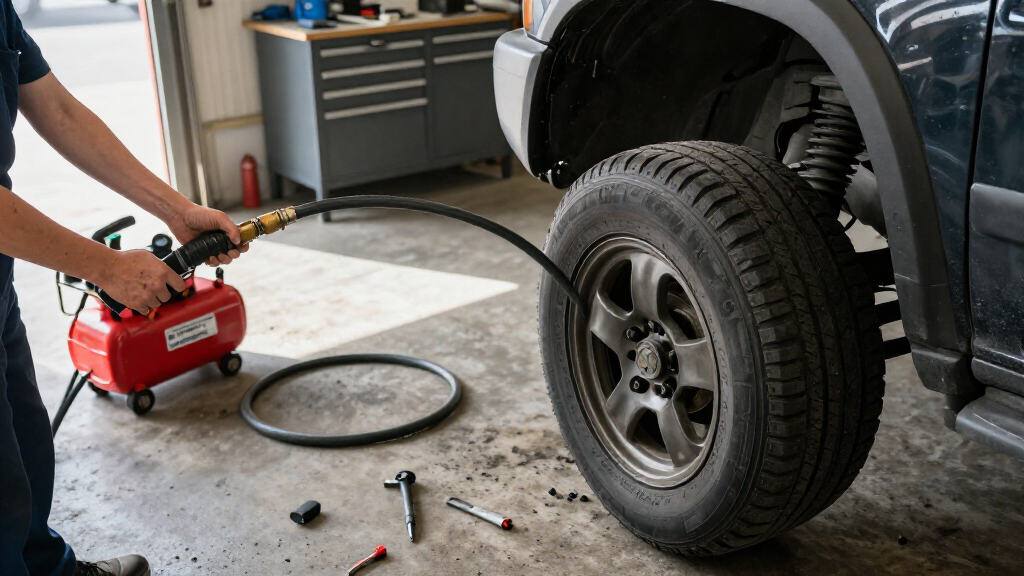
I ranked these automotive shop air compressors by how well their stated capacity and design match common garage work, from occasional inflation and cleanup to sustained tool use. I weighed airflow at working pressure more heavily than tank volume, then considered motor power, pressure, power supply, portability, noise, and oil-free or oil-lubricated maintenance needs. Where the product details did not establish duty cycle, recovery time, or a specific tool’s compatibility, I treat those as items buyers should verify rather than assume.
The order reflects distinct use cases, not a claim that one compressor suits every shop. The Ingersoll Rand 2340L5-V ranks first for its heavy-duty two-stage positioning; large stationary options follow for buyers with room and suitable electrical service. Compact and quieter models rank lower for general shop use because their smaller tanks or unspecified output make them better fits for intermittent tasks. I also account for setup burden: a powerful stationary compressor can be a poor choice if the garage cannot support its voltage, footprint, or installation needs.
| automotive shop air compressor | Pump |
|---|---|
| ECOMAX 6-Gallon 150 PSI Oil-Fr | Oil-free |
| Ingersoll Rand 2340L5-V 5 HP T | Two-stage cast iron |
| VEVOR 13-Gallon Oil-Free Air C | Oil-free reciprocating |
| 13.2-Gallon Ultra-Quiet Oil-Fr | Oil-free |
| VEVOR 2.1 Gallon Oil-Free Air | Oil-free |
| Klutch 20-Gallon Portable Air | Oil-free |
| Air Compressor 3 HP 110 Volt S | — |
| VELPAX 2HP Oil-Free Quiet Air | — |
| VEVOR 80-Gallon Oil-Free Stati | — |
| HoldwellS Oil-Free Air Compres | — |
| RyanTek 15-Gallon Oil-Free Air | Oil-free, twin-cylinder |
| Ingersoll Rand SS3L3 Single-St | — |
Factors to Consider When Choosing Automotive Shop Air Compressors
Before choosing among these models, I would start with the tools and the garage rather than the tank label. A compressor that fits the space but cannot sustain a tool’s airflow will interrupt work, while a high-capacity stationary unit can bring unnecessary electrical and installation demands. These checks help separate a practical shop match from an appealing spec sheet.
Match Delivered Airflow to Your Tools
Look up each tool’s required CFM at its operating pressure, then compare it with the compressor’s delivered airflow at that pressure. A rating at a different pressure—or an unclear airflow figure—may not predict how the compressor performs during real work. For tools used in long bursts, leave headroom rather than buying at the exact stated requirement; recovery time and duty cycle affect whether the tool can keep running. Air ratchets and inflation tasks usually impose different demands from continuous-use sanders or blasting equipment. If a listing omits usable airflow or duty-cycle details, ask the manufacturer before treating the compressor as a match.
Treat Tank Size as a Buffer, Not a Performance Rating
A larger tank stores more compressed air and can reduce how often the motor starts during short bursts, but it does not create unlimited output. A small compressor may refill a large tank slowly, so repeated tool use can still outpace its pump. That is why the 60- and 80-gallon models in this lineup suit fixed installations only when their airflow and power setup fit the intended work. Portable tanks make more sense when moving the compressor or saving floor space matters more than sustained delivery. Compare tank capacity alongside CFM, recovery, and duty cycle instead of using gallons as a shortcut.
Check Voltage, Circuit Capacity, and Installation
Confirm the compressor’s voltage and electrical requirements against the outlet and circuit available in the garage before choosing a model. A 220V stationary unit may need a dedicated circuit or professional electrical work, while a 120V compressor still needs a circuit capable of handling its startup and running load. Extension cords can introduce voltage drop, so check the manufacturer’s guidance instead of assuming a standard household cord is suitable. Stationary compressors also need a level, ventilated location with room for service access and safe clearance. Include installation constraints in the decision; they can outweigh a capacity advantage.
Weigh Noise Against Maintenance and Air Quality
Quiet compressors can make a shared garage more comfortable, especially when the unit runs near living areas, but low noise does not guarantee the airflow needed for a particular tool. Oil-free models avoid routine oil changes and can simplify ownership, while oil-lubricated designs require more maintenance but may suit buyers seeking a different durability and service profile. Both types still need attention to drains, filters, fittings, and moisture management. For paint work or sensitive pneumatic tools, plan for suitable filtration and a dryer; the compressor alone does not provide clean, dry air. Choose convenience features around your work rather than assuming one design is universally superior.
Plan for Recovery Time and Work Rhythm
Think about how you actually use air: short bursts with pauses, or long periods of continuous demand. In a home garage with intermittent tasks, a compact unit may recover between jobs and avoid taking up permanent floor space. A busy repair bay can benefit from higher sustained output and a larger receiver, but only if the pump’s duty cycle supports repeated operation. Ask how long the compressor takes to recover from a typical task and whether the manufacturer specifies a continuous run limit. If several tools may operate at once, add their airflow requirements and allow capacity for simultaneous use.
Budget for the Whole Setup, Not Just the Compressor
Plan for the hose, regulator, couplers, filtration, drain access, and any electrical or mounting work the installation requires. A compressor that arrives with accessories may reduce the number of separate parts to source, but included fittings still need to match your tools and air-line standard. Long or undersized hoses can restrict airflow, so select a diameter suited to the tool and distance from the compressor. A stationary machine may also call for vibration control and a clear path for draining condensation. Comparing the full setup helps avoid choosing a compressor that fits the spec sheet but not the garage.
Frequently Asked Questions
Can a 120V compressor run an impact wrench for automotive work?
It depends on the wrench’s airflow demand, the compressor’s delivered CFM at the required pressure, and how long you use it. A 120V label describes the electrical supply, not whether the machine can sustain a particular tool. Short bursts may work with a suitable compressor, while repeated lug-nut or repair work can make a lower-output model cycle frequently. Compare the tool and compressor specifications at the same pressure, and check the compressor’s duty cycle. If those figures are missing, treat the pairing as unconfirmed.
Is a 60- or 80-gallon compressor automatically better for a repair shop?
No. A larger tank provides a bigger reserve, but sustained tool use depends on the pump’s delivered airflow and duty cycle. A high-capacity tank paired with insufficient output can still run low during continuous work. Large stationary units also require room, appropriate electrical service, and a suitable installation location. For a shop, compare the expected simultaneous tool demand with the compressor’s airflow at working pressure before prioritizing gallons.
Should I choose an oil-free compressor for a home automotive garage?
An oil-free model can reduce routine lubrication tasks and may be convenient where simple upkeep matters. That convenience does not by itself indicate that the compressor will supply enough air for your tools or last longer in every work pattern. Check its airflow, duty cycle, noise, and maintenance instructions alongside the oil-free design. Oil-lubricated compressors require oil care, but some buyers may prefer their service profile for regular shop work. Pick based on workload and maintenance preference together.
Will a quiet compressor be powerful enough for sanding or painting?
Noise level and air output are separate specifications, so a quieter design may or may not suit those tasks. Compare the tool’s CFM requirement at its working pressure with the compressor’s delivered output, and check whether the machine can run for the needed duration. Painting also calls for clean, dry air, which may require a filter and moisture-control equipment beyond the compressor. Sanders can demand sustained airflow that a small tank cannot cover through stored air alone. Verify performance and air treatment needs before buying on noise claims.
What should I verify before installing a stationary shop compressor?
Confirm voltage, amperage, circuit requirements, and whether the unit needs a dedicated connection; do not assume an existing outlet is suitable. Measure the footprint and leave room for ventilation, drainage, and service access. Check the manufacturer’s requirements for mounting, vibration control, and operating environment, then plan how condensate will be drained safely. If wiring or installation is beyond your skill level, arrange qualified help before delivery. These checks can prevent a powerful compressor from becoming an impractical fit for the garage.
Conclusion
For a demanding repair shop with suitable space and power, I’d choose the Ingersoll Rand 2340L5-V as best overall; its 5 HP two-stage design makes it the lineup’s heavy-duty lead. The Ingersoll Rand SS3L3 is my pick for buyers who want a 60-gallon stationary format, while the VEVOR 80-gallon suits a larger fixed setup only when 220V service and installation needs are covered. For beginners and occasional home-garage tasks, the ECOMAX 6-gallon pancake compressor offers a compact starting point with an included accessory kit, though it is not a substitute for sustained high-airflow work. Buyers prioritizing quieter operation can shortlist the 13.2-gallon ultra-quiet or RyanTek 15-gallon models, while those needing a small portable unit can consider the VEVOR 2.1-gallon for intermittent jobs. I’d call the best value a matter of fit: choose the least demanding model that still meets your tools’ verified airflow needs, rather than paying for tank capacity your work cannot use.