For anyone seeking a reliable aftermarket tire pressure monitoring system (TPMS), the options can be overwhelming. The best models offer accurate readings, easy installation, and durable sensors, but tradeoffs often include price, sensor quantity, and feature complexity. The Flydew TPMS stands out for its solar charging and large display, making it ideal for tech-savvy users. On the other hand, the Tymate TM2 RV TPMS offers a solid balance of performance and affordability for RV owners. Choosing the right system depends on your vehicle type, budget, and desired features. Continue reading for a detailed comparison to help you make an informed decision.

Get business pricing on garage and car supplies
- Business-only prices and quantity discounts
- Tax-exempt purchasing
- Multiple users, one account, clear invoices
Complete the kit


Key Takeaways
- Top systems balance sensor quantity with ease of use; more sensors often mean higher cost and complexity.
- Solar charging models provide more convenience but may have limitations in low-light conditions.
- Large, color LCD displays significantly improve readability, especially for RV or trailer setups.
- Alarm modes vary, with some systems offering multiple customizable alerts to enhance safety.
- Build quality and sensor durability are essential, particularly for off-road or harsh environments.
| Flydew TPMS Tire Pressure Monitor with 4 External Sensors, Solar/USB-C Charging, Color LCD Display | 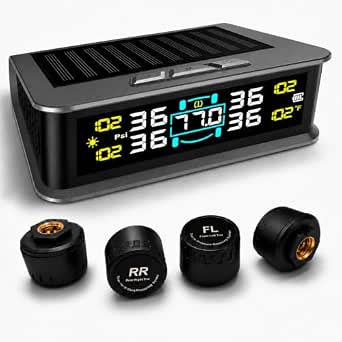 | Best Overall | Pressure Range: 0-99 PSI | Number of Sensors: 4 external sensors | Sensor Battery: CR1632 (replaceable) | VIEW ON AMAZON | See Our Full Breakdown |
| Tire Pressure Monitoring System with Solar & USB Charging, Color Display, 5 Alarm Modes |  | Best Value Pick | Alarm Modes: 5 | Sensors: 4 external pressure sensors | Charging: Solar and USB | VIEW ON AMAZON | See Our Full Breakdown |
| Tymate TM2 RV Tire Pressure Monitoring System – TPMS with 4 Sensors |  | Best for RVs and Large Vehicles | Max Tires Monitored: 10 | Pressure Range: 0-87 PSI | Sensor Battery Life: Up to 6 months | VIEW ON AMAZON | See Our Full Breakdown |
| Tymate TM12 RV Tire Pressure Monitoring System (TPMS) with 6 Sensors |  | Best for Large RVs and Extended Monitoring | Max Sensors Supported: 12 | Pressure Range: 0–144 PSI | Transmission Range: 50 ft (100+ ft with repeater) | VIEW ON AMAZON | See Our Full Breakdown |
| GUTA GT20 RV Tire Pressure Monitoring System with 6 Flow-Through Sensors |  | Best for Heavy-Duty and Commercial Vehicles | Max Tires Monitored: 24 | Pressure Range: 0-188 PSI | Sensor Type: Flow-through | VIEW ON AMAZON | See Our Full Breakdown |
| RV Tire Pressure Monitoring System (TPMS) with 4 Sensors, 6 Alarm Modes, Solar & USB-C Charging, Color LCD Display, 0-144 PSI, Black |  | Best Overall for RVs and Large Vehicles | Sensor Count: 4 | Sensor Type: External TPMS sensors | Pressure Range: 0-144 PSI / 0-10 BAR | VIEW ON AMAZON | See Our Full Breakdown |
| GUTA GT40 RV Tire Pressure Monitoring System – TPMS with 4 External Sensors |  | Best for Large Fleet and Heavy Vehicles | Max Tires Monitored: 10 (8 main + 2 spare) | Pressure Range: 0–188 PSI | Accuracy: ±2 PSI | VIEW ON AMAZON | See Our Full Breakdown |
| Masoll RV Tire Pressure Monitoring System with 4 Tire Pressure Sensors |  | Best for Basic RV Tire Monitoring | Sensor Count: 4 | Compatible Vehicles: Sedan, SUV, RV, trailer under 38 ft | Pressure Range: 0-87 PSI | VIEW ON AMAZON | See Our Full Breakdown |
| GUTA GT80 RV Tire Pressure Monitoring System with 10 Flow-Thru Sensors | 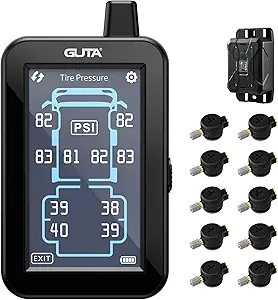 | Best for Extensive RV Tire Monitoring and Large Fleets | Included Sensors: 10 flow-thru sensors | Monitoring Capacity: Up to 22 tires | Display: Full-color LCD touchscreen | VIEW ON AMAZON | See Our Full Breakdown |
| Zradnox T15 Solar Tire Pressure Monitoring System with 4 External Sensors, LCD Display, and 6 Alarm Modes |  | Best Overall for Versatile Vehicle Monitoring | Brand: Zradnox | Model: T15 | Voltage: 3.7V DC | VIEW ON AMAZON | See Our Full Breakdown |
| Tire Pressure Monitoring System with Solar Charging, 4 External TPMS Sensors |  | Best for Moderate-Powered Vehicles in Varying Weather | Sensor Type: External | Number of Sensors: 4 | Monitoring Functions: Pressure and temperature | VIEW ON AMAZON | See Our Full Breakdown |
| Solar Powered Tire Pressure Monitoring System (TPMS) with 4 External Sensors, Red |  | Best Compact System for Versatile Vehicle Types | Power: Solar and USB | Sensors: 4 external cap sensors | Display: Digital LCD with backlight | VIEW ON AMAZON | See Our Full Breakdown |
| Tymate TM7 RV Tire Pressure Monitoring System – TPMS with 4 Sensors |  | Best for RVs and Trailers Requiring High-Pressure Range | Model: Tymate TM7 | Number of Sensors: 4 | Pressure Detection Range: 0-144 PSI | VIEW ON AMAZON | See Our Full Breakdown |
| tire pressure monitoring system aftermarket | Alarm Modes | Pressure Range | Display |
|---|---|---|---|
| Flydew TPMS Tire Pressure Moni | 6 (high/low pressure, high temperature, rapid leakage, low sensor battery, signal loss) | 0-99 PSI | Color LCD |
| Tire Pressure Monitoring Syste | 5 | — | Color with auto brightness |
| Tymate TM2 RV Tire Pressure Mo | 6 | 0-87 PSI | — |
| Tymate TM12 RV Tire Pressure M | 6 | 0–144 PSI | — |
| GUTA GT20 RV Tire Pressure Mon | — | 0-188 PSI | — |
| RV Tire Pressure Monitoring Sy | High pressure, low pressure, high temperature, sensor disconnection, low battery, sensor fault | 0-144 PSI / 0-10 BAR | Color LCD |
| GUTA GT40 RV Tire Pressure Mon | 6 (fast leak, high/low pressure, high temperature, sensor low battery, lost signal) | 0–188 PSI | HD LCD |
| Masoll RV Tire Pressure Monito | — | 0-87 PSI | High-definition anti-reflective LCD |
| GUTA GT80 RV Tire Pressure Mon | High pressure, low pressure, high temperature, leak, missing sensor, low battery | 0–188 PSI | Full-color LCD touchscreen |
| Zradnox T15 Solar Tire Pressur | 6 | 0-72 psi | — |
| Tire Pressure Monitoring Syste | High/low pressure, high temperature, leak, sensor fault | Less than 50 PSI | LCD color screen |
| Solar Powered Tire Pressure Mo | 6 | — | Digital LCD with backlight |
| Tymate TM7 RV Tire Pressure Mo | 6 | — | — |
More Details on Our Top Picks
Flydew TPMS Tire Pressure Monitor with 4 External Sensors, Solar/USB-C Charging, Color LCD Display
This system stands out for its comprehensive real-time monitoring of both pressure and temperature across four tires, with the convenience of dual charging options—solar and USB-C—and an intuitive color LCD display. Compared with the Tymate TM2, it offers more advanced alarm modes and a more flexible charging setup, which makes it ideal for those seeking a reliable, all-in-one setup. The external sensors are labeled and pre-paired, simplifying installation, but they may be more vulnerable to damage or theft than internal sensors, a tradeoff for ease of use. The adjustable alert thresholds cater to various vehicle types and loads, adding versatility. However, the external sensors require CR1632 batteries that will need replacement over time, and their exposed placement can increase risk of damage.
Pros:- Comprehensive pressure and temperature monitoring on all four tires
- Dual charging via solar panel and USB-C, extending battery life
- Pre-paired, labeled sensors with anti-theft nuts for simple installation
Cons:- External sensors are more susceptible to damage or theft
- Sensor batteries (CR1632) need replacement over time
Best for: Vehicle owners who want a versatile, easy-to-install system with detailed real-time data and flexible charging options.
Not ideal for: Those with very tight budgets or concerned about sensor theft, as external sensors may be more vulnerable and replacement batteries add ongoing costs.
- Pressure Range:0-99 PSI
- Number of Sensors:4 external sensors
- Sensor Battery:CR1632 (replaceable)
- Charging:Solar panel and USB-C
- Alarm Modes:6 (high/low pressure, high temperature, rapid leakage, low sensor battery, signal loss)
- Display:Color LCD
Our verdict“This pick suits users seeking a feature-rich, easy-to-maintain TPMS with flexible power options and clear display, though it involves some sensor vulnerability tradeoffs.”
Tire Pressure Monitoring System with Solar & USB Charging, Color Display, 5 Alarm Modes
Compared to the Flydew, this system offers a straightforward installation process and a slightly simplified alarm setup with five modes, making it a solid choice for budget-conscious buyers. Its dual solar and USB charging extend battery life, and the color display with auto brightness adjustment ensures clear readings across vehicle types such as sedans and SUVs. While it lacks the detailed labeling of sensors like the Flydew, its quick setup—about three minutes—appeals to users who prioritize simplicity. The external sensors are vulnerable to theft or damage, and the absence of advanced alarm customization may limit more demanding users. Pricing and verified reviews are not available, which can be a concern for some buyers.
Pros:- Dual solar and USB charging for extended battery life
- Fast installation within approximately 3 minutes
- Color display with auto brightness ensures clear readings
Cons:- Vulnerable external sensors may be at risk of theft or damage
- Limited alarm mode customization compared to higher-end models
Best for: Drivers seeking an affordable, easy-to-install TPMS with decent features for everyday use.
Not ideal for: Vehicle owners who require highly customizable alarms or enhanced sensor security, as this model offers fewer advanced options.
- Alarm Modes:5
- Sensors:4 external pressure sensors
- Charging:Solar and USB
- Display:Color with auto brightness
- Installation Time:Approximately 3 minutes
Our verdict“This system provides a practical balance of features and affordability, ideal for everyday vehicle owners who want quick setup and reliable monitoring.”
Tymate TM2 RV Tire Pressure Monitoring System – TPMS with 4 Sensors
This model is tailored for larger vehicles like RVs and trailers, with the ability to monitor up to 10 tires thanks to its pre-paired sensors and flexible power options—including solar, USB, and cigarette lighter. Its six alarm modes, including rapid leak detection and sensor voltage alerts, provide a thorough safety net. Compared to the Tymate TM12, the TM2 offers fewer sensors but remains highly suitable for typical RV setups. Its waterproof sensors (IP67) and long battery life (up to six months) make it durable, though the need for a metal valve stem for sensor stability can add installation complexity. The charging adapter for cigarette lighter socket is not included, which might be inconvenient.
Pros:- Supports monitoring of up to 10 tires, ideal for RVs and trailers
- Multiple power options including solar, USB, and cigarette lighter
- Long battery life with pre-labeled, pre-paired sensors
Cons:- Requires a metal valve stem for sensor stability
- Cigarette lighter adapter not included, adding to setup costs
Best for: RV owners and trailer travelers who need reliable, multi-tire monitoring with flexible charging options.
Not ideal for: Owners of smaller vehicles or those who prefer internal sensors or simpler setups, as this is designed for larger, more complex tire arrangements.
- Max Tires Monitored:10
- Pressure Range:0-87 PSI
- Sensor Battery Life:Up to 6 months
- Charging Options:Solar, USB, cigarette lighter
- Alarm Modes:6
- Waterproof Rating:IP67
Our verdict“This system offers comprehensive coverage for larger vehicles with flexible power and a straightforward setup, though it involves some additional accessories for full functionality.”
Tymate TM12 RV Tire Pressure Monitoring System (TPMS) with 6 Sensors
The Tymate TM12 stands out for its ability to monitor up to 12 tires across four zones, making it ideal for large RVs or multi-axle trailers. Its split-screen display shows six tires at once, providing a clear overview. The sensors are IP67 waterproof and support a wide pressure range up to 144 PSI, with quick plug-and-play installation and auto-calibration. Compared with the TM2, this model offers more sensors and expanded monitoring capacity but requires a repeater for longer distances or larger vehicles, which adds to complexity and cost. Dual power options—USB-C and solar—are convenient, but solar output can vary with sunlight, impacting battery life.
Pros:- Supports up to 12 tires across four zones
- Split-screen display for easy monitoring of six tires simultaneously
- Dual power supply options including USB-C and solar
Cons:- Requires a repeater (sold separately) for extended range or large vehicles
- Monitor can only be turned off manually when not charging by cable
Best for: Large RV owners or trailer operators needing extensive, zone-based tire monitoring with a high sensor capacity.
Not ideal for: Small vehicle owners or those who prefer a simple, minimal setup without extra repeaters or extensive sensor networks.
- Max Sensors Supported:12
- Pressure Range:0–144 PSI
- Transmission Range:50 ft (100+ ft with repeater)
- Alarm Modes:6
- Waterproof Rating:IP67
- Power Options:USB-C, Solar
Our verdict“This system is tailored for large RVs and trailers that demand extensive, zone-aware tire monitoring with high sensor capacity, though it involves additional components for full coverage.”
GUTA GT20 RV Tire Pressure Monitoring System with 6 Flow-Through Sensors
The GUTA GT20 is designed for heavy-duty use, offering real-time pressure and temperature monitoring for up to 24 tires. Its six flow-through sensors enable inflation without removal, saving time during setup or tire maintenance. Compared to the Tymate TM12, the GT20 provides a higher tire capacity, making it suitable for large RVs, trucks, or commercial fleets. The long-range signal booster extends transmission up to 100 feet, and the waterproof, dust-proof sensors add durability. However, the system requires metal valve stems for reliable performance, and the monitor’s battery lasts approximately 15 hours per charge, which might be limiting for extended trips. The sensor batteries (CR2032) are user-replaceable, but frequent replacements may be needed for intensive use.
Pros:- Supports monitoring of up to 24 tires
- Flow-through sensors allow inflation without removal
- Long-range signal booster for extended coverage
Cons:- Requires metal valve stems for sensor stability
- Monitor battery lasts only about 15 hours per charge
Best for: Heavy-duty vehicle owners or commercial operators managing large tire counts who need quick inflation and extensive coverage.
Not ideal for: Light vehicle owners or those seeking a system with internal sensors or minimal setup, as this is geared toward larger, rugged environments.
- Max Tires Monitored:24
- Pressure Range:0-188 PSI
- Sensor Type:Flow-through
- Battery:CR2032 (user-replaceable)
- Monitor Battery:Built-in, approx. 15 hours
- Transmission Distance:Up to 100 feet
Our verdict“This system is well-suited for heavy-duty vehicles with high tire counts, offering efficient inflation and wide coverage, though battery life and valve stem compatibility are considerations.”
RV Tire Pressure Monitoring System (TPMS) with 4 Sensors, 6 Alarm Modes, Solar & USB-C Charging, Color LCD Display, 0-144 PSI, Black
This external TPMS excels in providing comprehensive real-time pressure and temperature monitoring for larger vehicles such as RVs, trucks, and trailers, especially with its broad compatibility up to 50 feet. Its standout feature is the combination of six alarm modes and a color LCD display, making critical data easy to read at a glance—this surpasses the simpler displays of systems like the Masoll M13, which lack detailed alerts. The dual charging options—solar and USB-C—offer convenience, though solar charging can be less effective in low-light conditions, a tradeoff compared to systems with wired power. Installation is tool-free, appealing for those who prefer quick setup, but external sensors require periodic battery replacements, adding minor maintenance. Designed for larger vehicles, it’s ideal for owners who value detailed monitoring but want to avoid internal sensor vulnerabilities and complex wiring. This pick makes the most sense for RV owners and tow vehicle drivers who need reliable, broad-range monitoring with customizable alerts.
Pros:- Provides real-time tire pressure and temperature updates with rapid sensor refresh rates
- Includes six alarm modes and customizable alert thresholds for tailored safety
- Supports dual charging via solar and USB-C, minimizing power concerns
- Broad compatibility with large vehicles up to 50 feet long
Cons:- External sensors require periodic battery replacements, adding maintenance
- Solar charging effectiveness diminishes in low-light conditions
- Designed primarily for larger vehicles, less suitable for small cars
Best for: Owners of RVs, trucks, or trailers up to 50 feet long who want detailed, real-time monitoring with easy installation.
Not ideal for: Small car owners or those with minimal tire pressure concerns, as the system’s features are tailored for large vehicle safety and may be overkill.
- Sensor Count:4
- Sensor Type:External TPMS sensors
- Pressure Range:0-144 PSI / 0-10 BAR
- Accuracy:2 PSI / 3°F
- Alarm Modes:High pressure, low pressure, high temperature, sensor disconnection, low battery, sensor fault
- Display:Color LCD
- Charging:Solar and USB-C
- Sensor Refresh Rate:Every 0.3 seconds
- Compatibility:RVs, trucks, SUVs, trailers, fifth wheels; vehicles up to 50 ft
Our verdict“This TPMS offers a robust, feature-rich solution ideal for owners of large vehicles who prioritize safety and ease of use.”
GUTA GT40 RV Tire Pressure Monitoring System – TPMS with 4 External Sensors
Compared with the GUTA GT80, which supports up to 22 tires, the GT40 is more streamlined for smaller fleets or RV owners needing monitoring for fewer tires with simplicity. Its HD LCD screen displays pressure for up to 10 tires simultaneously, which is advantageous for those managing multiple wheels but less suitable for larger trailers or trucks requiring more sensors. The system’s support for both solar and USB charging ensures reliable power, yet it only includes four sensors, even though it can monitor ten tires, so additional sensors are needed for full coverage—a possible extra cost. Alarm modes are comprehensive, covering leaks, high/low pressure, and temperature, offering safety peace of mind. Its sensor range and auto backlight make it user-friendly, though external cap sensors are more exposed to damage, and the limited number of sensors could be a concern for larger vehicles. This makes it an excellent choice for RVs or trucks with a moderate number of tires but less so for extensive fleets.
Pros:- Large HD LCD display shows pressure for up to 10 tires at once
- Dual charging options with solar and USB for reliable power
- Six alarm modes for comprehensive safety alerts
- Auto backlight and easy setup with pre-configured sensors
Cons:- Includes only 4 sensors despite supporting up to 10 tires, requiring extra purchase
- External cap sensors are more vulnerable to damage than internal sensors
- Limited to monitoring fewer tires, not ideal for larger fleets
Best for: Owners of RVs, trucks, or trailers with up to 10 tires who need a straightforward, easy-to-read system with dual power options.
Not ideal for: Large fleet operators or those with more than 10 tires, as additional sensors are required and expansion is limited.
- Max Tires Monitored:10 (8 main + 2 spare)
- Pressure Range:0–188 PSI
- Accuracy:±2 PSI
- Alarm Modes:6 (fast leak, high/low pressure, high temperature, sensor low battery, lost signal)
- Display:HD LCD
- Charging:Solar and USB
- Signal Transmission Range:Up to 36 feet
- Sensors Included:4 external cap sensors
Our verdict“This system is well-suited for RV owners and smaller truck operators needing straightforward, reliable tire monitoring with multiple alert options.”
Masoll RV Tire Pressure Monitoring System with 4 Tire Pressure Sensors
The Masoll M13 stands out for simplicity and affordability, perfect for RV owners with four tires who need reliable pressure and temperature monitoring without extra bells and whistles. Its sensor setup is automatic, setting alarm thresholds after installation, a feature that appeals to users new to TPMS. While it supports solar charging and USB power, its maximum pressure limit of 99 PSI is lower than other systems like the GUTA GT80, which can handle up to 188 PSI—this limits its use on higher-pressure tires. Its anti-reflective LCD ensures clear readings in daylight, but the system lacks manual alarm threshold adjustments, which some users may find restrictive. The sensors require driving for 5-10 minutes to activate, making it less immediate than systems with continuous data refresh. Best suited for RVs or trailers with standard pressures, but not for high-pressure tires or larger fleets.
Pros:- Automatic pressure alarm calibration after sensor installation
- Supports solar and USB charging for continuous power
- Anti-reflective, daylight-friendly LCD display
- Simple, pre-configured sensors for quick setup
Cons:- Maximum pressure of 99 PSI limits use with higher-pressure tires
- Sensors need 5-10 minutes of driving to activate, delaying real-time data
- No manual threshold customization available
Best for: Small RV owners or trailer users who want a straightforward, easy-to-install TPMS without the need for custom thresholds.
Not ideal for: Users with high-pressure tires exceeding 99 PSI or those managing larger fleets requiring more sensors and customization.
- Sensor Count:4
- Compatible Vehicles:Sedan, SUV, RV, trailer under 38 ft
- Pressure Range:0-87 PSI
- Pressure Accuracy:1.5 PSI
- Power Source:Solar and USB
- Display:High-definition anti-reflective LCD
- Alarm Settings:Automatic at 25% over or 15% under reference
- Additional Requirement:Signal booster recommended for trailers over 38 ft
Our verdict“This system offers a no-fuss, reliable solution for small RV or trailer owners who prioritize ease of use over advanced features.”
GUTA GT80 RV Tire Pressure Monitoring System with 10 Flow-Thru Sensors
The GUTA GT80 is designed for maximum coverage, supporting up to 22 tires with 10 flow-thru sensors that allow inflation without removing the sensors—an excellent feature for frequent tire adjustments. Its full-color touchscreen display offers clear, real-time pressure and temperature data, making it easier than the GUTA GT40’s static LCD. The included signal booster extends wireless range up to 164 feet, ideal for large RVs, trailers, or fleets. However, it only ships with 10 sensors, so owners of larger setups need additional units, increasing cost. The sensors are compatible with metal valve stems and are built to withstand outdoor conditions, but their batteries will require periodic replacement. This system is best for owners who need extensive tire coverage, real-time updates, and easy inflation without sensor removal.
Pros:- Large, full-color touchscreen provides detailed tire data
- Flow-thru sensors enable inflation without sensor removal
- Includes signal booster for extended wireless range up to 164 feet
- Supports up to 22 tires with multiple safety alarms
Cons:- Ships with only 10 sensors, requiring additional purchase for full coverage
- Sensor batteries need periodic replacements, adding maintenance
- Designed primarily for metal valve stems, limiting flexibility
Best for: Large RVs, trailers, or fleet operators needing extensive tire monitoring with inflating capabilities and long-range wireless connectivity.
Not ideal for: Owners of small vehicles or those with fewer than 10 tires, as the system’s extensive features might be more than needed.
- Included Sensors:10 flow-thru sensors
- Monitoring Capacity:Up to 22 tires
- Display:Full-color LCD touchscreen
- Pressure Range:0–188 PSI
- Sensor Features:Flow-through, waterproof, dustproof
- Vehicle Compatibility:RVs, trailers, tow vehicles
- Signal Booster:Included, extends up to 164 ft
- Alarm Modes:High pressure, low pressure, high temperature, leak, missing sensor, low battery
Our verdict“This TPMS is ideal for large RVs and extensive fleets that need real-time, inflating-capable monitoring with a user-friendly display.”
Zradnox T15 Solar Tire Pressure Monitoring System with 4 External Sensors, LCD Display, and 6 Alarm Modes
The Zradnox T15 stands out for its combination of solar and USB charging options, making it highly adaptable for various usage scenarios. Compared with the Tire Pressure Monitoring System with Solar Charging, 4 External TPMS Sensors, the T15 offers a broader pressure range up to 72 psi, suitable for larger vehicles like RVs and trailers. Its six alarm modes provide comprehensive alerts for pressure, temperature, leaks, and battery issues, giving peace of mind during long trips. The external sensors are lightweight and easy to install but are more vulnerable to theft or damage compared to internal sensors. The auto sleep/wake feature conserves power, which is a plus for extended use, but the system is limited to tire pressures under 72 psi, restricting its use on some high-pressure tires.
Pros:- Dual solar and USB charging options for continuous power
- Six alarm modes covering pressure, temperature, leaks, and battery issues
- Lightweight, external sensors for easy installation
Cons:- External sensors can be vulnerable to theft or damage
- Limited to vehicles with tire pressures under 72 psi
Best for: Owners of RVs, trailers, or large SUVs needing reliable, multi-vehicle monitoring with power flexibility
Not ideal for: Small cars or vehicles with tire pressures exceeding 72 psi, as it isn’t designed for high-pressure tires
- Brand:Zradnox
- Model:T15
- Voltage:3.7V DC
- Sensor Battery:CR1632 (up to 1 year)
- Max Working Distance:32 feet
- Pressure Range:0-72 psi
- Alarm Modes:6
- Charging:Solar and USB
- Warranty:1 year
Our verdict“This system is ideal for users who need versatile, long-term monitoring on larger vehicles and value power options.”
Tire Pressure Monitoring System with Solar Charging, 4 External TPMS Sensors
This TPMS with solar and USB charging offers real-time pressure and temperature updates with a clear LCD display that automatically adjusts brightness, making it user-friendly for daily drivers. Compared to the Zradnox T15, it is limited to tire pressures below 50 PSI, which suits most standard cars but not larger or high-pressure vehicles. Its external sensors are sealed against weather, offering durability in rain or snow, though solar charging may be less effective in low sunlight, requiring frequent USB backup charging. The system enters sleep mode after 10 minutes of vehicle inactivity, conserving battery life, but this can be inconvenient if you prefer constant real-time data without waking the device manually.
Pros:- Real-time pressure and temperature monitoring with visual and audible alarms
- Weather-sealed sensors withstand harsh conditions
- Supports solar and USB charging for convenience
Cons:- Solar charging may be insufficient in low sunlight conditions
- Display sleeps after 10 minutes of inactivity, which could be inconvenient
Best for: Car owners who want reliable, weather-resistant monitoring with minimal wiring and easy installation
Not ideal for: Owners of larger vehicles or RVs with higher tire pressures over 50 PSI, as it isn’t calibrated for such pressures
- Sensor Type:External
- Number of Sensors:4
- Monitoring Functions:Pressure and temperature
- Pressure Accuracy:Within 0.5 PSI
- Pressure Range:Less than 50 PSI
- Alarm Modes:High/low pressure, high temperature, leak, sensor fault
- Power Options:Solar and USB
- Water Resistance:IPX67
- Display:LCD color screen
Our verdict“This pick makes the most sense for daily drivers needing durable, weatherproof monitoring without high-pressure requirements.”
Solar Powered Tire Pressure Monitoring System (TPMS) with 4 External Sensors, Red
The Solar Powered TPMS with external cap sensors offers a straightforward setup with a real-time LCD display and six alarm modes, including leak detection and temperature alerts. Compared with the Tymate TM7 RV TPMS, it is more compact and suitable for a wider range of vehicles, from sedans to SUVs. Its solar and USB charging keep the system operational without occupying the cigarette lighter socket, which is a major advantage for those who prefer a clean dashboard. The sensors are sealed against dust and water, enhancing durability, but they are limited to tire pressures under 3.5 bar (50 psi), making it unsuitable for high-pressure tires. Some users may find that sensors need reinstallation after initial setup for optimal operation.
Pros:- Dual solar and USB charging for continuous operation
- Six alarm modes covering leaks, pressure, temperature, and faults
- Compact, sealed sensors resistant to weather
Cons:- Limited to tire pressures under 3.5 bar (50 psi)
- Sensors may require reinstallation for optimal functioning
Best for: Owners of passenger vehicles seeking a simple, reliable, and space-saving TPMS with flexible power options
Not ideal for: High-pressure tire users or those with larger commercial vehicles, as it limits pressure to 3.5 bar
- Power:Solar and USB
- Sensors:4 external cap sensors
- Display:Digital LCD with backlight
- Pressure Units:Bar/Psi
- Alarm Modes:6
- Vehicle Compatibility:Sedans, SUV, MPV, VAN
- Warranty:12 months
Our verdict“This system suits those who want a compact, reliable TPMS for standard passenger vehicles with space-saving design.”
Tymate TM7 RV Tire Pressure Monitoring System – TPMS with 4 Sensors
The Tymate TM7 excels at monitoring high-pressure tires, supporting up to 144 PSI with an accuracy of ±1.5 PSI. Its plug-and-play design, powered directly from the cigarette lighter socket, simplifies setup compared to systems like the Flydew TPMS, which may require additional wiring. The six alarm modes include leak detection, high/low pressure, and sensor fault alerts, making it suitable for RV and trailer owners who need detailed oversight. However, for trailers over 36 feet, a separate Tymate repeater is necessary, adding to the setup complexity. The sensors, which use replaceable batteries, require periodic attention, especially for long-term use. This model’s broader pressure range makes it a better fit for larger, high-pressure tires, but the reliance on a separate repeater can be a drawback for some.
Pros:- Supports high-pressure ranges up to 144 PSI with high accuracy
- Simple plug-in operation with no wiring required
- Includes dual USB ports for mobile device charging
Cons:- Requires a separate repeater for trailers longer than 36 ft
- Sensors need battery replacement over time
Best for: RV owners and trailer drivers needing high-pressure monitoring with easy plug-in setup
Not ideal for: Standard sedans or vehicles with low-pressure tires, as it offers more range than necessary and is optimized for high-pressure applications
- Model:Tymate TM7
- Number of Sensors:4
- Pressure Detection Range:0-144 PSI
- Accuracy:±1.5 PSI
- Alarm Modes:6
- Power Source:Cigarette lighter socket
- Units:PSI/BAR
- Sensor Battery:Replaceable
Our verdict“This TPMS is best suited for large RVs and trailers that demand high-pressure monitoring and straightforward installation.”
How We Picked
These products were evaluated based on key factors that matter most to buyers: accuracy of pressure readings, sensor durability, ease of installation, battery life, and display clarity. We prioritized systems with proven reliability and good user reviews, especially for RV and trailer use where multiple sensors and alarm features are critical. Price was also considered, ensuring options provide good value without sacrificing core performance. The ranking reflects a balance between feature sets, usability, and overall build quality, helping readers find the best fit for their specific needs.Factors to Consider When Choosing Tire Pressure Monitoring System Aftermarket
Choosing an aftermarket tire pressure monitoring system involves more than just picking the latest model. It’s important to consider compatibility with your vehicle, sensor quantity, and power options. Ease of installation can vary, especially for those less comfortable with DIY setups. Think about display size and readability, especially if you plan to monitor tire pressure frequently. Also, evaluate alarm modes—some systems offer customizable alerts that can be vital for safety. Lastly, factor in your budget and whether you prefer solar, USB, or replaceable batteries for power sources.Sensor Quantity and Compatibility
Consider how many tires you need to monitor and whether the system supports additional sensors if you upgrade or add more tires. Many systems are designed specifically for RVs, trailers, or passenger cars, so check compatibility before purchasing. More sensors can offer comprehensive coverage but may complicate setup and increase costs. For smaller vehicles, a 4-sensor system might suffice, while RV owners often need 6 or more sensors for all tires, including spares.
Power Options and Battery Life
Solar charging is increasingly popular and offers the convenience of less frequent battery changes, but it can be less reliable in low-light conditions. USB or replaceable batteries provide more consistent power, especially in shaded or indoor environments. Evaluate how long sensors last between charges or replacements and whether the system offers low-battery alerts. Choosing a system with a long-lasting power source reduces maintenance efforts and ensures continuous monitoring.
Display and User Interface
A clear, large display makes a significant difference, particularly for RV drivers who need quick, at-a-glance information. Color screens enhance readability, especially in bright sunlight, and some models include customizable display layouts. Simplicity in the user interface can make setup and daily use easier, while more advanced options might offer detailed data but require a learning curve. Balance your preference for simplicity versus detailed monitoring features.
Alarm Modes and Customization
Alarm modes alert you to issues like low tire pressure or high temperature, which can prevent dangerous blowouts or damage. Systems with multiple alarm modes and volume controls provide greater safety control. Some systems allow customization of pressure thresholds, which is useful if you have specific tire requirements. Keep in mind that overly sensitive alarms can cause false alerts, so find a system that balances responsiveness with reliability.
Build Quality and Durability
Durability is vital for sensors exposed to the elements, especially in off-road or harsh environments. Look for sensors with weatherproof ratings and sturdy construction. Installation ease is also worth considering; some systems come with mounting accessories or adhesive mounts, simplifying setup. Investing in higher-quality sensors might cost more initially but can save money on replacements and repairs over time.
Frequently Asked Questions
How do I know if a TPMS is compatible with my vehicle?
Most aftermarket TPMS options are designed to be universal or have specific compatibility lists. Check the product specifications for sensor type, pressure range, and mounting options. For RVs or trailers, confirm the system supports the number of tires you have and whether sensors are compatible with your tire valves. If you’re unsure, contacting the manufacturer or seller can clarify compatibility and prevent misfits.
Are solar-powered TPMS systems reliable in low-light conditions?
Solar-powered systems work well in most environments, but their performance depends on exposure to sunlight. In shaded areas or indoor storage, sensors may not charge effectively, leading to reduced battery life or system failure. Some models include backup batteries or alternative power options to mitigate this issue. Consider your typical storage and driving conditions when choosing a solar-powered system to avoid unexpected outages.
What is the typical lifespan of TPMS sensors?
Most TPMS sensors last between 3 to 5 years, depending on build quality and environmental exposure. Sensors exposed to extreme weather, dirt, or off-road conditions may wear out sooner. Regular maintenance, such as cleaning and checking sensor batteries or seals, can extend their lifespan. Investing in higher-quality sensors often results in longer durability and fewer replacements over time.
Can I install a TPMS myself, or do I need professional help?
Many aftermarket TPMS systems are designed for DIY installation, especially those with external sensors and straightforward mounting options. However, some setups, particularly on complex RV systems, might benefit from professional installation to ensure accuracy and proper wiring. Reading the manufacturer’s instructions carefully and watching online tutorials can make self-installation manageable for most users. When in doubt, professional installation can guarantee proper setup and calibration.
Is it worth paying extra for systems with more sensors or advanced features?
Paying more for additional sensors or advanced features can be worthwhile if you need comprehensive coverage or enhanced safety alerts. Larger systems with multiple alarm modes and color displays are especially useful for RVs or trailers with many tires. However, for smaller vehicles, a simpler, budget-friendly system might suffice without sacrificing essential monitoring. Consider your specific vehicle setup and safety priorities before investing in premium features.
Conclusion
For general use and maximum value, the Flydew TPMS offers excellent features like solar charging and a large display, making it ideal for tech-conscious drivers. The Tymate TM2 RV TPMS balances affordability with reliable performance, perfect for RV owners on a budget. If you prioritize ease of installation and durability, systems like the GUTA GT20 or GUTA GT40 are solid choices. For those new to TPMS or with fewer tires, simpler models with fewer sensors provide straightforward monitoring. Ultimately, your choice should align with your vehicle type, environment, and safety priorities.
As an affiliate, we earn on qualifying purchases.Halloween Picks
halloween