In real-world driving, turbochargers excel if you value fuel efficiency and lower long-term costs, though they can cause lag at low RPMs. Superchargers offer immediate power and quick throttle response, making them ideal for instant acceleration, but they tend to use more fuel and require more maintenance. Your choice depends on whether you prioritize efficiency or instant responsiveness; keep going to discover which option best fits your driving style.

Get business pricing on garage and car supplies
- Business-only prices and quantity discounts
- Tax-exempt purchasing
- Multiple users, one account, clear invoices
Key Takeaways
- Turbochargers offer better fuel efficiency and lower long-term costs but may experience lag during initial acceleration.
- Superchargers provide immediate throttle response, making them ideal for quick acceleration and sporty driving.
- Turbos excel at maintaining efficiency over time, while superchargers increase engine load and fuel consumption.
- Maintenance for turbos is generally lower, but they require proper oil management; superchargers involve more mechanical parts prone to wear.
- The best choice depends on whether the driver prioritizes efficiency and smoothness or instant power and responsiveness.
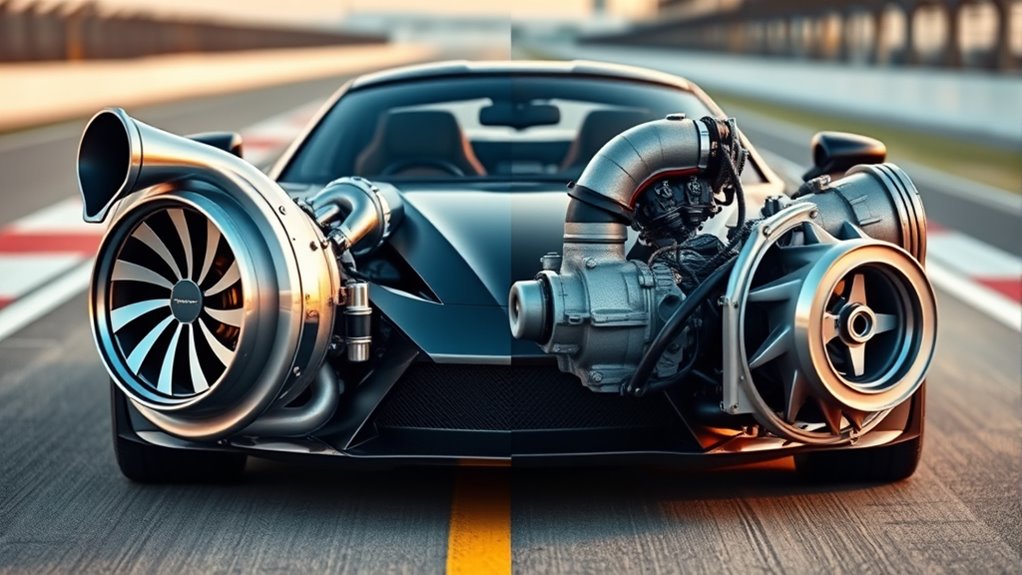
When choosing between a turbocharger and a supercharger for your vehicle, understanding how each one boosts engine performance is essential. Both devices aim to increase horsepower and torque, but they do so in different ways that impact engine efficiency and maintenance costs. A turbocharger uses exhaust gases to spin a turbine, which then compresses incoming air into the engine. This process improves engine efficiency because it recycles exhaust energy, allowing your engine to produce more power without considerably increasing fuel consumption. On the other hand, a supercharger is driven directly by your engine’s crankshaft via a belt or chain. This means it provides immediate boost, but it also demands more power from the engine itself, which can slightly reduce overall efficiency.
Turbochargers boost efficiency by using exhaust gases, while superchargers provide immediate power at the cost of higher engine load.
In real-world driving, you’ll notice that turbochargers tend to spool up gradually, especially at lower RPMs. This can lead to a slight delay, often called turbo lag, where power feels less responsive until the turbo kicks in. However, once spooled, turbos generate impressive power boosts with less strain on your engine, ultimately helping maintain better fuel economy and reducing long-term engine wear. Because turbos rely on exhaust gases, they tend to have lower maintenance costs over time, as there are fewer moving parts directly driven by the engine. However, they do require good oil management and periodic checks, especially if you push your car hard or use it for frequent high-performance driving. Additionally, many Ulta Beauty Store Hours are designed to accommodate shoppers with busy schedules, making it easier to find time for maintenance and upgrades.
Superchargers, meanwhile, deliver instant throttle response because they are belt-driven and spin at high speeds whenever the engine runs. This immediate boost feels more linear, which is advantageous in street racing or situations requiring quick acceleration. But this performance comes at a cost: superchargers typically increase the load on your engine, leading to higher fuel consumption and potentially more wear on engine components. They also tend to have higher maintenance costs due to their continuous operation and additional mechanical parts, such as belts and pulleys, which can wear out or break over time.
Ultimately, your choice depends on your driving style and priorities. If you want a more efficient setup with lower maintenance costs and are okay with a slight delay in power delivery, a turbocharger is often the better option. If you prefer immediate response and are willing to accept higher maintenance and fuel costs, a supercharger might suit you better. Both systems can considerably enhance your vehicle’s performance, but understanding their differences in engine efficiency and maintenance helps you make an informed decision tailored to your driving needs.
Products Worth Considering

Chemical Guys 14-Piece Arsenal Builder Car Wash Kit with Foam Blaster

Chemical Guys 16-Piece Arsenal Builder Car Wash Kit with Foam Cannon & Bucket

Chemical Guys Carbon Force Ceramic Paint Coating Kit, 1 fl oz, 3 Applicators
As an affiliate, we earn on qualifying purchases.
Frequently Asked Questions
How Do Turbo and Supercharger Impacts Fuel Economy?
When considering how turbo and superchargers impact fuel economy, you notice that turbochargers generally improve fuel efficiency by utilizing exhaust gases to boost power without extra fuel consumption. Superchargers, on the other hand, provide immediate power but often increase fuel use and emissions. So, if you want better fuel efficiency and lower emissions, a turbo is usually the smarter choice, while a supercharger prioritizes quick acceleration over efficiency.
Which Is More Reliable Long-Term: Turbo or Supercharger?
You’ll find that superchargers tend to be more reliable long-term because they have fewer parts that can fail, unlike turbos that face issues like turbo lag. However, superchargers generate more noise, which might bother you. Turbos are more efficient but can require more maintenance over time. Overall, if you prefer durability and less noise, a supercharger could be the better choice for long-term reliability.
Can Turbo and Supercharger Be Used Together?
Thinking about turbo and supercharger tandem? You can technically combine them, creating a twin-charger setup. This duo boosts power but complicates intercooler efficiency and boost pressure regulation. You’ll need advanced tuning to prevent overboost and manage heat. While it’s possible, it’s complex and costly. If you pursue this path, expect increased reliability concerns and maintenance needs, but enjoy the dramatic boost of combined forced induction.
Are There Maintenance Differences Between Turbo and Supercharger?
You’ll find that maintenance costs and repair frequency differ between turbochargers and superchargers. Turbos often require more frequent inspections and may need more repairs due to their high temperatures and complex parts. Superchargers generally have lower maintenance costs because they’re mechanically driven and simpler, but they can still experience belt wear and other issues. Overall, turbo maintenance tends to be more intensive and costly over time.
How Do Turbo and Supercharger Affect Vehicle Resale Value?
You might notice that turbochargers can boost resale value since they’re popular and often come stock, appealing to buyers looking for efficiency. Superchargers, especially aftermarket mods, can sometimes hurt resale if they’re seen as modifications rather than factory features. Resale value factors include the vehicle’s condition, original parts, and documented upgrades. Keep in mind, excessive aftermarket modifications may reduce appeal, so choose upgrades wisely to maintain your car’s value.
Conclusion
When choosing between a turbo and a supercharger, consider your driving style. Imagine you’re towing a heavy load; a supercharger might give you instant power, just like a recent case where a truck with a supercharger handled hills effortlessly. On the other hand, if you want better fuel efficiency for daily drives, a turbo could be your best bet. Ultimately, your choice depends on whether you prioritize quick response or long-term efficiency.