
Before ordering a car lift for your home garage, you need to measure the width from wall to wall, considering any obstructions, and the length to fit your vehicle with extra space for maneuvering. Check your ceiling height at multiple points to verify it’s tall enough for the lift and vehicle. Confirm your garage door height can accommodate the lift and vehicle passing through. Understanding your garage’s structural support and load capacity is also essential. Keep in mind, additional measurements might be needed for unique features—keep going to learn more.

Get business pricing on garage and car supplies
- Business-only prices and quantity discounts
- Tax-exempt purchasing
- Multiple users, one account, clear invoices
Key Takeaways
- Measure garage width and length to ensure sufficient space for vehicle parking and lift operation without obstructions.
- Check ceiling height at multiple points to confirm compatibility with the lift’s height requirements.
- Assess ceiling load capacity and structural support to safely bear the weight of the lift and vehicle.
- Verify garage door height and clearance to ensure the vehicle with the lift can pass through comfortably.
- Consider unique architectural features or slopes that may impact installation or operation space.
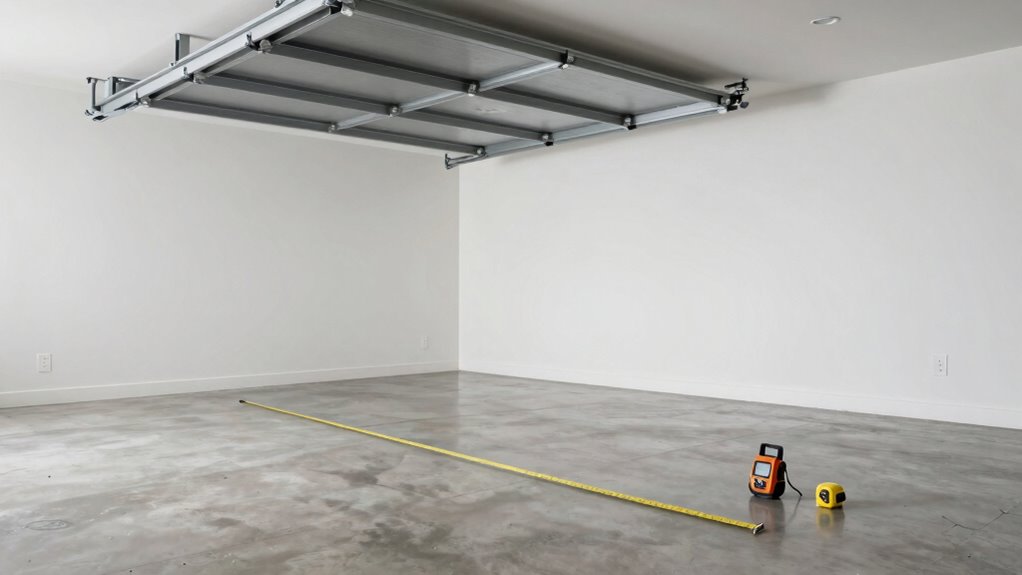
Measuring your home garage accurately is essential for organizing your space and planning for storage or renovations. When you’re contemplating a car lift, precise measurements ensure it fits comfortably and functions safely. Start by evaluating the available parking space, which includes the width and length of your garage. You need enough room to park your vehicle comfortably without blocking doors or creating tight spots. Measure the width from wall to wall, accounting for any obstructions like columns or built-in shelving. The length should give you enough clearance to park your car fully, with extra space in front and behind for easy maneuvering. Knowing your parking space dimensions helps determine the size of the lift you can accommodate without crowding your garage.
Next, pay close attention to your garage’s ceiling height. This is a critical measurement because a car lift requires sufficient clearance to operate safely and efficiently. Measure from the floor to the ceiling at multiple points to account for any uneven surfaces. Most standard home garages have a ceiling height between 8 and 10 feet, but some may have higher or lower ceilings. Check the specific requirements of the car lift you’re interested in—many models specify the minimum ceiling height needed. If your ceiling height is borderline, consider the lift’s height when extended, including any additional clearance needed for maintenance or inspection. Failing to evaluate ceiling height accurately can result in purchasing a lift that doesn’t fit or causes clearance issues later. Additionally, understanding your garage’s ceiling height helps ensure compatibility with the lift’s maximum extension and safe operation. It’s also helpful to consider structural support in your garage ceiling to ensure it can safely handle the weight and force exerted by a car lift. Knowing about load-bearing capacity can prevent potential safety hazards and ensure the longevity of your installation. Being aware of potential support reinforcement might be necessary if your ceiling is not originally designed for such loads.
Furthermore, assessing the garage door height is crucial because it directly impacts whether your vehicle with the lift installed can pass through comfortably without modifications. Ensure that the garage door opening is tall enough to accommodate the vehicle with the lift installed. This might involve measuring the height of your current garage door opening and comparing it with the lift’s height specifications. Remember, safety and functionality depend on these precise measurements. If your garage has a sloped ceiling or unusual architectural features, take additional measurements to avoid surprises during installation.
garage car lift size measurement tools
As an affiliate, we earn on qualifying purchases.
As an affiliate, we earn on qualifying purchases.
Frequently Asked Questions
What Is the Standard Height Required for a Two-Post Lift?
The standard height required for a two-post lift is typically between 12 to 14 feet, depending on your garage wall and ceiling height. You need enough clearance to fully lift the vehicle without hitting the ceiling or garage wall. Measure your garage ceiling height carefully, making sure there’s extra space for safety and ease of operation. Confirm these measurements before ordering to make certain your garage can accommodate the lift comfortably.
How Much Clearance Is Needed for Safe Vehicle Operation?
You’ll need at least 12 to 14 inches of clearance around your vehicle for safe operation, ensuring easy access for maintenance and movement. Additionally, proper garage ventilation is vital to prevent fumes buildup, especially when working with engines running. Good lighting is essential for safety and precision, so make sure your garage has adequate lighting requirements met. These measures help create a secure, efficient workspace for car lifts and vehicle maintenance.
Are There Specific Measurements for Different Vehicle Types?
Yes, different vehicle types require specific measurements for safe lift compatibility. Heavier vehicles, like trucks or SUVs, need stronger, more robust lifts, while lighter cars need less capacity. Check your vehicle’s weight and dimensions to guarantee the lift can handle its weight safely and fits properly. Measure height, width, and length, and compare these with the lift’s specifications to avoid issues during installation and operation.
How Do I Measure My Garage Door Opening for Lift Installation?
You need to measure your garage door opening precisely—it’s the gateway to your car lift! Start with the garage door width, ensuring there’s enough clearance for the lift arms and safety zones. Don’t forget the ceiling height; it’s vital for accommodating the lift’s height and your vehicle’s clearance. Use a tape measure to get accurate measurements, and double-check those numbers before ordering to avoid any surprises or fitting disasters.
What Additional Space Is Necessary for Maintenance and Safety?
You should leave at least 3-4 feet of space behind the lift for maintenance access and safety, making certain there’s enough room to work comfortably. Also, consider storage optimization by keeping tools and supplies organized, so they don’t clutter the area. Don’t forget lighting considerations—adequate lighting ensures safe operation and easy maintenance. These steps help you create a safe, functional space that maximizes your garage’s efficiency.
Conclusion
Now that you’ve mapped out your garage’s dimensions, you’re ready to choose the perfect car lift. Think of it as fitting a key into a lock—your space is the treasure chest, and the lift is the jewel that opens new possibilities. With these measurements in hand, you can confidently navigate the maze of options, ensuring your garage becomes a well-orchestrated symphony of functionality and style, ready to elevate your automotive haven to new heights.
Halloween Picks
halloween
As an affiliate, we earn on qualifying purchases.