

Understanding the differences between series and parallel hybrid configurations helps you optimize your vehicle’s tuning for better efficiency and performance. In a series hybrid, the engine acts as a generator, providing smoother operation but with some energy loss from double conversions. A parallel hybrid allows both engine and motor to drive the wheels directly, offering quick power and flexibility. If you explore these systems further, you’ll uncover how to fine-tune each for maximum benefits tailored to your driving needs.

Get business pricing on garage and car supplies
- Business-only prices and quantity discounts
- Tax-exempt purchasing
- Multiple users, one account, clear invoices
Key Takeaways
- Series hybrids simplify power flow, focusing on smooth operation and efficiency at steady speeds, ideal for tuning generator and battery management.
- Parallel hybrids allow direct power transfer from engine and motor, offering better performance and flexibility for tuning in variable driving conditions.
- Tuning strategies differ: series systems optimize generator output and charge cycles, while parallel systems improve coordination between engine and motor.
- Energy transfer losses are critical; tuning aims to minimize double conversions in series and optimize load sharing in parallel configurations.
- Understanding each system’s power flow helps tailor control algorithms and hardware adjustments to maximize efficiency and performance.
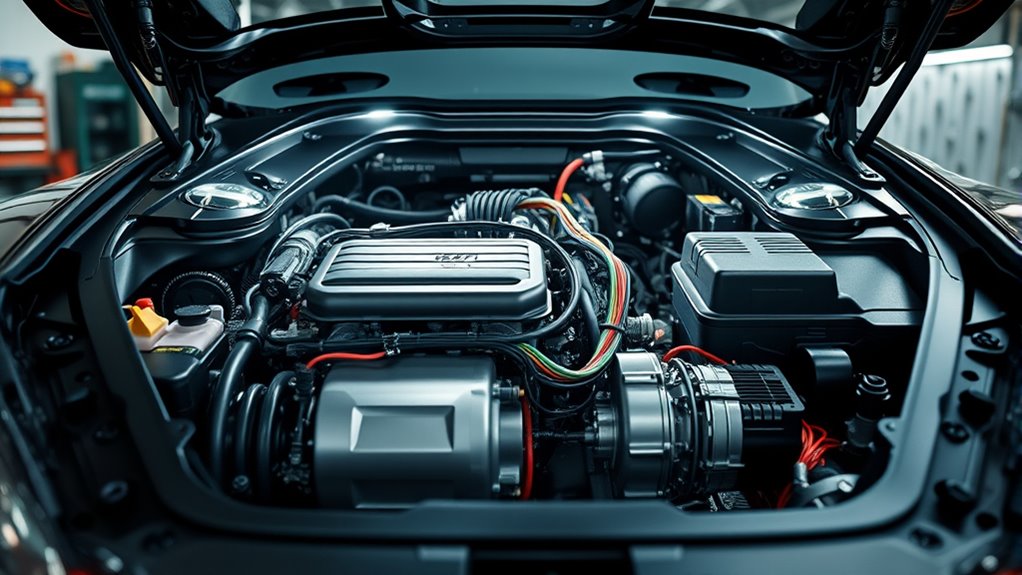
When it comes to tuning hybrid vehicles, understanding the differences between series and parallel configurations is essential. These setups determine how energy moves through your vehicle’s powertrain, directly impacting system efficiency and overall performance. In a series hybrid, the internal combustion engine acts primarily as a generator, producing electricity that powers the electric motor. Here, energy transfer is straightforward: the engine creates electrical energy, which then drives the wheels via the motor. This design simplifies the power flow, often leading to smoother operation and potentially better fuel economy at steady speeds, because the engine can operate in its most efficient range without directly driving the wheels. However, because the engine’s energy is converted twice—mechanical to electrical and back to mechanical—some energy loss occurs, which can affect the system efficiency during rapid acceleration or high-demand situations.
In contrast, a parallel hybrid allows both the engine and the electric motor to directly drive the wheels. When you accelerate, for instance, both sources can work together, sharing the load, which makes energy transfer more flexible. This setup can be more efficient under conditions requiring quick power delivery, such as climbing hills or rapid acceleration, because energy flows directly from the engine or motor to the wheels with fewer conversions. The system’s efficiency depends on how well the hybrid system manages this balance, minimizing energy waste during transfer. This direct pathway often results in improved performance at various speeds and better overall system efficiency, especially when optimized through tuning.
Tuning either system involves adjusting how energy transfer occurs during different driving conditions. For series hybrids, tuning might focus on optimizing the generator’s output and the battery’s charge/discharge cycles to maximize efficiency and reduce energy losses. For parallel systems, the goal is to improve the coordination between the engine and motor, ensuring they work together seamlessly while minimizing unnecessary energy transfer or waste. Both configurations benefit from tuning that enhances system efficiency by reducing energy loss during transfer, whether through better control algorithms or hardware upgrades.
Additionally, the choice of projector technology can influence the tuning approach, as different projector types have unique performance characteristics that affect image quality and system efficiency. Ultimately, your choice between series and parallel hybrid tuning hinges on your driving style and priorities. Series setups excel in steady driving conditions, emphasizing smoothness and fuel economy, while parallel configurations offer more flexibility and performance, especially in variable driving environments. By understanding how energy transfer differs in each, you can tailor your tuning approach to maximize system efficiency and achieve the best balance of power, economy, and reliability for your hybrid vehicle.
As an affiliate, we earn on qualifying purchases.
Frequently Asked Questions
How Do Hybrid Configurations Affect Vehicle Maintenance Costs?
Hybrid configurations can impact your vehicle’s maintenance costs by affecting battery longevity and maintenance frequency. Series hybrids often require less frequent maintenance but may put more strain on the battery, potentially increasing long-term replacement costs. Parallel hybrids balance engine and motor use, leading to balanced wear and potentially lower maintenance costs overall. Proper maintenance and regular checks make certain your hybrid runs efficiently, helping you manage costs effectively over time.
Can Series and Parallel Hybrids Be Combined in One Vehicle?
Yes, you can combine series and parallel hybrid configurations in one vehicle through hybrid integration, creating a series-parallel system. This setup offers more flexibility and efficiency, but it also increases powertrain complexity. You’ll notice enhanced performance and fuel economy, but maintenance might become more involved due to the advanced components. Overall, hybrid integration in a combined system balances advantages and challenges, giving you a versatile driving experience.
What Are the Environmental Impacts of Different Hybrid Setups?
Think of hybrid setups as a garden where different plants affect the environment differently. Your choice impacts emissions reduction and resource consumption. Series hybrids often reduce emissions more efficiently, while parallel systems can optimize fuel use. Combining both can maximize environmental benefits, but it depends on how you tune and operate them. Overall, selecting the right hybrid configuration helps lower pollution and conserves resources, making your vehicle more eco-friendly.
How Do Hybrid Configurations Influence Vehicle Resale Value?
You’ll find that hybrid configurations impact your vehicle’s resale value by affecting battery longevity and overall reliability. Series hybrids often have fewer moving parts, potentially extending battery life, which appeals to buyers. Parallel hybrids, with their proven technology, tend to have a strong resale market due to familiarity. Your choice influences resale value, as a well-maintained hybrid with a long-lasting battery attracts higher offers, making your investment more worthwhile.
Are There Specific Driving Conditions Better Suited for Each Hybrid Type?
Did you know that 70% of hybrid drivers report better driving efficiency on city streets? For your driving conditions, a series hybrid excels in stop-and-go traffic, offering peak efficiency and smoothness. Meanwhile, parallel hybrids handle highway terrain better, providing more power and fuel savings at higher speeds. Choose a series setup for urban commuting and a parallel system for long-distance or mixed terrain, ensuring your hybrid adapts perfectly to your driving needs.
Conclusion
Whether you choose a series or parallel hybrid setup, understanding their differences helps you optimize tuning for your needs. Imagine tuning a car with a series hybrid like a dedicated electric vehicle—focused on efficiency—versus a parallel hybrid that combines engine and electric power for flexibility. By grasping these configurations, you can tailor your hybrid system for performance or economy. Ultimately, your choice shapes how smoothly your vehicle balances power, efficiency, and driving experience.
Evergreen bestsellers Picks
bestsellers
As an affiliate, we earn on qualifying purchases.