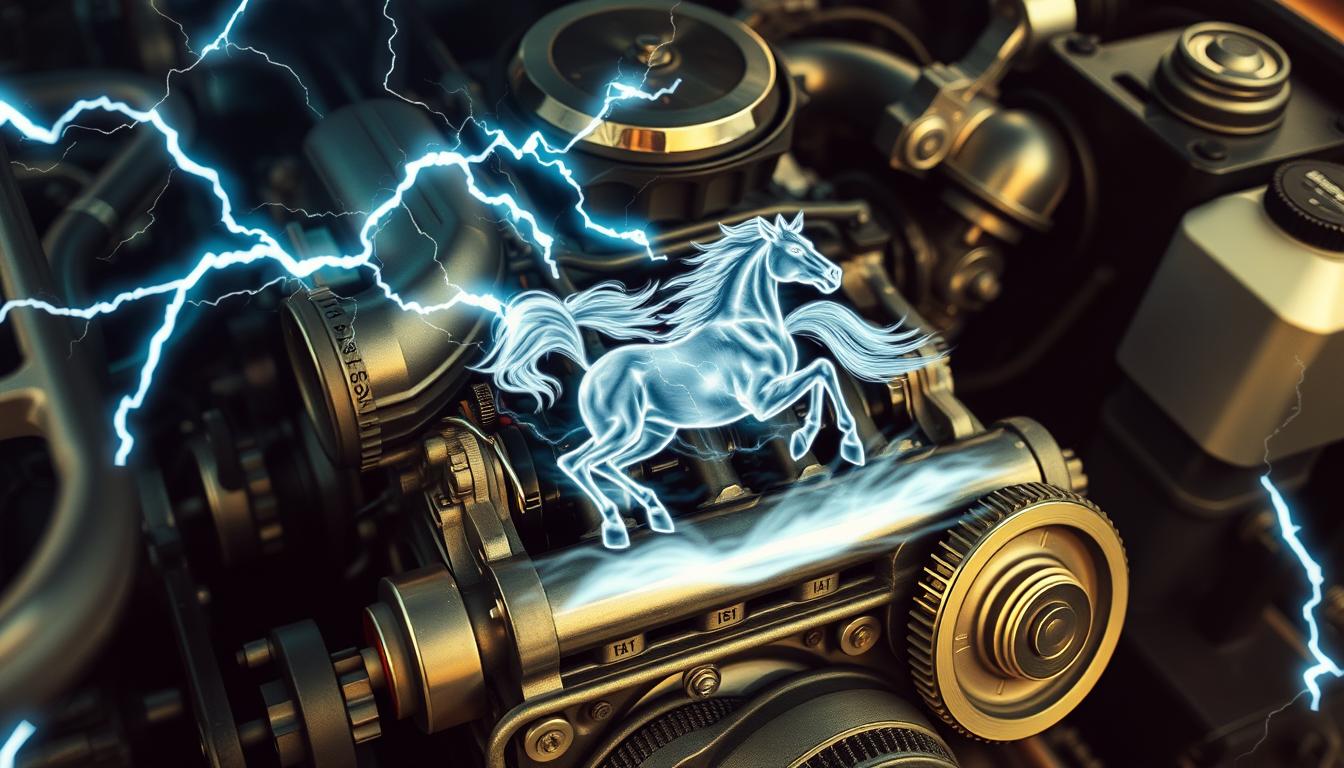
To log like a pro, focus on understanding AFR, knock, and LTFT data accurately. Guarantee your sensors are properly calibrated before capturing info. Watch for AFR near 14.7:1 for a balanced mix, but note deviations that signal problems. Monitor LTFT to see how your ECU adjusts over time, paying attention to positive or negative trims. Recognize knock activity as a warning of potential engine damage. Keep these tips in mind, and you’ll open deeper insights that help optimize performance and diagnose issues effectively.

Get garage and car supplies delivered free — and shop member deals
- Fast, free delivery on millions of items
- Access to Prime Big Deal Days deals on October 6–7
- Prime Video, Amazon Music and more included
Key Takeaways
- Ensure sensors are properly calibrated to obtain accurate AFR, knock, and LTFT data for reliable analysis.
- Monitor steady AFR near 14.7:1 to confirm a balanced mixture; deviations indicate potential issues.
- Use LTFT trends to identify long-term fuel system problems like vacuum leaks or injector clogging.
- Correlate knock activity with AFR and fuel trims to diagnose engine health and detect pre-ignition risks.
- Focus on pattern recognition in data logs rather than raw numbers to effectively troubleshoot and optimize engine performance.
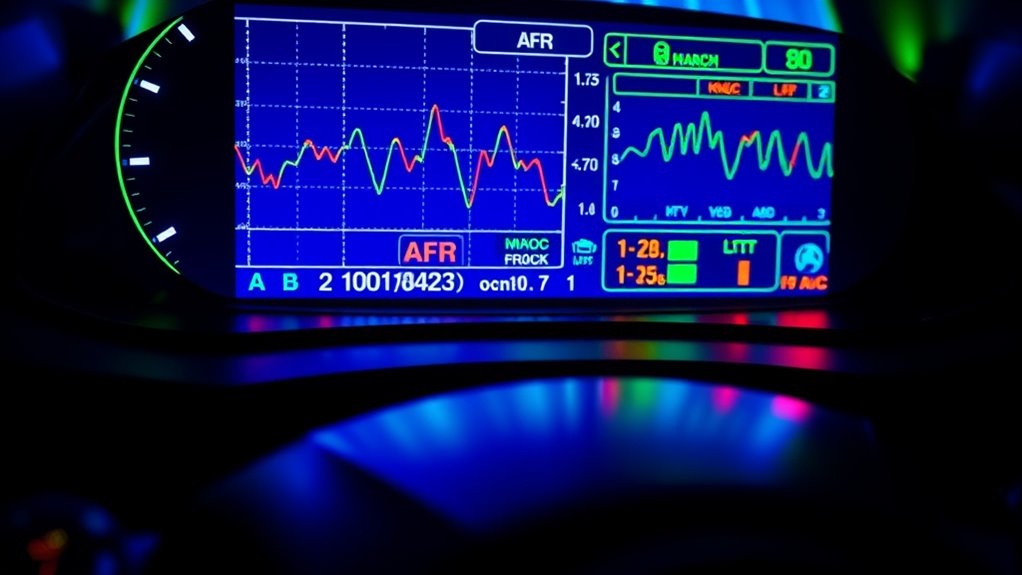
Whether you’re gathering data for a research project or monitoring equipment performance, mastering data-logging is vital for accurate and reliable results. When it comes to automotive tuning or engine diagnostics, understanding how to interpret data like AFR (Air-Fuel Ratio), knock, and LTFT (Long-Term Fuel Trim) is fundamental. These parameters reveal the health and efficiency of your engine, but only if your sensors are properly calibrated. Sensor calibration ensures that the data you collect reflects real-world conditions precisely. For example, if your oxygen sensors aren’t calibrated correctly, your AFR readings will be off, leading you to make misguided adjustments. Proper calibration aligns sensor outputs with actual air-fuel mixture ratios, providing a solid foundation for analysis.
Fuel trim, especially LTFT, plays a key role in tuning and diagnostics. LTFT indicates how the engine’s ECU is adjusting the fuel delivery over time to maintain an ideal mixture. If the LTFT readings are consistently positive, your engine is running lean, prompting the ECU to add more fuel. Conversely, negative values suggest a rich condition, where the ECU is subtracting fuel. Tracking these adjustments helps you identify underlying issues like vacuum leaks, clogged injectors, or improper sensor calibration. By monitoring fuel trim data alongside AFR and knock readings, you obtain a detailed picture of engine performance.
Interpreting AFR involves understanding whether the engine runs too rich or lean under various conditions. A steady AFR close to the stoichiometric 14.7:1 for gasoline indicates a balanced mixture. Deviations can signal problems—too rich might waste fuel and increase emissions, while too lean could cause knocking or engine damage. When you log AFR data, compare it against knock readings and fuel trim values. For instance, if AFR shows a lean condition coupled with high knock sensor activity, it’s a sign that the mixture is dangerously lean at high loads, warranting immediate adjustment.
Data-logging isn’t just about collecting numbers; it’s about making sense of them. Use the data to identify patterns, troubleshoot issues, and fine-tune your engine. Always confirm your sensors are calibrated correctly before starting your logs—improper calibration skews your entire analysis. Additionally, understanding the importance of attention to detail can significantly improve your diagnostic accuracy. When you review your logs, pay attention to how fuel trims respond to changes in AFR and knock activity. Consistent, well-calibrated data allows you to optimize performance, improve efficiency, and prevent damage. In essence, becoming proficient at data-logging empowers you to make informed decisions, turning raw data into actionable insights that keep your engine running smoothly.
As an affiliate, we earn on qualifying purchases.
Frequently Asked Questions
What Tools Are Best for Real-Time Data Logging?
When choosing tools for real-time data logging, you want devices that offer accurate sensor calibration and clear data visualization. Look for OBD-II scanners or dedicated datalogging interfaces compatible with your vehicle’s ECU. These tools allow you to monitor AFR, knock, and LTFT live, helping you make quick adjustments. Prioritize user-friendly software and reliable connections, so you can interpret your data effectively and optimize performance on the fly.
How Do I Distinguish Between Normal and Problematic AFR Readings?
Think of your AFR readings as a heartbeat—steady and balanced indicates health, but irregular beats signal trouble. To distinguish normal from problematic readings, confirm your sensor calibration is accurate, as faulty calibration skews airflow measurement. Consistently high or low AFRs outside your target range suggest issues like rich or lean conditions. Regularly monitor these patterns, and trust your data to guide adjustments, keeping your engine running smoothly.
Can Data Logging Help Improve Fuel Economy?
Data logging can definitely help improve your fuel economy by giving you detailed insights into your engine’s performance. With accurate data, you can fine-tune your engine for ideal AFR, reduce unnecessary fuel consumption, and adjust timing or fueling settings. This active engine tuning allows you to maximize efficiency, save money on fuel, and keep your vehicle running smoothly. Regular logging and analysis are key to maintaining and improving your fuel efficiency over time.
What’s the Ideal LTFT Value During Different Driving Conditions?
During different driving conditions, you want your LTFT (Long Term Fuel Trim) to stay close to zero, indicating your air fuel ratio is ideal. When cruising, a slight positive LTFT suggests your engine needs a bit more fuel, while a negative LTFT means it’s running rich. Monitoring these values helps you maintain the perfect air fuel ratio, ensuring efficient fuel use and prime engine performance.
How Often Should I Review and Analyze My Logged Data?
You should review and analyze your logged data regularly to guarantee sensor calibration stays accurate and to catch any potential issues early. How often depends on your driving habits and modifications, but checking after every few drives is a good rule of thumb. Keep your data stored properly, so you can compare trends over time. Frequent analysis helps optimize performance, maintain fuel efficiency, and prevent long-term engine problems.
Conclusion
Now that you’ve mastered reading AFR, knock, and LTFT data, you’re like a skilled navigator steering through a dense forest of numbers. With each log, you illuminate hidden trails and uncover the secrets your engine whispers. Think of yourself as a detective, piecing together clues to unseal peak performance. Keep honing your skills, and soon you’ll command your data logs like a seasoned pro, transforming chaos into clarity and your ride into a finely tuned symphony on wheels.
Halloween Picks
halloween
As an affiliate, we earn on qualifying purchases.